
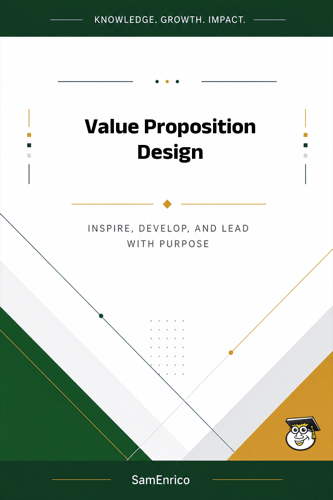
Value Proposition Design eBook
Creatively develop products and services customers
Creatively develop products and services customers actually want.
Formats
Free sample
Chapter 1: The Build-Trap--–- Every failed product begins with the same innocent question: "What if we built something that does...?" By the time the answer arrives, the company is usually out of money.On a Tuesday morning in March 2014, a software engineer named Marcus sat in a glass-walled conference room in San Francisco. He had just raised $4.2 million for his startup, a platform that promised to "revolutionize how teams manage internal communications." His investors were excited. His team of twelve was ready. His product roadmap stretched across three whiteboards, complete with color-coded stickers for features labeled "MVP," "Phase 2," and "Delighter."There was only one problem. Marcus had never talked to a customer.Not one.He had surveyed exactly zero potential users.
He had not conducted a single interview. He had not watched anyone struggle with the problem he was trying to solve. Instead, he had assumed—based on his own frustration with email—that other people shared his pain and would pay for his solution.Eighteen months later, Marcus stood in front of the same whiteboards, now erased and blank. The company had burned through $3.8 million. They had built 47 features, launched three major versions, and acquired exactly 214 paying customers—far short of the 5,000 needed to survive.
The investors had pulled their remaining commitment. The team had scattered to other startups.Marcus's story is not unusual. It is, in fact, the statistical norm.The Statistic That Should Terrify You According to a Harvard Business School study analyzing over 30,000 new products, 72 percent fail to meet revenue targets. Not because of bad engineering. Not because of incompetent marketing.
Not because of insufficient funding. The primary cause, identified across every industry studied, is a lack of customer demand.Let that sink in. Nearly three out of every four new products fail because nobody actually wanted them in the first place.The data gets worse. A separate analysis by CB Insights of over 100 startup post-mortems found that 42 percent of failed startups cited "no market need" as the single most important factor in their demise. That is nearly double the second-place cause, which was "ran out of cash"—and note that running out of cash is usually a symptom, not a disease.
You run out of cash because nobody is buying.Here is what these numbers mean for you: if you are reading this book, you are statistically likely to fail at whatever product you are currently building or planning to build. That is not pessimism. That is mathematics.But here is also what these numbers mean: you are holding the antidote.The Build-Trap Defined The pattern that killed Marcus's startup has a name. I call it the Build-Trap.The Build-Trap is the addictive tendency for founders, product managers, and development teams to start building a solution before validating that anyone actually wants it. It operates like a gambling addiction: the act of building triggers a small dopamine release in the brain, creating a sense of progress and accomplishment.
Writing code feels like moving forward. Designing interfaces feels like creating value. Adding features feels like improving the product.But these feelings are decoupled from reality. They measure effort, not outcome. They measure activity, not value.The Build-Trap has three distinct stages, each more dangerous than the last.Stage One: The Assumption Cascade.
It begins innocently. Someone says, "I think customers would love a feature that..." or "Our competitor has X, so we should build Y." These statements sound like hypotheses, but they function as assumptions. They cascade: one assumption stacks on another until the entire product rests on a foundation of unverified beliefs.Stage Two: The Commitment Spiral. Once the team writes the first line of code, psychological commitment kicks in. Sunk cost fallacy takes hold.
The engineer who spent three days on a feature will defend it. The designer who created mockups will advocate for them. The founder who promised investors a timeline will refuse to delay. The team spirals deeper into building, asking only "how" and "when," never "whether."Stage Three: The Launch and Die. The product launches.
Customers are indifferent. The team blames marketing ("we didn't promote it enough"), pricing ("we charged too much"), or timing ("the market isn't ready"). They add more features, run more ads, discount more aggressively. Nothing works. The product dies, and the team repeats the same pattern on the next idea.The Build-Trap is seductive because it feels like work.
Real work. The kind of work that earns salaries and justifies budgets and impresses investors. But it is a trap precisely because it substitutes activity for validation.Famous Autopsies: When Giants Fell into the Trap If you think the Build-Trap only claims inexperienced startups, consider three cautionary tales from companies that should have known better.New Coke (1985). The Coca-Cola Company, one of the most sophisticated consumer goods organizations in history, decided to reformulate its flagship product. They conducted 200,000 taste tests.
Blind trials showed that consumers preferred the sweeter taste of New Coke over both original Coke and Pepsi. The data looked ironclad.But the taste tests asked the wrong question. They measured a single sip, not a relationship. They measured preference, not identity. Coca-Cola had spent a century positioning itself as "the real thing"—an American icon, a nostalgic touchstone, a part of people's lives.
When New Coke replaced it, customers didn't reject the taste. They rejected the betrayal.The company had fallen into the Build-Trap by solving a problem that did not exist. Nobody was asking for a new Coke. The taste tests revealed a preference for sweetness in isolation, but that preference disappeared when weighed against brand loyalty, nostalgia, and identity. The product failed not because it was bad, but because it solved no emotional job for the customer.The result: 40,000 angry phone calls per day to Coca-Cola's switchboard, a public relations disaster, and the return of original Coke as "Coca-Cola Classic" just 79 days later.Google Glass (2013).
Google's moonshot factory, X Development, created a wearable computer with a heads-up display, camera, and voice control. Technologically, it was astonishing. It could take photos by winking, display directions in your field of vision, and translate foreign languages in real time.Google spent millions developing Glass. They launched a beta program for "Explorers" who paid $1,500 for the privilege of being early adopters. The technology worked.But Google had never asked: "Do people want to wear a computer on their face?" The answer turned out to be no, for reasons that had nothing to do with technology.
Glass made wearers look strange. It raised privacy concerns because the camera was always potentially recording. It signaled wealth and tech elitism in social situations where those signals were unwelcome. Restaurant owners banned Glass before it even launched.The Build-Trap here was subtle: Google solved a technical curiosity, not a social pain. They built what was feasible (the technology existed) without asking what was desirable (would people actually wear it?).
The product was revived later for enterprise applications (warehouse workers, surgeons), but the consumer version became a symbol of hubris.Quibi (2020). The most spectacular recent example. Quibi raised $1.75 billion to create a mobile-only streaming platform with "quick bites" of premium content (10 minutes or less). The founders were Hollywood legends. The talent was A-list.
The technology was innovative—it allowed seamless switching between portrait and landscape viewing.Quibi launched with tremendous fanfare and died six months…
This is the end of the free sample. Get the eBook to keep going. Buy now
About this book
Details
- Author
- Fritz Elliott
- Publisher
- SamEnrico
- Language
- English
- Genre
- Non-Fiction, Self-Help, Value Creation
- Released
- 2026-06-11
- Pages (approx.)
- 151
- Available as
- eBook, Audiobook

Read better in the ZLOADR app
Your eBooks on your phone or tablet. Sign in with your SamEnrico account and start reading.
More by Fritz Elliott
 Emergency Room De escalationFritz Elliott$11.99
 Mindfulness of Thoughts MBSRFritz Elliott$11.99
 OCD And Perinatal OCD In FathersFritz Elliott$11.99
 Survey Data Encryption with AIFritz Elliott$11.99
 The Silk Road in the Sky: Abbas ibn Firnas and the Dream of FlightFritz Elliott$11.99
 Understanding Cantu–Sanchez–corona–fragoso SyndromeFritz Elliott$17.99
 Virtual Lab Experience for PhDFritz Elliott$12.99
 Living Cost Comparison HandbookFritz Elliott$12.99
 Hand Control InstallerFritz Elliott$11.99
 How to Become a Mixing SupervisorFritz Elliott$11.99