
Non-FictionSelf-HelpConflict Resolution
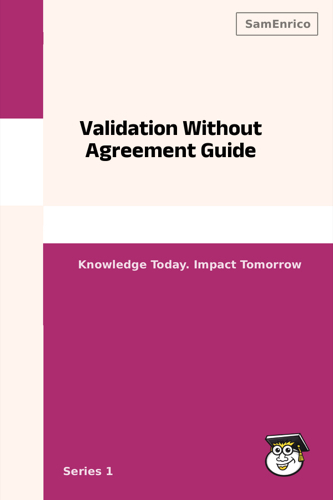
Validation Without Agreement Guide eBook
Acknowledge feelings you don't share or endorse wi
by Dukes Pok
Acknowledge feelings you don't share or endorse without compromising your truth.
Formats
Free sample
Chapter 1: The Binary Trap--–- You are standing in your kitchen. Across the counter, someone you love has just said something that makes your chest tighten. It is not a fact they have disputed. It is not a mistake you have made. It is a feeling they have expressed—a frustration, a fear, a conviction—and you do not share it.
You do not agree with it. In fact, a part of you wants to argue, to correct, to explain why they are wrong. Another part of you wants to nod along just to end the discomfort. And a smaller, quieter part wonders if there is a third option.That third option is what this book exists to teach. But before we can build the skill of validation without agreement, we must first understand why it feels so impossible.
Why does a simple disagreement trigger something that feels like danger? Why does acknowledging someone else’s emotional reality feel like betraying your own? And why do most of us believe, deep down, that every conflict forces us to choose between two bad options: sacrifice our truth to keep the peace, or fight to prove we are right and risk the relationship?This chapter is called The Binary Trap because that is exactly what it is: a cognitive and emotional cage that convinces you there are only two doors.The Neuroscience of Disagreement Let us begin with the body, because the body does not care about your intentions. The body cares about survival. And here is what the body does not know: a disagreement about politics, parenting, or whose turn it was to do the dishes is not a physical threat.
But your amygdala—the almond-shaped cluster of neurons in your brain that acts as a threat-detection system—cannot tell the difference between a predator lunging at you and a friend telling you that you are wrong.This is called amygdala hijack, a term popularized by psychologist Daniel Goleman. When your amygdala perceives a threat, it bypasses your prefrontal cortex (the rational, thinking part of your brain) and triggers the sympathetic nervous system. Your heart rate increases. Your breathing becomes shallow. Cortisol and adrenaline flood your system.
You are now in fight-or-flight mode. And here is the critical insight: the brain processes social rejection and disagreement using the same neural pathways it uses to process physical pain. A study by researchers at UCLA found that the anterior cingulate cortex, the region associated with the distressing aspect of physical pain, activates when people feel socially excluded. Disagreement does not just feel bad. It feels like injury.The Binary Trap is not a character flaw.
It is not a failure of kindness or intelligence. It is biology. Your brain evolved in an environment where being ejected from your tribe meant death. Agreement kept you alive. Disagreement endangered you.
And although you now live in a world where disagreeing with your cousin about tax policy will not get you eaten by a predator, your nervous system has not received that memo.This explains why even small disagreements can feel enormous. It explains why you might cry during an argument about something trivial. It explains why your spouse’s criticism of how you loaded the dishwasher can trigger the same physiological response as being chased by a bear. Your brain is not broken. It is just outdated.The Two Doors: Capitulation or Combat When the amygdala hijacks your brain, your available options narrow dramatically.
You are no longer capable of nuance, curiosity, or creativity. You are reduced to binary thinking. And in the context of disagreement, that binary looks like this:Door One: Capitulation. You agree to keep the peace. You say “you are right” even when you do not believe it.
You swallow your truth because the cost of conflict feels too high. You become what this book calls the Peacekeeper.Door Two: Combat. You fight to prove you are right. You raise your voice, withdraw your affection, or marshall evidence to dismantle the other person’s position. You prioritize being correct over being connected.
You become what this book calls the Warrior.There is a third profile that emerges when the binary feels so intolerable that you simply leave: The Ghost. The Ghost avoids disagreement entirely. If a topic might cause friction, the Ghost changes the subject, leaves the room, or ends the relationship preemptively. The Ghost has chosen neither capitulation nor combat. The Ghost has chosen disappearance.Here is what all three profiles share: none of them know how to hold two truths at once.
None of them can say “I hear you, and I see it differently” without collapsing into one door or the other. The Peacekeeper collapses into the other person’s truth. The Warrior collapses into their own. The Ghost collapses into silence.The Crucial Distinction: Validation vs. Endorsement The entire premise of this book rests on a single distinction.
If you remember nothing else, remember this: Validation is not endorsement.Validation is the act of acknowledging that someone’s emotional experience is real, understandable, and worthy of attention. It says, “I see that you feel this way.” It says, “It makes sense to me that you would feel that, given who you are and what you have been through.” Validation requires zero agreement with the person’s conclusions, beliefs, or actions.Endorsement is the act of agreeing with someone’s conclusion, belief, or action. It says, “You are right.” It says, “I would have done the same thing.” Endorsement is what most people fear they are being asked to provide when they are actually being asked only to listen.The Binary Trap exists because we conflate these two things. We believe that if we validate someone’s feeling, we are endorsing their position. We believe that if we say “I hear that you are angry,” we are also saying “You have a right to be angry.” We believe that listening is agreeing.This is false.
Let me prove it with examples.A therapist validates a patient’s fear of flying. The patient says, “Every time I get on a plane, I am certain it will crash.” The therapist does not say, “You are right, the plane will crash.” The therapist says, “I hear how real that fear is for you. It makes sense that you would feel that way, given what you have experienced.” The therapist has validated the emotion without endorsing the belief that the plane will crash.A parent validates a child’s anger about bedtime. The child screams, “This is so unfair! You are the worst parent in the world!” The parent does not say, “You are right, I am terrible.” The parent says, “I hear how furious you are that bedtime is here.
You really wanted to keep playing.” The parent has validated the emotion without endorsing the insult.A manager validates an employee’s frustration about a policy. The employee says, “This rule is stupid and whoever made it is an idiot.” The manager does not say, “You are right, the rule is stupid.” The manager says, “I hear how frustrated you are. This policy is causing real problems for your team.” The manager has…
This is the end of the free sample. Get the eBook to keep going. Buy now
About this book
Details
- Author
- Dukes Pok
- Publisher
- SamEnrico
- Language
- English
- Genre
- Non-Fiction, Self-Help, Conflict Resolution
- Released
- 2026-06-09
- Pages (approx.)
- 129
- Available as
- eBook, Audiobook

Read better in the ZLOADR app
Your eBooks on your phone or tablet. Sign in with your SamEnrico account and start reading.
More by Dukes Pok
 The OCD Family Support GuideDukes Pok$11.99
 HIIT Music Tempo GuideDukes Pok$11.99
 Conductor Rehearsal PsychologyDukes Pok$11.99
 Step Four Moral Inventory CourseDukes Pok$11.99
 The Iron Fists of Shanghai: How a 19th-Century Martial Arts Master Shaped the WorldDukes Pok$11.99
 AI Tool Free to PaidDukes Pok$12.99
 Churn Prediction ModelsDukes Pok$12.99
 The Breeder's Guide to Java ChickensDukes Pok$11.99
 High School Math TutorDukes Pok$11.99
 How to Start a Blood Pressure Machine Operation (coin Operated) Business (Beginners Guide)Dukes Pok$11.99
You may also like
 Hong Kong Handover 1997Dunn Johnnie$11.99
 Zumba For Postnatal Recovery CourseNeal Christian$11.99
 Zumba for BeginnersLadner Nikia$11.99
 YouTube Comment Mining GuideHumes Pandora$12.99
 Worry Box MeditationCarlin Rudy$11.99
 Workplace Stress MeditationNguyen Lynn$11.99
 Workplace Stress and Sleep RepairHawley Ivory$11.99
 Workplace Perfectionism CureDelaney Jeffry$11.99
 Workplace Injustice Anger GuideWallen Isabelle$11.99
 Work Addiction and Burnout LinkGreenwood Ester$11.99
 Women in Yoga and WellnessBeattie Galina$11.99
 Women in Stand Up ComedyChun Evangeline$11.99