
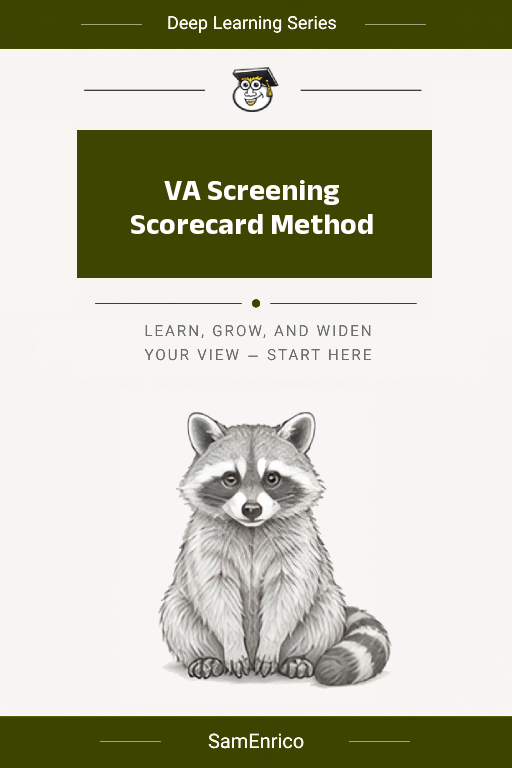
VA Screening Scorecard Method eBook
Rate Filipino and Kenyan candidates objectively us
Rate Filipino and Kenyan candidates objectively using a scorecard for English, software skills, and reliability, removing gut feel from hiring.
Formats
Free sample
Chapter 1: The $50,000 Hello--Every hiring mistake arrives with a smile.That is the cruel irony of the bad hire. They do not show up late to the interview. They do not drop coffee on your keyboard. They do not announce, "By the way, I will be disappearing for three weeks without warning." No. The bad hire arrives polished, punctual, and promising.
They say all the right things. They laugh at your jokes. They nod vigorously when you describe your company's "fast-paced, entrepreneurial environment." And then, six weeks later, you are awake at 2:00 AM, scrolling through Slack messages, realizing that the charming Filipino VA you hired has cost you fifty thousand dollars.This is not hyperbole. This is the actual number.Let me tell you about David.The Anatomy of a Perfectly Disastrous Hire David was the founder of a mid-sized e-commerce fulfillment company in Austin, Texas. He had seventeen full-time employees, a warehouse, and a growing problem: customer service emails were piling up like snowdrifts.
He needed help. Specifically, he needed a virtual assistant in the Philippines who could handle customer inquiries, process returns, and manage the company's help desk software.He posted a job on an online platform. Within forty-eight hours, he had ninety-three applications.Like most founders, David was busy. He did not have time to review ninety-three resumes. So he did what busy people do: he skimmed.
He looked at photos. He read the first three sentences of each cover letter. He noticed that one candidate, let us call her "Grace," had a warm smile, a degree from a university he vaguely recognized, and a cover letter that said, "I am passionate about helping customers feel heard and valued."He scheduled a Zoom interview.The interview went beautifully. Grace was articulate. She laughed at his jokes.
When he asked, "Where do you see yourself in five years?" she said, "Growing with a company that values its people." David felt a warmth in his chest. This was it. This was the person. He offered her the job that afternoon at $1,600 per month—a generous salary by Manila standards.Six months later, David had lost $50,000.Let us follow the money.The Math of Disaster The $50,000 was not a single expense. It was a death by a thousand cuts.First, there was the direct salary: 1,600permonthforsixmonths=1,600 per month for six months = 1,600permonthforsixmonths=9,600.
That was the least painful part.Second, there was the management overhead. David and his operations manager spent an average of two hours per day correcting Grace's work. She misunderstood customer requests. She processed returns incorrectly. She once refunded a customer 400foraproductthathadneverbeenordered.At David′sinternalcostof400 for a product that had never been ordered.
At David's internal cost of 400foraproductthathadneverbeenordered.At David′sinternalcostof75 per hour for management time, two hours per day for six months (approximately 260 working hours) added another $19,500.Third, there were the client refunds and lost revenue. Grace's errors triggered twenty-seven customer complaints, twelve refunds, and three chargebacks. Total cost: $8,400.Fourth, there was the team morale tax. David's other VAs—the good ones—had to cover for Grace's mistakes. One of them, a reliable worker named Marco, started looking for a new job three months into Grace's tenure.
He told David in his exit interview: "I was spending half my day fixing her errors. I didn't sign up to be a babysitter." The cost of replacing Marco: $12,500 in recruiting, training, and lost productivity.Add it up: 9,600+9,600 + 9,600+19,500 + 8,400+8,400 + 8,400+12,500 = $50,000.And that was just the direct cost. David never calculated the opportunity cost—the projects he could not launch, the customers he never acquired, the sleep he lost.All because of a gut feeling.The Dirty Secret of Unstructured Interviews Here is what David did not know: unstructured interviews—the kind where you "wing it," ask whatever comes to mind, and rely on your instincts—are statistically worthless.I do not mean "slightly less effective than structured interviews." I mean they predict only 9 to 14 percent of future job performance. This is not my opinion. This is the consensus of industrial-organizational psychology, supported by meta-analyses spanning decades and thousands of studies.
When you conduct an unstructured interview, you are essentially flipping a weighted coin. You have a slightly better chance of being right than random chance. Slightly.Think about that for a moment.If you hired entirely at random—closing your eyes and pointing at a list of names—you would be right about 50 percent of the time (assuming half the candidates are competent). An unstructured interview gets you to about 55 or 60 percent. You are paying thousands of dollars and investing hours of your time for a marginal improvement over blind luck.Why is unstructured interviewing so terrible?
Because your brain is not designed to evaluate candidates. Your brain is designed to seek confirmation, avoid discomfort, and reward charisma.When David interviewed Grace, his brain was not calculating the probability that she could accurately process returns. His brain was asking: "Do I like her? Does she seem nice? Would I enjoy having coffee with her?" These are social questions, not predictive questions.
And yet, they drove his decision.The $50,000 Hello, Part Two: You Are Not Special Perhaps you are thinking, "That is David's problem. I am better at hiring. I have good instincts."I have heard this from hundreds of founders, CEOs, and hiring managers. Every single one of them believed they had above-average intuition. This is statistically impossible.
Half of them are below average. And the research shows that even experienced managers—people who have conducted hundreds of interviews—perform no better than novices when using unstructured methods. Experience does not fix a broken process. It only makes you more confident in your wrongness.Consider the US Department of Labor's research on bad hires. They estimate that a bad hire costs an organization 30 percent of that employee's first-year earnings.
For a 50,000peryearemployee,thatis50,000 per year employee, that is 50,000peryearemployee,thatis15,000. But that estimate assumes an in-person, domestic employee with minimal time zone friction and no communication barriers.For remote global talent—specifically virtual assistants in the Philippines and Kenya—the true cost is closer to 60 percent of first-year earnings. Why? Because the communication breakdowns are more frequent. The oversight is more difficult.
The time zone lag turns small problems into big ones. And the "out of sight, out of mind" effect means small reliability issues compound into catastrophic failures.David learned this the hard way. You do not have to.The Culture Fit Lie Let me say something controversial: "culture fit" is the enemy of good hiring.I know this sounds heretical. Every business book, every HR blog, every Linked In influencer preaches the gospel of culture fit. "Hire for culture fit, train for skill." "Values alignment is everything." "Would you want to grab a beer with this person?"These slogans are destroying your teams.Here is the problem: "culture fit" is almost always a mask for "culture clone." When you hire for fit, you are not measuring alignment with your company's values.
You are measuring similarity to yourself. You are asking: "Is this person like me? Do they share my background? Do they laugh at my jokes? Do they have the same communication style?"This is affinity bias dressed in business casual…
This is the end of the free sample. Get the eBook to keep going. Buy now
About this book
Details
- Author
- Naquin Deedra
- Publisher
- SamEnrico
- Language
- English
- Genre
- Non-Fiction, First 30 Days
- Released
- 2026-05-30
- Pages (approx.)
- 122
- Available as
- eBook, Audiobook

Read better in the ZLOADR app
Your eBooks on your phone or tablet. Sign in with your SamEnrico account and start reading.
More by Naquin Deedra
 Culturally Informed Parental AngerNaquin Deedra$11.99
 Sober Fun Recovery GuideNaquin Deedra$11.99
 The Foster Parent Who Never QuitNaquin Deedra$11.99
 Glassdoor Salary ComparisonNaquin Deedra$11.99
 The Priority Vision BoardNaquin Deedra$11.99
 Founder Salary DecisionsNaquin Deedra$11.99
 Childhood Moving Frequent StressNaquin Deedra$11.99
 Design Thinking For RelationshipsNaquin Deedra$11.99
 The Headless Heist: Tokyo's Diamond Dismemberment MysteryNaquin Deedra$11.99
 The Boxer Uprising: China’s Last Stand Against Foreign DominationNaquin Deedra$11.99
 How to Produce Super GlueNaquin Deedra$11.99
 A Collector's Handbook to the Fiat 132Naquin Deedra$11.99
You may also like
 Hong Kong Handover 1997Dunn Johnnie$11.99
 Zumba For Postnatal Recovery CourseNeal Christian$11.99
 Zumba for BeginnersLadner Nikia$11.99
 YouTube Comment Mining GuideHumes Pandora$12.99
 Worry Box MeditationCarlin Rudy$11.99
 Workplace Stress MeditationNguyen Lynn$11.99
 Workplace Stress and Sleep RepairHawley Ivory$11.99
 Workplace Perfectionism CureDelaney Jeffry$11.99
 Workplace Injustice Anger GuideWallen Isabelle$11.99
 Work Addiction and Burnout LinkGreenwood Ester$11.99
 Women in Yoga and WellnessBeattie Galina$11.99
 Women in Stand Up ComedyChun Evangeline$11.99