
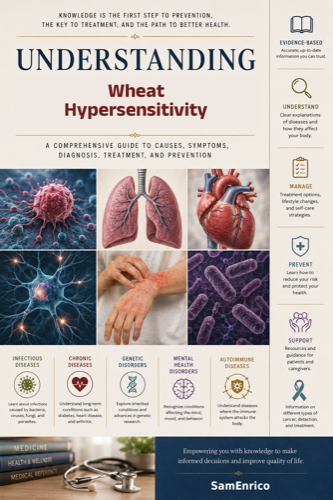
Non-FictionInformativeEducational
Understanding Wheat Hypersensitivity eBook
This disease publication, published by SamEnrico,
This disease publication, published by SamEnrico, covers Understanding Wheat Hypersensitivity
Formats
Free sample
Chapter 1: The Bread Loaf Lie--–- The first time I realized that food might be poisoning me, I was standing in a hospital hallway, clutching a folder full of normal test results, while a gastroenterologist told me that my debilitating joint pain, crushing fatigue, and "brain fog so thick I could barely remember my own phone number" were likely just stress. She suggested I try yoga, drink more water, and—I swear this is true—eat more whole grains.I had been eating whole grains my entire life. I had been the person who brought quinoa salads to potlucks, who lectured friends about the importance of dietary fiber, who genuinely believed that a bowl of oatmeal with berries was the pinnacle of both nutrition and moral virtue. And yet, there I stood, thirty-seven years old, unable to walk up a flight of stairs without my knees feeling like they were filled with shattered glass, unable to concentrate on a single page of a book for more than ninety seconds, and increasingly convinced that I was either dying or losing my mind.The gastroenterologist meant well. Most of them do.
But she was operating within a framework that could not accommodate what I was experiencing. Her framework said: normal blood work equals healthy patient. Her framework said: whole grains are good for you. Her framework said: if the tests don't show anything, the problem must be psychological. She was not being cruel.
She was being conventional. And convention, in this case, was deadly wrong.This book exists because I eventually stopped listening to well-meaning doctors who had never been trained to recognize wheat hypersensitivity, and started listening to my own body, to a small group of renegade researchers, and to thousands of patients who had been told the same lies I had been told. The lie is not malicious. It is structural. It is embedded in dietary guidelines, medical education, food industry marketing, and the cultural assumption that wheat—this ancient, humble grass that has fed civilizations for ten thousand years—could not possibly be making us sick.But it is.
And the evidence is overwhelming.The Unquestioned Cornerstone For the past half-century, the United States Department of Agriculture has enshrined grains as the foundation of the healthy diet. The famous Food Guide Pyramid, introduced in 1992, placed bread, cereal, rice, and pasta at the very bottom—the largest section, the foods you should eat most abundantly. The later My Plate guidelines continued this tradition: grains occupy a full quarter of the plate, alongside vegetables, fruits, and protein. The message has been consistent, loud, and almost completely unchallenged in mainstream medicine: whole grains are essential for health.But here is what the pyramid does not tell you. The recommendation to "eat more whole grains" is based largely on observational studies that cannot distinguish correlation from causation.
People who eat whole grains also tend to exercise more, smoke less, eat more vegetables, and have higher incomes and better access to healthcare. When you control for those factors, the supposed protective effect of whole grains shrinks dramatically—and for a subset of the population, the effect may actually reverse.More importantly, the dietary guidelines assume a uniform human biology. They assume that what is healthy for the average person is healthy for every person. This is the same logical error that once led doctors to recommend a glass of red wine for heart health—ignoring the millions of people with alcohol intolerance, liver disease, or a family history of addiction.Wheat is not inherently evil. It is not a poison in the way that arsenic or cyanide are poisons.
But for a significant and growing portion of the population, wheat triggers immune reactions, inflammatory cascades, and gastrointestinal disturbances that range from mildly annoying to completely disabling. And the standard medical response—to dismiss these reactions, to attribute them to stress or anxiety or irritable bowel syndrome or "eating too fast"—has left millions of people suffering in silence, convinced that something is wrong with them, when in fact something is wrong with the advice they have been given.This chapter is called "The Bread Loaf Lie" not because bread is literally a lie, but because the story we have been told about bread—about its necessity, its harmlessness, its role as a benign and even beneficial staple—is incomplete to the point of deception. It is a lie by omission. And the first step toward healing is to recognize that you have been lied to, not out of malice, but out of institutional inertia.The Patient Who Changed Everything Before we dive into the science—and there will be plenty of science in the chapters ahead—I want to tell you about a patient I interviewed while researching this book. Let's call her Sarah.
Sarah was a forty-two-year-old nurse when her symptoms began. She had worked twelve-hour shifts in a busy emergency room for nearly two decades, standing on her feet, lifting patients, making split-second decisions that sometimes meant the difference between life and death. She was tough. She was competent. She did not complain.But over the course of eighteen months, her body began to betray her.
First came the fatigue—not the normal tiredness after a long shift, but a bone-deep exhaustion that made her feel like she was moving through wet cement. Then came the joint pain: her fingers swelled so badly that she could barely grip a pen, her knees ached with every step, her lower back felt like it was being slowly crushed. Then came the brain fog. She started making medication errors—small ones at first, then larger. She forgot to document a critical lab value.
She nearly gave the wrong dose of insulin to a diabetic patient. She took a leave of absence, then another. Eventually, she stopped working altogether.Sarah saw fourteen doctors over five years. She saw primary care physicians, rheumatologists, neurologists, psychiatrists, and a pain specialist. She had MRIs of her brain and spine.
She had nerve conduction studies. She had blood drawn so many times that her veins became scarred and difficult to access. She was tested for multiple sclerosis, lupus, rheumatoid arthritis, Lyme disease, myasthenia gravis, and amyotrophic lateral sclerosis. Every test came back normal or inconclusive.She was told she had fibromyalgia. She was told she had chronic fatigue syndrome.
She was told she had conversion disorder—a psychiatric condition where emotional distress manifests as physical symptoms. One doctor suggested she was faking it for disability benefits. Another told her husband that she needed "tough love," not sympathy.At her lowest point, Sarah told me, she considered ending her life. "I wasn't suicidal in the way people think," she said. "I didn't want to die.
I just couldn't imagine living another forty years like that. The pain, the confusion, the humiliation of being told it was all in my head when I knew—I knew—that something was physically wrong."Then, by accident, she stumbled across an online forum for people with non-celiac gluten sensitivity. She had never heard the term. She had been tested for celiac disease early in her diagnostic journey—the standard blood test had come back negative—and her doctors had assured…
This is the end of the free sample. Get the eBook to keep going. Buy now
About this book
Details
- Author
- Schwartz Angela
- Publisher
- SamEnrico
- Language
- English
- Genre
- Non-Fiction, Informative, Educational
- Released
- 2026-05-18
- Pages (approx.)
- 134
- Available as
- eBook, Audiobook

Read better in the ZLOADR app
Your eBooks on your phone or tablet. Sign in with your SamEnrico account and start reading.
More by Schwartz Angela
 One Hour Meeting Rule GuideSchwartz Angela$11.99
 Blue Zone Community BelongingSchwartz Angela$11.99
 Food Addiction Apps for RecoverySchwartz Angela$11.99
 The Goal Setting Weight GuideSchwartz Angela$11.99
 Conversation Starters for Any SituationSchwartz Angela$11.99
 The Visionary Economist: John E. Jackson and the Rise of Black Wall StreetSchwartz Angela$11.99
 ToymakerSchwartz Angela$11.99
 Startup Founder Depression HandbookSchwartz Angela$12.99
 Ghana Customer Support GuideSchwartz Angela$12.99
 How to Start a Barge Rental or Leasing BusinessSchwartz Angela$11.99
You may also like
 Hong Kong Handover 1997Dunn Johnnie$11.99
 Zumba For Postnatal Recovery CourseNeal Christian$11.99
 Zumba for BeginnersLadner Nikia$11.99
 YouTube Comment Mining GuideHumes Pandora$12.99
 Worry Box MeditationCarlin Rudy$11.99
 Workplace Stress MeditationNguyen Lynn$11.99
 Workplace Stress and Sleep RepairHawley Ivory$11.99
 Workplace Perfectionism CureDelaney Jeffry$11.99
 Workplace Injustice Anger GuideWallen Isabelle$11.99
 Work Addiction and Burnout LinkGreenwood Ester$11.99
 Women in Yoga and WellnessBeattie Galina$11.99
 Women in Stand Up ComedyChun Evangeline$11.99