
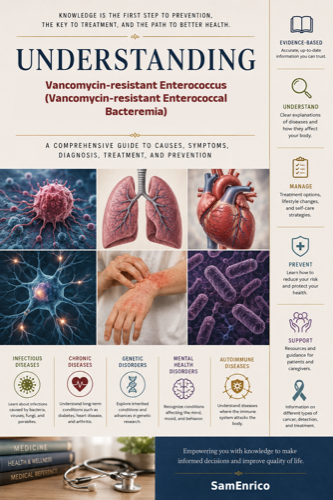
Understanding Vancomycin-resistant Enterococcus (Vancomycin-resistant Enterococcal Bacteremia) eBook
This disease publication, published by SamEnrico,
This disease publication, published by SamEnrico, covers Understanding Vancomycin-resistant Enterococcus (Vancomycin-resistant Enterococcal Bacteremia)
Formats
Free sample
Chapter 1: The Ideal Pathogen...--In the spring of 1986, a 54-year-old man undergoing hemodialysis at a London teaching hospital developed a fever that would not break. His blood cultures grew Enterococcus faecium—a bacterium so unremarkable that the laboratory nearly dismissed it as contamination. The treating physicians reached for vancomycin, the antibiotic reserved for the most stubborn Gram-positive infections, confident that this drug had never failed against enterococci. Within days, the patient was dead. When the microbiology team re-tested the isolate, they discovered something that should have been impossible: the bacteria were growing happily in concentrations of vancomycin that would kill any other enterococcus.
The world had just met its first Vancomycin-resistant Enterococcus (VRE), and medicine would never be the same.Nearly four decades later, VRE has become a fixture of hospitals on every continent, an organism that has turned the last line of defense into an open door. This book is about that bacterium—how it evolved, how it spreads, how it kills, and most importantly, what clinicians can still do to stop it. But before we can understand the monster, we must understand the making of the monster. This chapter tells the origin story of Enterococcus as a pathogen, from its dismissal as a harmless commensal to its current status as one of the most feared organisms in the intensive care unit.The Commensal That Refused to Stay in Its Lane The human gastrointestinal tract is home to trillions of bacteria, a teeming metropolis of microbial life that most people never think about until something goes wrong. Among the hundreds of species that reside there, Enterococcus has always been a minor character—not the most abundant, not the most virulent, not even particularly interesting to microbiologists who preferred the drama of Escherichia coli or the terror of Staphylococcus aureus.
For most of medical history, enterococci were considered harmless passengers, occasionally causing a urinary tract infection in an elderly patient but rarely anything more serious.That perception began to shift in the 1970s, when clinicians noticed that enterococci were showing up in the blood of hospitalized patients with alarming frequency. At first, these were dismissed as transient bacteremias from contaminated intravenous lines or superficial wounds. But the pattern persisted. Enterococci were not just contaminants; they were pathogens in their own right, and they were getting better at causing disease in the most vulnerable patients.The taxonomic reclassification that occurred in 1984 was more than an academic exercise. For decades, enterococci had been classified as Group D Streptococcus, lumped together with streptococci that caused everything from sore throats to rheumatic fever.
But genetic analysis revealed that these organisms were distinct—different enough to warrant their own genus, Enterococcus, named for their preferred habitat in the enteric tract. This reclassification was the first official recognition that enterococci were not just confused streptococci but a unique lineage with unique properties.The properties that make enterococci successful commensals are the same properties that make them dangerous pathogens. They are remarkably hardy organisms, capable of surviving on dry surfaces for weeks, resisting the effects of bile salts and detergents, and growing in temperatures ranging from 10 to 45 degrees Celsius. They can survive pasteurization, a fact that has implications for dairy products and, as we will see in Chapter 10, for the food supply. They are, in short, built to endure.Two Species, Two Stories Not all enterococci are created equal.
Of the more than fifty species in the genus Enterococcus, two cause the vast majority of human infections: Enterococcus faecalis and Enterococcus faecium. Understanding the differences between these two species is essential to understanding the VRE problem, because they have followed very different evolutionary paths.E. faecalis is the more virulent of the two. It produces a range of toxins and adhesion factors that allow it to attach to human tissues, invade deeper sites, and cause tissue damage. Before the VRE era, E.
faecalis accounted for approximately 80 to 90 percent of all enterococcal infections. It is also, fortunately for clinicians, more susceptible to antibiotics. Ampicillin, a humble penicillin derivative, still works against most E. faecalis isolates, and the combination of ampicillin and gentamicin was for decades the gold standard for treating serious enterococcal infections, including endocarditis.E. faecium tells a different story.
It is less inherently virulent than E. faecalis—it lacks many of the toxins and adhesion factors that make its cousin so dangerous—but it is far more resilient in the face of antibiotics. E. faecium has an extraordinary capacity to acquire resistance genes from other bacteria, transforming itself from a nuisance into a nightmare. When vancomycin resistance emerged in the 1980s, it was E.
faecium that carried the vancomycin resistance genes, not E. faecalis. Today, in most hospitals, over 70 percent of E. faecium bloodstream isolates are vancomycin-resistant, while the vast majority of E. faecalis isolates remain susceptible.This divergence matters enormously for clinical practice.
When a blood culture grows E. faecalis, the clinician can still reach for ampicillin with reasonable confidence. When it grows E. faecium, the equation changes entirely. The species difference is so important that modern microbiology laboratories report it automatically, and every clinician should know to look for it.The Intrinsic Advantage To understand why VRE is so difficult to treat, we must first understand what makes Enterococcus difficult to treat even when it is not resistant.
This is the concept of intrinsic resistance—the built-in, inherent resistance to certain antibiotics that does not require the acquisition of new genes.Enterococcus is intrinsically resistant to several important classes of antibiotics. The most clinically significant of these is resistance to cephalosporins. Cephalosporins are among the most widely used antibiotics in hospitals, effective against a broad range of Gram-positive and Gram-negative bacteria. They work by inhibiting cell wall synthesis, the same mechanism as penicillins but with modifications that protect them from bacterial enzymes called beta-lactamases. For most bacteria, cephalosporins are lethal.But not for Enterococcus.
The enterococcal penicillin-binding proteins—the enzymes that build the cell wall—have an unusually low affinity for cephalosporins. The drugs simply do not bind effectively, and the bacteria continue to synthesize their cell walls as if nothing had happened. This is not a resistance mechanism that Enterococcus acquired from another species; it is a feature of its own biology, present in the earliest enterococci that colonized the intestines of animals hundreds of millions of years ago.Here is the crucial point, one that confuses many students of infectious disease: Cephalosporins do not kill Enterococcus at all. They do not work poorly; they do not work somewhat; they do not work. If you give a patient with an enterococcal bloodstream infection a cephalosporin, you are giving placebo at best and potentially harming the patient by delaying effective therapy.So why do cephalosporins matter in the story of VRE?
Not because they kill VRE, but because they kill everything else. When a hospitalized patient receives broad-spectrum cephalosporins, the drugs decimate the normal bacterial flora of the gut—the Gram-negative rods and anaerobes that usually keep enterococci in check. With the competition eliminated, enterococci, including VRE, can overgrow to enormous numbers. This overgrowth increases the risk of translocation into the bloodstream, the risk of transmission to other patients, and the risk that a resistant…
This is the end of the free sample. Get the eBook to keep going. Buy now
About this book
Details
- Author
- Stamper Arnette
- Publisher
- SamEnrico
- Language
- English
- Genre
- Non-Fiction, Informative, Educational
- Released
- 2026-05-09
- Pages (approx.)
- 157
- Available as
- eBook, Audiobook

Read better in the ZLOADR app
Your eBooks on your phone or tablet. Sign in with your SamEnrico account and start reading.
More by Stamper Arnette
 Anger At Authority FiguresStamper Arnette$11.99
 The Backpack DiscoveryStamper Arnette$11.99
 Physical Activity for Academic StaminaStamper Arnette$11.99
 Buying Dignity Recovery PlanStamper Arnette$11.99
 The Nap and Memory GuideStamper Arnette$11.99
 The Grand Sumo Tour: How Japan’s Ancient Rituals Captivated Early 20th Century AmericaStamper Arnette$11.99
 Land Acquisitions AnalystStamper Arnette$11.99
 Career Pivot Promotion CaseStamper Arnette$12.99
 Bubble Repeating Group GuideStamper Arnette$12.99
 How to Become a Lockstitch-machine OperatorStamper Arnette$11.99