
Non-FictionInformativeEducational
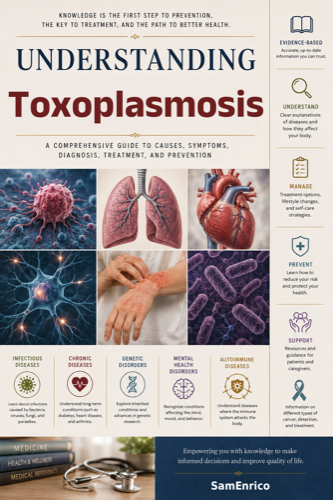
Understanding Toxoplasmosis
This disease publication, published by SamEnrico,
by South Anglea
This disease publication, published by SamEnrico, covers Understanding Toxoplasmosis
Formats
About this book
Free sample
Chapter 1: The Arc of Life...--In the dusty heat of a Tunisian laboratory in 1908, two French scientists peered through a brass-barreled microscope at a slide that would quietly change the course of infectious disease research. Charles Nicolle and Louis Manceaux were not looking for a new pathogen. They were studying a small North African rodent called Ctenodactylus gundi, a species of little interest to anyone outside a handful of taxonomists and colonial naturalists. The rodent was sick, though no one could say why. It had died of what appeared to be a routine infection, and the two researchers were performing a standard post-mortem examination when they noticed something unusual in the spleen.
There, among the expected cells and debris, were crescent-shaped organisms unlike anything they had seen before. The crescents were small—far smaller than most bacteria—and they curved inward like tiny arches. Nicolle, who would later win the Nobel Prize for his work on typhus, recognized immediately that he was looking at something new. He turned to Manceaux and suggested a name: Toxoplasma, from the Greek toxon, meaning "arc" or "bow." Gondi would follow, taken from the rodent's species name. And so, without fanfare or headlines, Toxoplasma gondii entered the scientific literature—a footnote in a 1909 paper that almost no one read.For the next sixty years, the parasite remained a medical curiosity.
It was found occasionally in other animals—rabbits, birds, mice—but it did not seem to cause significant disease. A few scattered case reports appeared in the medical literature: a child with an unexplained fever, a man with swollen lymph nodes, an infant born with an oddly shaped head. But no one connected these dots. The prevailing attitude among infectious disease specialists was that Toxoplasma was a harmless commensal, an accidental passenger that happened to live in a wide range of hosts without causing trouble. If you had asked a doctor in 1950 what he knew about toxoplasmosis, he might have shrugged.
If you had asked him whether it was a problem for pregnant women, he would have had no answer. The parasite was studied by…
This is the end of the free sample. Get the eBook to keep going. Buy now
Contents
- Chapter 1
- Chapter 2
- Chapter 3
- Chapter 4
- Chapter 5
- Chapter 6
- Chapter 7
- Chapter 8
- Chapter 9
- Chapter 10
- Chapter 11
- Chapter 12
Details
- Author
- South Anglea
- Publisher
- SamEnrico
- Language
- English
- Genre
- Non-Fiction, Informative, Educational
- Released
- 2026-05-18
- Pages (approx.)
- 155
- Available as
- eBook, Audiobook

Read better in the ZLOADR app
Your eBooks on your phone or tablet. Sign in with your SamEnrico account and start reading.
More by South Anglea
 Imposter Syndrome for Nonprofit LeadersSouth Anglea$11.99
 Active Listening For NegotiatorsSouth Anglea$11.99
 TM for Musicians GuideSouth Anglea$11.99
 The Self Talk for ConflictSouth Anglea$11.99
 The GAD Medication GuideSouth Anglea$11.99
 The Tercios: Spain's Invincible LegionsSouth Anglea$11.99
 Restaurant Business Plan One PageSouth Anglea$12.99
 FreeCAD Replaces AutoCAD GuideSouth Anglea$12.99
 How to Start a Candle Business (Beginners Guide)South Anglea$11.99
 Threat Detection and Incident ResponseSouth Anglea$11.99
You may also like
 Hong Kong Handover 1997Dunn Johnnie$11.99
 Zumba For Postnatal Recovery CourseNeal Christian$11.99
 Zumba for BeginnersLadner Nikia$11.99
 YouTube Comment Mining GuideHumes Pandora$12.99
 Worry Box MeditationCarlin Rudy$11.99
 Workplace Stress MeditationNguyen Lynn$11.99
 Workplace Stress and Sleep RepairHawley Ivory$11.99
 Workplace Perfectionism CureDelaney Jeffry$11.99
 Workplace Injustice Anger GuideWallen Isabelle$11.99
 Work Addiction and Burnout LinkGreenwood Ester$11.99
 Women in Yoga and WellnessBeattie Galina$11.99
 Women in Stand Up ComedyChun Evangeline$11.99