
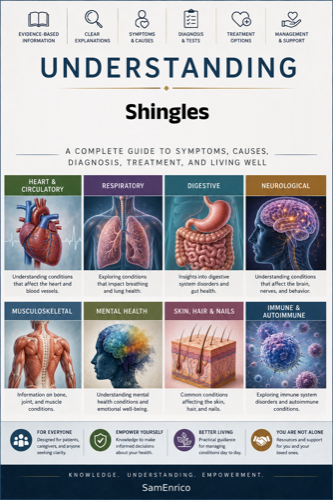
Non-FictionInformativeEducational
Understanding Shingles eBook
This condition publication, published by SamEnrico
This condition publication, published by SamEnrico, covers Understanding Shingles
Formats
Free sample
Chapter 1: The Sleeping Giant...--–- The first time Margaret felt it, she was reaching for a coffee mug on the top shelf of her kitchen cabinet. A sharp, electric twinge shot from her right shoulder blade down to her ribs—like someone had touched a live wire to her skin. She dismissed it as a pulled muscle from gardening. Three days later, she was in the emergency room, unable to wear a shirt because the light pressure of cotton fabric felt like acid. Her husband had to drive her.
She couldn't sit against the car seat. By the time a doctor correctly diagnosed shingles, the 72-hour window for optimal antiviral treatment had already closed. Margaret would spend the next fourteen months in chronic pain, sleeping in a recliner because bedsheets were unbearable, and wondering why no one had ever warned her.Margaret's story is not rare. It is, in fact, painfully ordinary.Every year, approximately one million Americans develop shingles. That is one person every thirty seconds.
One in three people will experience it in their lifetime. Yet despite these staggering numbers, shingles remains one of the most misunderstood, misdiagnosed, and mismanaged conditions in modern medicine. Most people think they know what it is—a rash, some blisters, a week of discomfort, and then it's over. That assumption is dangerously wrong.This book exists because of that gap between perception and reality. Between what doctors know and what patients are told.
Between the minor inconvenience most people imagine and the life-altering neurological event that shingles actually is.The Name That Misleads The very term "shingles" is a linguistic misfortune. It derives from the Latin cingulum, meaning "belt" or "girdle"—a reference to the band-like pattern the rash often takes around the torso. But that name, descriptive as it is, has become a trap. It focuses attention on the skin, on the visible, on the temporary. It conjures images of roofing tiles or a minor dermatological annoyance.
The name should have been something else entirely. Something that warned of nerves, of lightning bolts of pain, of a virus that has been hiding inside your body since childhood, waiting for the precise moment of weakness to strike.The medical name—Herpes Zoster—is not much better. The word "herpes" frightens people for the wrong reasons, conjuring associations with a different family of viruses entirely. And "zoster," from the Greek for "girdle," merely repeats the belt metaphor. So we are left with a disease that sounds like a roofing problem, gets mistaken for a pulled muscle or kidney stone, and announces itself with pain long before any visible evidence appears.This naming problem is not merely semantic.
It has real consequences. When patients hear "shingles," they do not rush to the doctor. They wait for the rash. And waiting is exactly what the virus wants.The Virus That Never Leaves To understand shingles, you must first understand a disturbing fact about your own body: you are carrying a time bomb. Specifically, you are carrying the Varicella-Zoster Virus (VZV), the same virus that gave you chickenpox, most likely when you were a child.
And it will never leave.Here is what happens. When you contract chickenpox—typically through airborne respiratory droplets from an infected person—the virus runs its course. You develop the familiar itchy, blistering rash. Your immune system fights it off. You recover.
You think the story is over.It is not.VZV is a member of the Herpesviridae family, a group of viruses with a sinister talent: latency. After the primary infection resolves, VZV does not exit your body. Instead, it retreats along your peripheral nerves and takes up permanent residence in clusters of nerve cells called dorsal root ganglia. These are small, almond-shaped collections of neurons located just outside your spinal cord. Think of them as the virus's bunkers.
Hidden. Protected. Waiting.Inside these ganglia, the virus goes dormant. It stops replicating. It becomes invisible to your immune system—not because it is hiding, but because it has stopped producing the proteins that immune cells use to recognize infected cells.
It is a perfect sleeper agent, integrated into your own nervous system, doing nothing for years or even decades.This latency is an evolutionary masterpiece. By not killing its host and by remaining undetectable, VZV ensures its own survival. It spreads to new hosts during the active chickenpox phase, then waits inside those hosts for the rest of their lives, ready for a second act.That second act is shingles.One in Three The statistics are sobering. Among people who reach age 85, nearly half will experience at least one episode of shingles. For those over 60, the incidence rate climbs steadily.
But age is not the only factor. People with compromised immune systems—from HIV, cancer, chemotherapy, organ transplantation, or long-term steroid use—face dramatically higher risks. One study found that people with Hodgkin's lymphoma are nearly ten times more likely to develop shingles than the general population.Even healthy younger adults are not immune. Stress, physical trauma, or even a severe sunburn can trigger reactivation in people in their twenties and thirties. The common thread is not age but cell-mediated immunity—the part of your immune system that uses T-cells to patrol your tissues and destroy virus-infected cells.
When that specific branch of immunity weakens, the sleeping virus wakes.And here is the cruelest statistic: once you have had shingles, you can get it again. For decades, the medical community believed that a single episode conferred lifetime immunity. That turned out to be false. Recurrence rates range from 1% to 6%, and for immunocompromised individuals, the rate is significantly higher. The virus does not learn.
It does not remember. It will wake up again if given the chance.A Neurological Event, Not a Skin Rash This is the single most important concept in this entire book, so it deserves to be stated clearly and repeatedly: shingles is a neurological disease that happens to produce a skin rash. It is not a skin disease.The rash is a symptom. The underlying problem is inflammation of the peripheral nerves—specifically, the sensory nerves that carry signals from your skin to your spinal cord and brain. When VZV reactivates, it does not start in the skin.
It starts deep inside your body, inside the dorsal root ganglia. From there, the virus travels down the length of the affected nerve, like a fire spreading along a fuse. When it reaches the nerve endings in your skin, it causes the characteristic blistering rash. But by that point, the nerve itself has already been under inflammatory assault for days.This explains the defining feature of early shingles: pain before rash. In nearly 70% of cases, patients experience localized pain, burning, tingling, or itching in a specific area for 48 to 72 hours before any visible skin changes appear.
This is the virus traveling down the nerve, irritating it, inflaming it. The rash is not the beginning. It is the middle.Understanding this sequence changes everything. If you are waiting for the rash to seek medical attention, you are waiting too long. The therapeutic "golden window" for antiviral treatment is 72 hours from the onset of symptoms—not from the appearance of the…
This is the end of the free sample. Get the eBook to keep going. Buy now
About this book
Details
- Author
- Almeida Arlean
- Publisher
- SamEnrico
- Language
- English
- Genre
- Non-Fiction, Informative, Educational
- Released
- 2026-05-18
- Pages (approx.)
- 156
- Available as
- eBook, Audiobook

Read better in the ZLOADR app
Your eBooks on your phone or tablet. Sign in with your SamEnrico account and start reading.
More by Almeida Arlean
 Investor Pitch PersuasionAlmeida Arlean$11.99
 Paleo Autoimmune Protocol DietAlmeida Arlean$11.99
 Advanced Peg Systems CourseAlmeida Arlean$11.99
 Zion Canyon Mystery DisappearancesAlmeida Arlean$11.99
 Sunflower Seeds Quit AidAlmeida Arlean$11.99
 Image Rehearsal Therapy ManualAlmeida Arlean$11.99
 Weapon Focus Effect GuideAlmeida Arlean$11.99
 Fat Soluble Vitamins GuideAlmeida Arlean$11.99
 The Sole Revolution: How America Laced Up the WorldAlmeida Arlean$11.99
 The Rollin' Pioneers: How South Africa's First Skateboarders Defied ApartheidAlmeida Arlean$11.99
 How to Produce Space HeatersAlmeida Arlean$11.99
 10 Ways to Use Purple Sprouting Broccoli (Recipe Book)Almeida Arlean$11.99
You may also like
 Hong Kong Handover 1997Dunn Johnnie$11.99
 Zumba For Postnatal Recovery CourseNeal Christian$11.99
 Zumba for BeginnersLadner Nikia$11.99
 YouTube Comment Mining GuideHumes Pandora$12.99
 Worry Box MeditationCarlin Rudy$11.99
 Workplace Stress MeditationNguyen Lynn$11.99
 Workplace Stress and Sleep RepairHawley Ivory$11.99
 Workplace Perfectionism CureDelaney Jeffry$11.99
 Workplace Injustice Anger GuideWallen Isabelle$11.99
 Work Addiction and Burnout LinkGreenwood Ester$11.99
 Women in Yoga and WellnessBeattie Galina$11.99
 Women in Stand Up ComedyChun Evangeline$11.99