
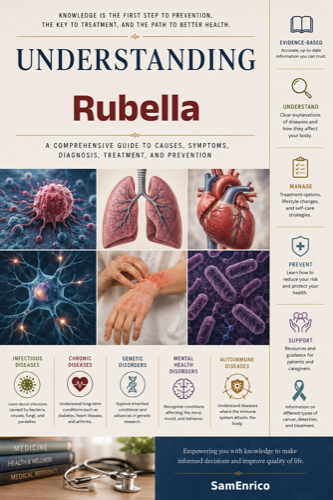
Non-FictionInformativeEducational
Understanding Rubella eBook
This disease publication, published by SamEnrico,
This disease publication, published by SamEnrico, covers Understanding Rubella
Formats
Free sample
Chapter 1: The Quiet Invader...--Rubella does not announce itself with thunder. There is no violent fever, no dramatic collapse, no telltale sign that screams “Danger—stay away.” Instead, the virus slips into the body like a whisper, often so mild that those infected barely notice. A slight fever. A few pink spots that fade in three days. Perhaps nothing at all.
This is precisely what makes rubella one of the most deceptive and dangerous infectious diseases known to medicine. It preys on the very fact that it seems harmless.Yet beneath this gentle exterior lies a biological agent capable of extraordinary devastation—not to the person who carries it, but to the unborn child whose mother may never even know she was exposed. This chapter unravels the fundamental nature of rubella: what it is, how it differs from the diseases it is constantly confused with, where it still lurks in the world today, and why understanding these basics could save a life.The Virus: A Very Small Enemy Rubella is caused by a virus belonging to the Togaviridae family, genus Rubivirus. To put that in perspective, this family includes only a handful of viruses that infect humans, and rubella is the most famous among them. Under an electron microscope, the rubella virus appears as a spherical particle approximately 50 to 70 nanometers in diameter—so small that more than 200,000 of them could fit on the head of a pin.The virus carries a single strand of RNA, the genetic blueprint that allows it to hijack human cells and force them to produce millions of copies of itself.
Encasing this RNA is a protein shell called a capsid, and surrounding that is a lipid envelope studded with spike-like proteins (E1 and E2) that attach to receptors on human cells. These spikes are the keys that unlock the door to infection.Once rubella enters the body—typically through the nose or throat—it begins replicating in the respiratory tract and lymph nodes. From there, it spreads through the bloodstream to virtually every organ. In children and most adults, the immune system clears the infection within one to two weeks, leaving behind lifelong immunity. But in a developing fetus, whose immune system is immature and whose cells are dividing rapidly, the virus causes a different catastrophe altogether.
The fetus cannot clear the infection. Instead, rubella persists, disrupting organ development in ways that can last a lifetime.This dual nature—mild in children, catastrophic before birth—is rubella’s defining paradox.The Name Game: Why Rubella Is Not Measles One of the most persistent sources of confusion in medicine—and a frequent cause of diagnostic error—is the similarity between rubella and other rash-causing illnesses. Historically, rubella was called “German measles,” a name that has caused nothing but confusion for nearly two centuries. The term “German” had nothing to do with the country; it came from the Latin germanus, meaning “similar,” because physicians recognized that rubella resembled measles. But resemblance is not identity, and the consequences of mixing them up can be serious.Rubella versus Rubeola (Measles)True measles, caused by the paramyxovirus, is a severe illness.
It announces itself with a high fever (often exceeding 104°F or 40°C), the “three C’s”—cough, coryza (runny nose), and conjunctivitis (red, watery eyes)—followed by a dark red, blotchy rash that starts on the face and spreads downward. The rash typically lasts five to seven days. Complications include pneumonia, encephalitis (brain swelling), and in rare cases, subacute sclerosing panencephalitis (a fatal brain degeneration that appears years later). Before vaccination, measles killed approximately 2.6 million people globally each year.Rubella, by contrast, is a much milder illness. Fever rarely exceeds 101°F (38.3°C).
The “three C’s” are absent or very mild. The telltale sign is swollen, tender lymph nodes behind the ears and at the back of the neck—a finding so characteristic that doctors call it “posterior auricular and suboccipital lymphadenopathy.” The rubella rash is pink or light red, often described as looking like a mild sunburn or a scattering of rose petals. It appears first on the face and spreads to the trunk and limbs, but it typically fades within three days, earning rubella the nickname “three-day measles.”The single most important difference, however, is what happens during pregnancy. Measles during pregnancy increases the risk of premature labor and low birth weight but does not typically cause the kind of severe birth defects seen with rubella. Rubella during the first trimester causes Congenital Rubella Syndrome (CRS) in up to 85 percent of cases.
This distinction alone justifies every effort to tell these two diseases apart.Rubella versus Roseola Another common source of confusion, particularly among parents of young children, is roseola. Roseola (caused by human herpesvirus 6 or 7) typically affects infants between six months and two years of age. It has a distinct pattern: sudden high fever (often 103°F to 105°F) for three to five days, followed by a rapid drop in fever and the appearance of a pink rash as the child is already recovering. The rash looks similar to rubella, but the timing—fever then rash, rather than fever with rash—helps distinguish them. Roseola does not cause CRS, and it is not a vaccine-preventable disease.Why the Distinction Matters For parents and healthcare providers, telling these illnesses apart is not merely an academic exercise.
A child suspected of having rubella requires immediate isolation to prevent spread to pregnant women. Laboratory confirmation is essential. Public health authorities must be notified. And any pregnant woman exposed to that child needs urgent testing. A misdiagnosis of roseola or measles could delay these critical steps.Throughout this book, whenever we refer to “rubella,” we mean the specific virus described above—not measles, not roseola, not any other rash illness.
They are not the same. The stakes could not be higher.A World Map of Risk: Where Rubella Still Lives If you live in North America, most of Western Europe, Australia, or Japan, you may never encounter a rubella case. The World Health Organization (WHO) declared the Region of the Americas free of endemic rubella transmission in 2015—a remarkable public health achievement. Europe has also made dramatic progress, though occasional outbreaks occur in under-vaccinated communities.But endemic rubella transmission persists across large swaths of the globe. According to the most recent WHO data, countries with active rubella transmission include:Africa: Nigeria, Democratic Republic of the Congo, Ethiopia, Angola, and many others where vaccination coverage remains below the 80-85 percent threshold needed for herd immunity.
In some African nations, fewer than half of children receive the rubella-containing vaccine.Southeast Asia: India, Indonesia, Myanmar, Bangladesh. India alone accounts for a significant proportion of global rubella cases, although the country has made substantial progress with mass vaccination campaigns.Western Pacific: The Philippines, Papua New Guinea, Vietnam. China has dramatically reduced rubella but still reports cases.Eastern Mediterranean: Afghanistan, Pakistan, Somalia, Sudan, where conflict and displacement have disrupted vaccination programs.Europe: Most of Western Europe is rubella-free, but the WHO European Region has seen resurgences in countries such as Romania, Poland, and Ukraine, where vaccine hesitancy or access issues have left pockets of susceptibility.For travelers, this map matters. A pregnant woman who visits a country where rubella circulates puts…
This is the end of the free sample. Get the eBook to keep going. Buy now
About this book
Details
- Author
- Mcclendon Vertie
- Publisher
- SamEnrico
- Language
- English
- Genre
- Non-Fiction, Informative, Educational
- Released
- 2026-05-11
- Pages (approx.)
- 160
- Available as
- eBook, Audiobook

Read better in the ZLOADR app
Your eBooks on your phone or tablet. Sign in with your SamEnrico account and start reading.
More by Mcclendon Vertie
 Sports Nutrition AssessmentMcclendon Vertie$11.99
 Travel Blue Zone GuideMcclendon Vertie$11.99
 The Self Hypnosis for ChemotherapyMcclendon Vertie$11.99
 Bipolar Disorder and CocaineMcclendon Vertie$11.99
 Anger Management for ConstructionMcclendon Vertie$11.99
 The Alchemists of Alexandria: Forging the Foundations of ScienceMcclendon Vertie$11.99
 Invoice Factoring vs Bank LoansMcclendon Vertie$12.99
 FinCEN Access and EnforcementMcclendon Vertie$12.99
 NFT Marketplace Business SetupMcclendon Vertie$11.99
 How to Become a Stamp-pad MakerMcclendon Vertie$11.99
You may also like
 Hong Kong Handover 1997Dunn Johnnie$11.99
 Zumba For Postnatal Recovery CourseNeal Christian$11.99
 Zumba for BeginnersLadner Nikia$11.99
 YouTube Comment Mining GuideHumes Pandora$12.99
 Worry Box MeditationCarlin Rudy$11.99
 Workplace Stress MeditationNguyen Lynn$11.99
 Workplace Stress and Sleep RepairHawley Ivory$11.99
 Workplace Perfectionism CureDelaney Jeffry$11.99
 Workplace Injustice Anger GuideWallen Isabelle$11.99
 Work Addiction and Burnout LinkGreenwood Ester$11.99
 Women in Yoga and WellnessBeattie Galina$11.99
 Women in Stand Up ComedyChun Evangeline$11.99