
Non-FictionInformativeEducational
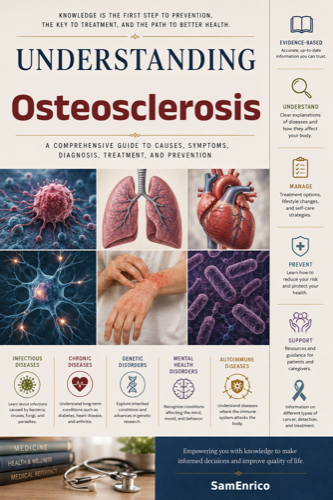
Understanding Osteosclerosis eBook
This disease publication, published by SamEnrico,
by Bohn Sha
This disease publication, published by SamEnrico, covers Understanding Osteosclerosis
Formats
Free sample
Chapter 1: The Density Paradox...–- Every medical student hears it drilled into their memory: bone density is the gold standard of skeletal health. Higher T-scores mean stronger bones. Osteoporosis, defined as low bone mass, leads to fractures. Therefore, the logical conclusion follows that denser bones must be better bones. This assumption has driven public health campaigns, billion-dollar supplement industries, and clinical practice guidelines for decades.
Patients proudly announce their "excellent bone density" after a DXA scan, believing they have been given a clean bill of skeletal health. They walk out of clinics reassured, unaware that a high bone mineral density reading might actually be a warning siren, not an all-clear signal.The reality, as this book will demonstrate, is far more nuanced and clinically treacherous. Osteosclerosis—the pathologic increase in bone mineral density—represents a collection of disorders where the skeleton becomes excessively dense, yet paradoxically weaker, more brittle, and potentially life-threatening. This opening chapter dismantles the density-centric worldview and establishes the foundational framework for understanding why some bones become too dense, how this process differs fundamentally from normal bone remodeling, and why every clinician must learn to recognize the red flags hidden within a "normal" or "elevated" bone density report.The Clinical Case That Changed Everything Consider the case of a 52-year-old woman who presented to her primary care physician with progressive fatigue and bone pain in her lower back. She had been healthy her entire life, exercised regularly, and took calcium and vitamin D supplements diligently.
Her DXA scan showed a lumbar spine T-score of +2.8—far above the normal range and well into what most algorithms would celebrate as "superior bone density." Her physician prescribed continued supplementation and sent her on her way.Over the next eighteen months, she developed worsening anemia, required blood transfusions, and eventually suffered a spontaneous femoral neck fracture while simply walking across her kitchen. Orthopedic surgeons noted that her bone was extraordinarily hard—drills broke during attempted fixation—and the fracture failed to heal. Only then was a bone biopsy performed, revealing osteopetrosis, a genetic form of osteosclerosis that had been silently obliterating her bone marrow space for decades.Her "excellent bone density" was never excellent. It was the first clue to a deadly underlying disease, and it was missed.This case illustrates the central problem this book addresses: osteosclerosis is underrecognized, frequently misdiagnosed as normal or even desirable, and carries devastating complications when ignored. The density paradox—that denser bone can be weaker bone—lies at the heart of understanding this condition.Defining Osteosclerosis: Precision Matters Osteosclerosis derives from the Greek roots "osteon" (bone) and "sklerosis" (hardening).
In clinical terms, it refers to an abnormal increase in bone mineral density due to an imbalance in the bone remodeling process. However, this definition requires careful unpacking because the term appears across radiology, pathology, and clinical medicine with slightly different shades of meaning.From a radiologic perspective, osteosclerosis describes any focal or diffuse area of increased density on imaging studies, regardless of cause. A bone island, a blastic metastasis, and osteopetrosis all produce white spots or white bones on X-ray, but their implications could not be more different. This is why the radiologist's interpretation must go beyond pattern recognition to integrate clinical context—a fact we will explore in depth in Chapter 6.From a histologic perspective, osteosclerosis represents an excess of mineralized bone tissue per unit volume, often accompanied by abnormal architecture. Normal bone contains a delicate balance of cortical (dense outer layer) and trabecular (spongy inner network) bone.
In osteosclerosis, the trabeculae thicken, the cortex expands, and the marrow space—the factory where blood cells are produced—shrinks. This marrow compromise, detailed in Chapter 8, is often the first clinical manifestation of diffuse osteosclerosis.From a pathophysiologic perspective, osteosclerosis results from one of three mechanisms: excessive bone formation by osteoblasts, inadequate bone resorption by osteoclasts, or a combination of both. These mechanisms are not mutually exclusive, and understanding which pathway is dominant in a given patient determines treatment approach. Chapter 3 explores the genetic mutations that cause osteoclast dysfunction, while Chapter 4 examines acquired causes of osteoblast overactivity.The Bone Remodeling Unit: A Brief Refresher To understand osteosclerosis, one must first understand normal bone remodeling. The skeleton is not static; it undergoes continuous renewal through a tightly regulated process called remodeling.
This process serves three essential functions: repairing microdamage, replacing old or fatigued bone, and maintaining calcium homeostasis.The bone remodeling cycle occurs in discrete units called bone multicellular units (BMUs). Each BMU operates like a construction crew, following a predictable sequence. First, osteoclasts—large, multinucleated cells derived from the monocyte-macrophage lineage—resorb a packet of old bone, creating a cavity. This resorption phase lasts approximately three weeks. Second, reversal cells prepare the surface for new bone formation.
Third, osteoblasts—cuboidal cells derived from mesenchymal stem cells—fill the cavity with new bone matrix (osteoid), which subsequently mineralizes. This formation phase takes four to six months. In a healthy adult, resorption and formation are coupled: approximately ten percent of the skeleton is remodeled each year, and bone mass remains stable.The coordination between osteoclasts and osteoblasts is governed by the RANK/RANKL/OPG signaling pathway, which deserves special attention because its disruption is central to many forms of osteosclerosis. Osteoclast precursors express a receptor called RANK on their surface. When RANK binds to its ligand, RANKL—produced primarily by osteoblasts and osteocytes—osteoclast differentiation and activation occur.
Osteoprotegerin (OPG), a decoy receptor produced by osteoblasts, binds to RANKL and prevents it from activating RANK, thereby inhibiting osteoclast formation. The ratio of RANKL to OPG determines the net rate of bone resorption.Any mutation, toxin, or disease that increases RANKL, decreases OPG, or directly activates osteoclasts will increase bone resorption, leading to osteoporosis or osteolysis. Conversely, mutations that impair osteoclast formation or function (Chapter 3), or conditions that increase OPG or decrease RANKL, will reduce resorption and cause osteosclerosis. The balance is exquisitely sensitive, and even small perturbations can produce dramatic skeletal consequences.Distinguishing Osteosclerosis from Its Mimics No discussion of osteosclerosis is complete without differentiating it from conditions that produce similar radiographic findings but have different pathophysiologies, prognoses, and treatments. Three entities cause particular confusion.Osteoporosis represents the opposite end of the bone density spectrum.
It is defined by low bone mass and microarchitectural deterioration, leading to increased fracture risk. Whereas osteosclerosis results from too much bone formation or too little resorption, osteoporosis results from too little formation or too much resorption. The two conditions are not opposites in a mechanical sense—both produce brittle bones, but through different mechanisms—and they can coexist in the same patient, particularly in older adults with genetic osteosclerosis who develop age-related bone loss. Distinguishing between them requires attention to DXA pitfalls (Chapter 6) and clinical context.Osteopetrosis is often used interchangeably with osteosclerosis in casual clinical conversation, but this is inaccurate. Osteopetrosis is a specific genetic subset of osteosclerosis caused by mutations in genes required for osteoclast function (TCIRG1, CLCN7, etc.).
All patients with osteopetrosis have osteosclerosis, but not all patients with osteosclerosis have osteopetrosis. The broader category includes acquired forms (Chapter 4), secondary forms (Chapter 5), and other genetic dysplasias (Chapter 3). Throughout this book, we will use precise terminology…
This is the end of the free sample. Get the eBook to keep going. Buy now
About this book
Details
- Author
- Bohn Sha
- Publisher
- SamEnrico
- Language
- English
- Genre
- Non-Fiction, Informative, Educational
- Released
- 2026-05-11
- Pages (approx.)
- 148
- Available as
- eBook, Audiobook

Read better in the ZLOADR app
Your eBooks on your phone or tablet. Sign in with your SamEnrico account and start reading.
More by Bohn Sha
 Africa Rising Consumer ReportBohn Sha$11.99
 The Door in Face Negotiation TacticBohn Sha$11.99
 Probate Avoidance StrategiesBohn Sha$11.99
 Red Light Meditation TechniqueBohn Sha$11.99
 Doorway Visualization New SpaceBohn Sha$11.99
 The Bloodied Crown: How Money Fueled the French Wars of ReligionBohn Sha$11.99
 Window Sign PainterBohn Sha$11.99
 Teaching Phonics to Chinese LearnersBohn Sha$12.99
 Freelance Terms of Service GuideBohn Sha$12.99
 How to Become a Type-casting Machine OperatorBohn Sha$11.99
You may also like
 Hong Kong Handover 1997Dunn Johnnie$11.99
 Zumba For Postnatal Recovery CourseNeal Christian$11.99
 Zumba for BeginnersLadner Nikia$11.99
 YouTube Comment Mining GuideHumes Pandora$12.99
 Worry Box MeditationCarlin Rudy$11.99
 Workplace Stress MeditationNguyen Lynn$11.99
 Workplace Stress and Sleep RepairHawley Ivory$11.99
 Workplace Perfectionism CureDelaney Jeffry$11.99
 Workplace Injustice Anger GuideWallen Isabelle$11.99
 Work Addiction and Burnout LinkGreenwood Ester$11.99
 Women in Yoga and WellnessBeattie Galina$11.99
 Women in Stand Up ComedyChun Evangeline$11.99