
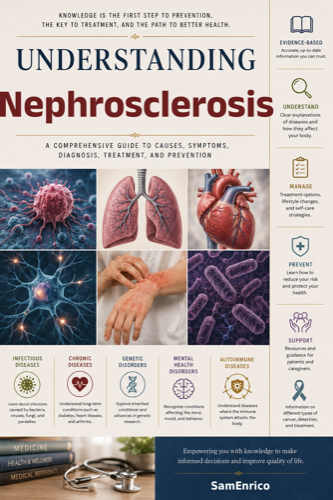
Understanding Nephrosclerosis eBook
This disease publication, published by SamEnrico,
This disease publication, published by SamEnrico, covers Understanding Nephrosclerosis
Formats
Free sample
Chapter 1: The Silent Scar...--The human body is remarkably forgiving—up to a point. Your liver can regenerate after losing two-thirds of its mass. Your skin repairs itself so efficiently that a deep cut can become invisible within months. Your bones, when broken, knit themselves back together stronger than before. But your kidneys?
They do not heal. They do not regenerate. And when they scar, they scar for life.This is the fundamental truth that stands at the center of nephrosclerosis, a disease that most people have never heard of but that quietly claims more kidneys than almost any other condition. It is the thief that operates in plain sight, the gradual hardening of the kidney's tiny blood vessels that turns a vital organ into a brick of scar tissue—sometimes over decades, sometimes in a matter of days. And by the time you notice anything is wrong, significant damage has often already been done.If you are reading this book, you or someone you love has likely received a diagnosis that sounded foreign, frightening, and frustratingly vague.
"Nephrosclerosis." The word itself feels heavy, clinical, distant. Your doctor may have explained it as "hardening of the kidney arteries" or "hypertensive kidney disease" or simply "wear and tear on the kidneys." Perhaps you were told it is common, that many people your age have it, that medication can slow it down. All of these statements are true. But they are also dangerously incomplete.This chapter is not a medical textbook's dry recitation of facts. It is an invitation to truly understand what is happening inside your body—or inside the body of someone you care for.
Because understanding is the first and most powerful step toward taking control. Without understanding, you are merely following orders, taking pills whose purposes blur together, showing up for blood tests whose numbers you do not fully grasp. With understanding, you become an active participant in your own care, a partner with your medical team, and a fierce advocate for your own health.Let us begin at the beginning: what nephrosclerosis actually is, who it strikes, why it has been hiding in plain sight, and why—despite its stealth—you have every reason to be hopeful.What Is Nephrosclerosis? A Definition in Plain Language The word "nephrosclerosis" comes from three Greek roots: nephros (kidney), scleros (hardening), and osis (condition of). Put simply, it is the condition of kidney hardening.
But that translation, while accurate, fails to capture the living reality of the disease.Imagine for a moment a garden hose left out in the sun for years. The rubber becomes brittle. The walls lose their flexibility. When you turn on the water, the pressure backs up instead of flowing smoothly. Small cracks appear.
Water leaks out. Eventually, the hose becomes so stiff and damaged that barely anything gets through at all.Your kidneys contain millions of tiny blood vessels called arterioles—so small that dozens could fit inside the diameter of a single human hair. These arterioles are exquisitely designed to handle pressure, to expand and contract with each heartbeat, to deliver exactly the right amount of blood to the filtering units called glomeruli. But when blood pressure runs high year after year, those arterioles suffer the same fate as the garden hose. Their walls thicken.
They lose elasticity. Proteinaceous material called hyaline deposits into the walls, like lime scale building up inside a pipe. The vessels narrow. Blood flow slows. And the delicate filtering units downstream, starved of oxygen and nutrients, begin to die.That is nephrosclerosis.
It is not a tumor. It is not an infection. It is not a poison that came from outside your body. It is the cumulative, irreversible scarring of your kidney's blood vessels, driven overwhelmingly by one thing: high blood pressure that was not adequately treated, or in some cases, that proved unusually aggressive despite treatment.The Two Faces of Nephrosclerosis: Benign and Malignant One of the most important distinctions to understand is that nephrosclerosis comes in two dramatically different forms. Think of them as the slow burn versus the wildfire.Benign Nephrosclerosis: The Slow Thief The word "benign" in medicine does not mean harmless.
It means slow-moving, indolent, taking its time. Benign nephrosclerosis is the version that affects millions of people worldwide, typically developing over twenty, thirty, or forty years. A person with benign nephrosclerosis might have mildly elevated blood pressure in their forties, slightly elevated creatinine in their fifties, trace protein in their urine in their sixties, and noticeable kidney dysfunction by their seventies. For many, the disease progresses so slowly that they die of something else entirely—heart disease, stroke, cancer—long before their kidneys fail completely.This is both good news and bad news. The good news is that there is ample time to intervene.
The bad news is that because the disease causes no symptoms for decades, most people never know they have it until significant damage has accumulated. They feel fine. They look fine. Their kidneys, however, are slowly turning to stone.The pathology of benign nephrosclerosis is a study in gradual destruction. Under a microscope, the afferent arterioles—the small arteries that bring blood into the filtering units—show characteristic thickening of their walls.
Hyaline, a glassy pink proteinaceous material, accumulates in the vessel wall, pushing inward and narrowing the lumen. The glomeruli downstream become ischemic, their delicate capillary loops collapsing like deflated balloons. Eventually, entire glomeruli are replaced by scar tissue. The tubules, which normally reabsorb and secrete vital substances, atrophy from lack of blood flow. And the spaces between the tubules fill with collagen, the same protein that forms scars on your skin.What drives this process?
The mechanical force of high pressure against vessel walls. Every time the heart contracts, it sends a pulse wave through the arteries. In a healthy person with blood pressure of 120/80 mm Hg, that pulse wave is gentle. In a person with untreated hypertension of 160/100 mm Hg, that pulse wave pounds against the arteriolar walls with nearly double the force. Over thirty years—roughly one billion heartbeats—that added force causes microscopic tears, inflammation, and the deposition of hyaline as the vessel attempts to repair itself.Malignant Nephrosclerosis: The Wildfire If benign nephrosclerosis is a slow burn, malignant nephrosclerosis is a five-alarm fire.
The word "malignant" here does not mean cancer. It means rapidly progressive, dangerous, and potentially fatal. Malignant nephrosclerosis occurs when blood pressure rises extremely high—often diastolic pressures above 130 mm Hg—and causes catastrophic damage in weeks or months rather than decades.This is not a condition that hides. Patients with malignant nephrosclerosis are desperately ill. They present with blinding headaches, blurred vision from retinal hemorrhages and swelling of the optic nerve (papilledema), confusion or seizures from hypertensive encephalopathy, and rapidly rising creatinine indicating acute kidney injury.
Their blood tests may show microangiopathic hemolytic anemia (MAHA)—a condition in which red blood cells are shredded as they pass through damaged small vessels—and thrombocytopenia (low platelets). Their urine may contain blood and protein.On gross examination, the kidneys of a patient with malignant nephrosclerosis have a characteristic "flea-bitten" appearance: tiny petechial hemorrhages dotting the surface like flea bites. Under the microscope, the arterioles show…
This is the end of the free sample. Get the eBook to keep going. Buy now
About this book
Details
- Author
- Prater Lorilee
- Publisher
- SamEnrico
- Language
- English
- Genre
- Non-Fiction, Informative, Educational
- Released
- 2026-05-08
- Pages (approx.)
- 160
- Available as
- eBook, Audiobook

Read better in the ZLOADR app
Your eBooks on your phone or tablet. Sign in with your SamEnrico account and start reading.
More by Prater Lorilee
 IRA Contribution Deadline GuidePrater Lorilee$11.99
 Competitive Program Application Stress WorkbookPrater Lorilee$11.99
 Mindfulness For Cancer Pain ReliefPrater Lorilee$11.99
 The Later Termination Support GuidePrater Lorilee$11.99
 Loving Kindness for DialysisPrater Lorilee$11.99
 The Trickster’s Excalibur: Anansi and the Round TablePrater Lorilee$11.99
 Healthcare AssistantPrater Lorilee$11.99
 Excel Economics Final CramPrater Lorilee$12.99
 Ulta Beauty SWOT LibraryPrater Lorilee$12.99
 How to Become a Drill-press OperatorPrater Lorilee$11.99