
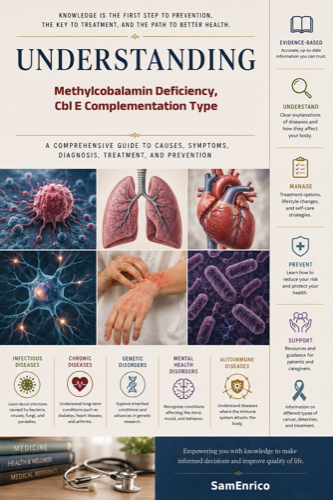
Non-FictionInformativeEducational
Understanding Methylcobalamin Deficiency, Cbl E Complementation Type eBook
This disease publication, published by SamEnrico,
by Dillon Chin
This disease publication, published by SamEnrico, covers Understanding Methylcobalamin Deficiency, Cbl E Complementation Type
Formats
Free sample
Chapter 1: The Falling Girl...--The child had walked perfectly at thirteen months. Not a stumble, not a wobble—she had simply pushed herself up from the carpet one Tuesday afternoon and walked across the living room as if she had been doing it for years. Her mother, Elena, had cried happy tears while filming the video that would later be played at birthday parties and family gatherings. Sophia was perfect. She said "Mama" at ten months.
She pointed to dogs and said "doggie" by her first birthday. She stacked blocks with a concentration that made her grandmother laugh and say, "This one is going to be an engineer."By eighteen months, Sophia had stopped walking.It wasn't dramatic. There was no fall, no fever, no seizure that announced itself with terror and paramedics. She simply began to prefer crawling. Then she began to need help standing.
Then her legs felt different to Elena's touch—not firm and muscled like a toddler's should be, but soft, almost doughy. The pediatrician said it was probably a virus. "Give it two weeks," he said, with the warm confidence of someone who had seen a thousand mild illnesses resolve on their own.Two weeks became four. Four became eight. Sophia, who had been saying short sentences like "more milk" and "Daddy home," began to lose words.
First the sentences fragmented into single words. Then the single words became grunts and points. Then she stopped pointing.Elena took her to a neurologist, who ordered an MRI. The images came back showing something called "cerebral atrophy"—brain shrinkage—in a child who was not yet two years old. The neurologist used words like "devastating" and "progressive" and "we don't know why." He ordered blood tests.
The blood tests came back showing that Sophia's vitamin B12 level was normal. Perfectly normal. Right in the middle of the reference range."Her B12 is fine," the neurologist said, crossing it off his list. "Not nutritional."And with that single sentence, Sophia's case was closed on the B12 front. The search for answers continued elsewhere—for mitochondrial disorders, for leukodystrophies, for everything else that causes progressive neurological deterioration in a previously healthy toddler.
The family spent four years and more than eighty thousand dollars on tests, consultations, travel, and treatments that did nothing. They were told their daughter might have cerebral palsy. Then they were told it might be a form of spinocerebellar ataxia. Then they were told it might be something called Rett syndrome, except Sophia did not have the characteristic hand-wringing movements. Then they were told, in so many words, that they might never know.They did not know that the answer had been sitting in those normal B12 results all along.
They did not know that "normal" B12 in the blood does not mean "functional" B12 inside the cell. They did not know about a tiny gene on chromosome 5 called MTRR that was quietly sabotaging every cell in Sophia's body. They did not know about a process called methylation that underpins everything from DNA repair to neurotransmitter production to the very maintenance of the myelin sheath that insulates their daughter's dying neurons.They did not know about the Methyl B12 Trap.The Most Misunderstood Vitamin in Medicine Vitamin B12—cobalamin—is the only vitamin that is not made by plants or animals. It is made exclusively by bacteria. Soil bacteria produce it.
The bacteria in the guts of ruminant animals produce it. Humans acquire it by eating meat, dairy, and eggs that have concentrated bacterial B12 from animal digestive systems. Vegans are at risk for B12 deficiency not because plants lack B12 but because modern agriculture removes the soil bacteria that would otherwise provide it. This singular fact—that human health depends on a vitamin we cannot make and cannot get from most of our food—makes B12 uniquely vulnerable.But the vulnerability runs much deeper than dietary intake. Because even when B12 is present in the bloodstream at perfectly normal levels, it can fail to do its job.
This is the central insight that medicine has been slow to absorb, and it is the reason why patients like Sophia spend years undiagnosed while their bodies deteriorate.The problem is not the quantity of B12. The problem is what happens to B12 after it enters the cell.Once inside the cell, B12 undergoes a remarkable transformation. It must be converted into two completely different molecular forms, each destined for a different cellular location and a different biochemical job. The first form is methylcobalamin, which works in the fluid part of the cell called the cytoplasm. The second form is adenosylcobalamin, which works inside the energy-producing organelles called mitochondria.
This is not a simple on-off switch. It is a complex assembly line requiring multiple enzymes, transport proteins, and recycling mechanisms.Cbl E deficiency—named for complementation group E, the classification assigned when researchers first identified the genetic defect by fusing cells together in a petri dish—is a disorder of the methylcobalamin assembly line. Specifically, it is a disorder of the recycling system that keeps methylcobalamin functional. The gene responsible is called MTRR, which stands for methionine synthase reductase. The name is unwieldy, but its function is simple: MTRR builds the machine that recharges methylcobalamin after each use.Think of methylcobalamin as a rechargeable battery.
It powers one of the most important chemical reactions in human biology: the conversion of a toxic substance called homocysteine into an essential substance called methionine. Each time the battery discharges, it must be recharged. The recharging station is an enzyme called methionine synthase reductase, and the instructions for building that recharging station are encoded in the MTRR gene. In Cbl E deficiency, the recharging station is broken. The battery works perfectly—once.
Then it goes dead and cannot be revived.The result is a cellular catastrophe disguised as a normal lab result.The Two Faces of Vitamin B12To understand why Cbl E deficiency is so devastating and so easily missed, one must understand the split personality of vitamin B12. The same molecule that enters the cell through the bloodstream must be carved into two entirely different tools for two entirely different jobs.Methylcobalamin (Me Cbl) is the form that works in the cytoplasm. Its job is to donate methyl groups—tiny chemical units consisting of one carbon atom bonded to three hydrogen atoms—to a reaction that transforms homocysteine into methionine. This reaction is the only way the human body can recycle homocysteine back into useful methionine. Without it, homocysteine accumulates to toxic levels while methionine becomes deficient.Adenosylcobalamin (Ado Cbl) is the form that works inside the mitochondria, the power plants of the cell.
Its job is to assist in the breakdown of certain fats and proteins, specifically the conversion of methylmalonyl-Co A to succinyl-Co A. Without it, methylmalonic acid accumulates and causes damage to the mitochondria themselves.The critical point for understanding Cbl E deficiency is that these two forms are not interchangeable. A cell cannot substitute adenosylcobalamin for methylcobalamin any more than a car can run on diesel when it requires gasoline. The two forms are chemically distinct, with different structures and different binding partners.Cbl E deficiency affects only…
This is the end of the free sample. Get the eBook to keep going. Buy now
About this book
Details
- Author
- Dillon Chin
- Publisher
- SamEnrico
- Language
- English
- Genre
- Non-Fiction, Informative, Educational
- Released
- 2026-06-02
- Pages (approx.)
- 159
- Available as
- eBook, Audiobook

Read better in the ZLOADR app
Your eBooks on your phone or tablet. Sign in with your SamEnrico account and start reading.
More by Dillon Chin
 Mindfulness for Chronic Fatigue GuideDillon Chin$11.99
 The STOP Practice GuideDillon Chin$11.99
 Teen Self Esteem and Social SkillsDillon Chin$11.99
 Ayurvedic Stress Management GuideDillon Chin$11.99
 The Difficult Conversation About EstrangementDillon Chin$11.99
 Tipu Sultan's Last Stand: The Fall of SeringapatamDillon Chin$11.99
 Compliance Monitoring WorkflowDillon Chin$12.99
 Brazil Currency Exchange StrategiesDillon Chin$12.99
 Tripuhyite MiningDillon Chin$11.99
 How to Start a Cement Made of Fireclay Business (Beginners Guide)Dillon Chin$11.99
You may also like
 Hong Kong Handover 1997Dunn Johnnie$11.99
 Zumba For Postnatal Recovery CourseNeal Christian$11.99
 Zumba for BeginnersLadner Nikia$11.99
 YouTube Comment Mining GuideHumes Pandora$12.99
 Worry Box MeditationCarlin Rudy$11.99
 Workplace Stress MeditationNguyen Lynn$11.99
 Workplace Stress and Sleep RepairHawley Ivory$11.99
 Workplace Perfectionism CureDelaney Jeffry$11.99
 Workplace Injustice Anger GuideWallen Isabelle$11.99
 Work Addiction and Burnout LinkGreenwood Ester$11.99
 Women in Yoga and WellnessBeattie Galina$11.99
 Women in Stand Up ComedyChun Evangeline$11.99