
Non-FictionInformativeEducational
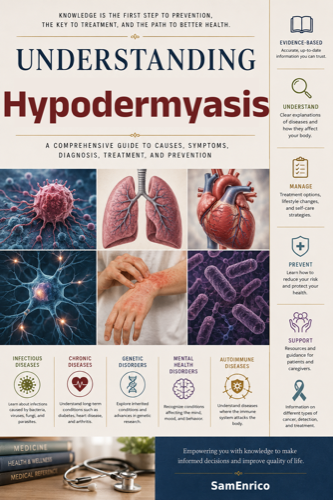
Understanding Hypodermyasis eBook
This disease publication, published by SamEnrico,
by Raley Naida
This disease publication, published by SamEnrico, covers Understanding Hypodermyasis
Formats
Free sample
Chapter 1: The Screaming Cow...–- The morning had started like any other on the rolling pastures of County Cork, Ireland, in the spring of 1972. Michael O’Sullivan, a third-generation dairy farmer, walked his herd toward the milking parlor, his boots sinking into the dew-soaked grass. Then, without warning, his best milk cow—a placid, heavy-hipped Friesian named Brigid—stopped dead. Her eyes rolled white. She let out a sound Michael had never heard in his forty years of farming: a high, keening shriek that cut through the mist like a siren.
Brigid threw her head back and bolted, crashing through a fence, running blindly into a stone wall, then spinning and running again. Within seconds, the entire herd was in chaos. Twelve animals stampeded in no particular direction, tails raised, eyes wild, as if the ground itself had become their enemy. Michael could only stand helplessly, watching his livelihood tear itself apart for no reason he could understand. The veterinarian arrived three hours later, after the cows had collapsed from exhaustion.
He walked among the trembling animals, saying nothing, until he knelt beside Brigid and parted the hair on her spine. There they were: two small, smooth swellings beneath the skin, each with a tiny, perfectly round hole at its center. As the vet watched, a small, pale object moved inside one of the holes. "Warble fly," he said quietly. "You have warble fly." Michael had never heard the name.
But he was about to learn that inside his cows—inside Brigid, right now, as she lay panting on the cold ground—something had been living, growing, and migrating for six months. And it was only just beginning to show itself.This is the hidden reality of hypodermyasis. It is a disease of unremarkable beginnings and extraordinary journeys. It is a disease in which the smallest of flies—an insect that lives for only five days and never eats a single meal—launches its offspring on a migration through the spine, the esophagus, and the flesh of living animals. It is a disease that has shaped the economics of cattle farming across the Northern Hemisphere, that has blinded humans, that has driven nations to spend millions on eradication, and that remains, in the twenty-first century, one of the most bizarre and misunderstood parasitic infestations known to medical science.
This book is the story of that disease. It is a story of biology, of horror, of triumph, and of the ongoing battle between a tiny fly and the global livestock industry. And it begins, as all good stories do, with a single, simple question: what exactly is hypodermyasis?Defining the Unseen Invader Hypodermyasis (pronounced hy-po-der-MY-uh-sis) is a specific type of myiasis—the technical term for the infestation of living tissue by the larvae of flies. More precisely, hypodermyasis refers exclusively to infestation by flies of the genus Hypoderma, commonly known as warble flies, heel flies, or cattle grubs. These are not your common houseflies or blowflies.
These are highly specialized parasites that have evolved over millions of years to complete their larval development inside the bodies of large mammals, particularly cattle, but also yaks, reindeer, goats, and, on rare and terrifying occasions, human beings.The name itself tells a story. "Hypo" comes from the Greek word for "under" or "beneath," and "derma" means "skin." Hypodermyasis is, quite literally, the condition of having something beneath the skin. And indeed, the most visible sign of the disease in livestock is the appearance of warbles—those smooth, raised swellings on the animal's back, each with a small breathing hole through which the mature larva draws air. But the name also conceals as much as it reveals. For the majority of the parasite's life inside its host, it is not beneath the skin at all.
It is much, much deeper.To understand hypodermyasis, one must first understand that it is not a single disease but a spectrum of conditions caused by several related species. The two most important are Hypoderma bovis, known as the northern cattle grub or the ox warble fly, and Hypoderma lineatum, the common cattle grub. These two species account for the vast majority of economic losses worldwide. But they are far from alone. Hypoderma sinense infests yaks across the high plateaus of China and Tibet.
Hypoderma tarandi, sometimes called the reindeer warble fly, is a scourge of Arctic herds, its larvae tunneling through the hides of caribou and reindeer from Scandinavia to Siberia. And then there are the outliers: Przhevalskiana silenus, a related but distinct genus, causes a similar condition in goats, though it is technically not hypodermyasis at all but a parallel evolutionary solution to the same ecological challenge. (We will return to this taxonomic distinction in Chapter 2, but for now, it is enough to know that when farmers speak of "goat warble fly infestation," they are describing a cousin of true hypodermyasis, not the disease itself.)The Economic Shadow Why should anyone care about a fly that infests cattle? The answer, in a word, is money. Hypodermyasis is one of the most economically damaging parasitic diseases of livestock in the temperate regions of the Northern Hemisphere.
The losses are staggering, though they are rarely tallied in a single ledger. Instead, they accumulate in small, invisible ways: a pound of milk lost here, a pound of weight gain lost there, a hide that cannot be sold for leather, a carcass condemned at slaughter.Consider the hide first. The warble—that breathing hole the mature larva cuts in the animal's back—leaves a permanent defect in the leather. A single warble can render a hide worthless for high-quality leather goods. In heavily infested herds, it is not uncommon for 10 to 20 holes to riddle a single animal's back.
Multiply that by millions of cattle slaughtered each year in North America and Europe, and the losses run into the tens of millions of dollars annually. During the height of hypodermyasis endemicity in the United Kingdom before eradication, the leather industry estimated that warble damage cost it £5 million per year—in 1970s currency, equivalent to more than £50 million today.Then there is milk production. Infested cattle are under constant physiological stress. Their immune systems are fighting a chronic parasitic infection. Their bodies are diverting nutrients to repair the tissue damage caused by migrating larvae.
The result is a measurable drop in milk yield. Studies from the 1960s and 1970s, when the disease was still widespread, consistently found that heavily infested cows produced 10 to 15 percent less milk than their uninfested herdmates. For a dairy farmer operating on thin margins, that difference can mean the difference between profit and bankruptcy.Weight gain in beef cattle suffers a similar fate. The larvae are not content to simply reside passively in their hosts. They migrate through muscle tissue, creating hemorrhagic tracts known colloquially as "butcher's jelly"—a gelatinous, blood-soaked path of destroyed muscle fibers that renders the surrounding meat unappetizing and often leads to whole carcasses being condemned at slaughter.
Even in animals that survive to market weight, the chronic inflammation caused by the migrating larvae reduces feed efficiency. Infested cattle require more food to gain the same amount of weight as their clean counterparts. In feedlot operations…
This is the end of the free sample. Get the eBook to keep going. Buy now
About this book
Details
- Author
- Raley Naida
- Publisher
- SamEnrico
- Language
- English
- Genre
- Non-Fiction, Informative, Educational
- Released
- 2026-06-02
- Pages (approx.)
- 155
- Available as
- eBook, Audiobook

Read better in the ZLOADR app
Your eBooks on your phone or tablet. Sign in with your SamEnrico account and start reading.
More by Raley Naida
 Strength Training Motivation GuideRaley Naida$11.99
 Weekly Review for MinimalistsRaley Naida$11.99
 Persona Mask Dreams WorkbookRaley Naida$11.99
 Swimmer's Shoulder FlexibilityRaley Naida$11.99
 The Great Coffee Blockade: How a Single Port Changed the WorldRaley Naida$11.99
 The Frozen Symphony: The Day Music Stopped in AntarcticaRaley Naida$11.99
 Independent Contractor Classification ManualRaley Naida$12.99
 AI Rare Disease Diagnosis GuideRaley Naida$12.99
 Spanish Project ManagerRaley Naida$11.99
 How to Start a Mowers for Agricultural Use Business (Beginners Guide)Raley Naida$11.99
You may also like
 Hong Kong Handover 1997Dunn Johnnie$11.99
 Zumba For Postnatal Recovery CourseNeal Christian$11.99
 Zumba for BeginnersLadner Nikia$11.99
 YouTube Comment Mining GuideHumes Pandora$12.99
 Worry Box MeditationCarlin Rudy$11.99
 Workplace Stress MeditationNguyen Lynn$11.99
 Workplace Stress and Sleep RepairHawley Ivory$11.99
 Workplace Perfectionism CureDelaney Jeffry$11.99
 Workplace Injustice Anger GuideWallen Isabelle$11.99
 Work Addiction and Burnout LinkGreenwood Ester$11.99
 Women in Yoga and WellnessBeattie Galina$11.99
 Women in Stand Up ComedyChun Evangeline$11.99