
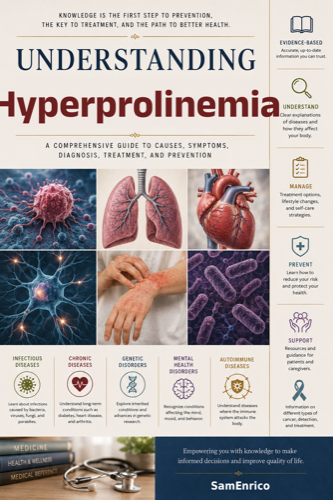
Non-FictionInformativeEducational
Understanding Hyperprolinemia eBook
This disease publication, published by SamEnrico,
This disease publication, published by SamEnrico, covers Understanding Hyperprolinemia
Formats
Free sample
Chapter 1: The Proline Puzzle...--–- The first time Elena Vega heard the word “proline,” she was sitting in a cramped hospital consultation room, holding a six-month-old baby who had stopped smiling. The fluorescent lights hummed overhead. Her son Mateo, once a chubby, cooing infant who tracked faces across the room, now lay still in her arms, his eyes unfocused, his limbs occasionally jerking in small, involuntary spasms. The neurologist—a kind but exhausted woman named Dr. Harris—had just finished walking through a battery of normal test results.
Normal EEG. Normal MRI. Normal hearing screen. Normal everything. “We’re calling it developmental delay of unknown etiology,” Dr.
Harris said, closing Mateo’s chart. “Sometimes these things just take time to declare themselves.”Elena nodded, but something in her chest refused to accept the verdict. She had been a pharmacist for twelve years. She knew the difference between “we don’t know yet” and “we’re not looking hard enough.” Over the next eighteen months, she would become intimately familiar with that difference. She would visit seven specialists in three states.
She would watch Mateo lose skills he had once mastered—first the smile, then the ability to sit unsupported, then the purposeful reach for toys. She would be told, at various points, that her son had atypical epilepsy, then infantile autism, then a possible mitochondrial disorder, then “anxiety” (at eighteen months old), and finally, by a physician who had spent exactly eleven minutes in the room, “probably nothing progressive—just watch and wait.”But Elena did not watch and wait. She read. She read medical textbooks. She read Pub Med abstracts at 2 AM while Mateo slept fitfully beside her.
She read patient forums for conditions she had never heard of: pyridoxine-dependent epilepsy, cerebral folate deficiency, succinic semialdehyde dehydrogenase deficiency. And then, one evening in the spring of 2023, she stumbled across a case report from a French metabolic center. The title was unassuming: “Late diagnosis of hyperprolinemia type II presenting as treatment-resistant seizures and developmental regression.” It described a three-year-old boy who had been labeled with refractory epilepsy, autism spectrum disorder, and global developmental delay. His proline levels, when finally measured, were seven times the upper limit of normal. A low-proline diet and high-dose vitamin B6 had, within six months, reduced his seizures by ninety percent and restored some lost developmental skills.Elena read the paper three times.
Then she requested Mateo’s old newborn screening results from the state health department. She had to pay a fifty-dollar records fee and wait two weeks. When the report finally arrived, she scanned it with the focus of a woman who had learned to read medical data the way a cryptographer reads code. And there it was: a small, unremarkable entry in the “other amino acids” section. Proline: 478 micromoles per liter.
Reference range: 50–180. Flagged with a single asterisk and the note: “Borderline elevation—no action indicated; repeat testing at physician’s discretion.”No action indicated. No action. Four hundred seventy-eight micromoles per liter of an amino acid that, when accumulated in the brain, can interfere with neurotransmitter function, alter osmotic balance, and induce oxidative stress. And the response from the system was a shrug.Elena printed the page, highlighted the number in yellow, and made an appointment with a metabolic geneticist at a university hospital two hundred miles away.
That appointment would change everything. But as she drove home that evening, Mateo asleep in his car seat, she thought about all the other families—the ones who didn’t have a background in pharmacology, who didn’t know how to search Pub Med, who trusted the words “probably nothing” and went home to watch their children fade by inches. She thought about the thousands of people, children and adults alike, who had been labeled with idiopathic epilepsy, treatment-resistant schizophrenia, or “developmental delay of unknown cause,” when the real explanation was sitting in their blood the whole time, waiting to be measured. She thought about proline.And she began to write.What This Chapter Will Do for You This chapter is the foundation upon which everything else in this book is built. If you are reading this because you or someone you love has been diagnosed with hyperprolinemia—or because you suspect that diagnosis has been missed—your first question is almost certainly the same one Elena had: What is this thing, and how did we get here?
The answer to that question requires us to start at the very beginning, not with complex biochemistry (though that will come), but with a simple framing of the problem.In this chapter, we will accomplish four critical goals:Define hyperprolinemia clearly and without jargon —then immediately explain why the definition alone is insufficient to understand the condition’s impact.Introduce the two types of hyperprolinemia (Type I and Type II) and explain why the distinction between them is the single most important fact for prognosis and treatment.Present the incidence data —how common is this condition, and why is the true number almost certainly higher than the published estimates?Establish the central metaphor of this book : that hyperprolinemia is not a single disease but a spectrum, and that understanding where a patient falls on that spectrum is the key to effective management.By the end of this chapter, you will have a clear, practical understanding of what hyperprolinemia is, why it has been overlooked for so long, and why the remainder of this book matters—not just for the rare families who have a diagnosis, but for the far larger population who have the condition and don’t yet know it.Defining the Unfamiliar: What Is Hyperprolinemia?Let us begin with the simplest possible definition. Hyperprolinemia (hyper-pro-lee-nee-mee-uh) is a metabolic condition characterized by abnormally high levels of the amino acid proline in the blood. The prefix hyper- means “above normal,” prolin- refers to the amino acid proline, and -emia means “in the blood.” Put together: too much proline circulating in the bloodstream.That definition is technically correct. It is also dangerously incomplete.To understand why, consider an analogy. If someone told you that a patient had “hyperglycemia,” you would know that they had too much glucose in their blood.
But you would not know whether they had transient reactive hypoglycemia (a benign, self-correcting condition), type 2 diabetes (a chronic but manageable condition), or type 1 diabetes (a life-threatening condition requiring immediate insulin therapy). The single fact of “high glucose” is insufficient to determine severity, treatment, or prognosis. The same is true for hyperprolinemia. The simple presence of elevated proline tells you very little. It is the type, the degree, and the clinical context that matter.Proline itself is not a toxin in the usual sense of the word.
It is one of the twenty standard amino acids that the human body uses to build proteins. Every time you eat a piece of chicken, a slice of cheese, or a serving of tofu, you are consuming proline. Every time your body repairs a torn ligament, heals a surgical incision, or produces a new antibody, it uses proline. In normal physiology, proline is a busy, helpful, indispensable worker.But like any essential substance, proline becomes dangerous when it exceeds the…
This is the end of the free sample. Get the eBook to keep going. Buy now
About this book
Details
- Author
- Archuleta Verlene
- Publisher
- SamEnrico
- Language
- English
- Genre
- Non-Fiction, Informative, Educational
- Released
- 2026-05-09
- Pages (approx.)
- 160
- Available as
- eBook, Audiobook

Read better in the ZLOADR app
Your eBooks on your phone or tablet. Sign in with your SamEnrico account and start reading.
More by Archuleta Verlene
 Public Speech Anger GuideArchuleta Verlene$11.99
 Codependents Anonymous Step GuideArchuleta Verlene$11.99
 Franchise Builder's Second ChanceArchuleta Verlene$11.99
 Time Blocking For Healthcare WorkersArchuleta Verlene$11.99
 Silent Protocol: The Sabotage of the Deep Sea CableArchuleta Verlene$11.99
 The Unseen Verdict: The Untold Story of Judge Ketanji Brown Jackson’s Path to the Supreme CourtArchuleta Verlene$11.99
 How to Start a Casting of Magnesium Products Business (Beginners Guide)Archuleta Verlene$11.99
 Grant Writer Freelance Business HandbookArchuleta Verlene$12.99
 Behavioral Analytics Fraud GuideArchuleta Verlene$12.99
 Clinical NurseArchuleta Verlene$11.99
You may also like
 Hong Kong Handover 1997Dunn Johnnie$11.99
 Zumba For Postnatal Recovery CourseNeal Christian$11.99
 Zumba for BeginnersLadner Nikia$11.99
 YouTube Comment Mining GuideHumes Pandora$12.99
 Worry Box MeditationCarlin Rudy$11.99
 Workplace Stress MeditationNguyen Lynn$11.99
 Workplace Stress and Sleep RepairHawley Ivory$11.99
 Workplace Perfectionism CureDelaney Jeffry$11.99
 Workplace Injustice Anger GuideWallen Isabelle$11.99
 Work Addiction and Burnout LinkGreenwood Ester$11.99
 Women in Yoga and WellnessBeattie Galina$11.99
 Women in Stand Up ComedyChun Evangeline$11.99