
Non-FictionInformativeEducational
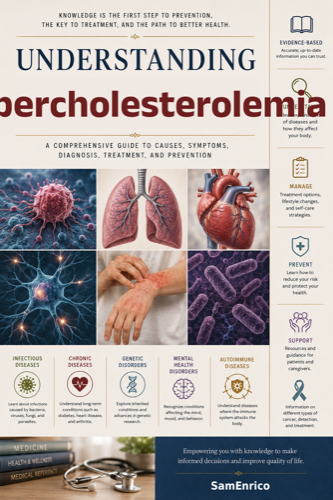
Understanding Hypercholesterolemia eBook
This disease publication, published by SamEnrico,
This disease publication, published by SamEnrico, covers Understanding Hypercholesterolemia
Formats
Free sample
Chapter 1: The Cholesterol Lie--– You have been told, probably by well-meaning doctors, nurses, and internet articles, that cholesterol is a waxy poison that clogs your arteries like bacon grease solidifying in a kitchen drainpipe. You have been told to fear eggs, avoid shrimp, and eliminate anything with a yellow tint. You have been told that the number on your lab report labeled “total cholesterol” is a verdict on your future health — high means doomed, low means safe. Almost none of that is true.Let that sink in for a moment. The foundational story you have heard about cholesterol is not just oversimplified; in many ways, it is flatly wrong.
And this misunderstanding is not harmless. It has created a generation of people who fear a molecule their own bodies cannot survive without, who avoid nutritious foods that have little effect on blood cholesterol, and who believe that a single number on a blood test tells them everything they need to know about their risk of a heart attack. This chapter will tear down that false story and rebuild it from the ground up.Before we can understand how to manage high cholesterol — the focus of this entire book — we must first understand what cholesterol actually is, why your body fights to maintain it, and why the relationship between the cholesterol you eat and the cholesterol in your blood is far more complicated than you have been told.The Molecule Your Life Depends On Cholesterol is a type of lipid, a fat-like substance that does not dissolve in water. Your blood is mostly water, so cholesterol cannot travel through it freely. Instead, your body packages cholesterol into lipoproteins — tiny spherical carriers that act like delivery trucks, transporting cholesterol and other fats to the cells that need them.
Every single day, your body produces somewhere between 800 and 1,500 milligrams of cholesterol, primarily in your liver but also in every cell that has a nucleus. To put that number in perspective, a single large egg contains about 180 milligrams of dietary cholesterol. Your liver produces in one day the equivalent of five to eight eggs’ worth of cholesterol, regardless of whether you eat eggs or not.Why would your body go to such metabolic expense to make a molecule that, according to popular belief, is trying to kill you? The answer is that cholesterol is not a toxin. It is a raw material so essential that evolution has preserved every mechanism needed to maintain its production even when you stop eating it entirely.Cholesterol serves at least four non-negotiable functions in your body.
The first is structural. Every cell in your body is surrounded by a membrane — a thin, flexible barrier that separates the inside of the cell from the outside world. That membrane is made mostly of fat molecules called phospholipids, but cholesterol is interspersed throughout, acting as a fluency regulator. Without cholesterol, cell membranes would become too rigid in cold temperatures and too leaky in warm temperatures. Cholesterol keeps membranes fluid and stable, allowing cells to change shape, divide, and communicate with neighboring cells.
Your brain, which is about 20 percent cholesterol by dry weight, is particularly dependent on this structural role.The second function is hormonal. Cholesterol is the backbone molecule from which every steroid hormone in your body is synthesized. Cortisol, the primary stress hormone that regulates metabolism and immune response, is made from cholesterol. Aldosterone, which controls blood pressure and fluid balance, is made from cholesterol. And the sex hormones — testosterone, estrogen, and progesterone — are all derived directly from cholesterol.
Without cholesterol, your body could not produce these essential signaling molecules. You would be unable to respond to stress, regulate your blood pressure, or reproduce.The third function is digestive. Your liver uses cholesterol to produce bile acids, which are released into your small intestine to help emulsify and absorb dietary fats, including fat-soluble vitamins A, D, E, and K. Without adequate cholesterol, fat digestion would be severely impaired, leading to deficiencies in these critical vitamins.The fourth function is solar. Cholesterol is the precursor molecule for vitamin D.
When ultraviolet B radiation from sunlight hits your skin, it converts a cholesterol derivative (7-dehydrocholesterol) into previtamin D3, which then isomerizes into active vitamin D. This is why people with extremely low cholesterol levels sometimes have difficulty maintaining adequate vitamin D status even with sun exposure.The point of this biochemical tour is simple: cholesterol is not your enemy. It is an indispensable molecule that your body produces continuously and defends tightly. If you never ate a single milligram of dietary cholesterol for the rest of your life, your liver would simply ramp up its own production to meet your body’s needs. The goal of managing hypercholesterolemia is not to eliminate cholesterol — that would kill you.
The goal is to balance where cholesterol goes and how much of it lingers in places where it can cause harm.Dietary Cholesterol Versus Blood Cholesterol Here is where the most damaging confusion has taken root. For decades, public health guidelines treated dietary cholesterol — the cholesterol you eat in foods like eggs, shrimp, and meat — as the primary driver of blood cholesterol levels. This assumption seemed logical: eat cholesterol, absorb cholesterol, and your blood cholesterol rises. But biological systems rarely operate on such simple input-output logic, and the cholesterol pathway is a perfect example of why.Your body has evolved a sophisticated feedback system to keep blood cholesterol within a relatively narrow range. When you eat dietary cholesterol, your intestine absorbs some of it, but your liver detects the incoming cholesterol and responds by reducing its own production.
For most people, this feedback loop works efficiently enough that dietary cholesterol has a weak, often clinically insignificant effect on blood cholesterol levels. A 2015 meta-analysis published in the American Journal of Clinical Nutrition reviewed 40 randomized controlled trials and found no significant association between dietary cholesterol intake and blood LDL cholesterol levels in the majority of study participants.But — and this is a crucial but — not everyone responds the same way. Approximately 25 percent of the population are what researchers call “hyper-responders.” In these individuals, the feedback mechanism is less effective. When they eat dietary cholesterol, their livers do not adequately down-regulate their own production, leading to a measurable increase in blood LDL cholesterol. For the other 75 percent, eggs, shrimp, and shellfish are not significant drivers of LDL levels.This variation explains why nutritional science has seemed contradictory on the topic of eggs.
One study finds that eggs raise cholesterol; another finds no effect. Both studies can be correct, depending on the genetic makeup of the participants. The mistake has been treating the population as uniform when it is not.What this means for you, the reader, is that you cannot know whether dietary cholesterol affects your blood levels without testing — ideally through a controlled experiment where you measure your LDL before and after a period of deliberate dietary cholesterol intake. Your doctor can help you design such a test. Alternatively, you can simply follow the guidance in Chapter 9, which distinguishes between the stricter TLC Diet (recommended for hyper-responders and those with established heart disease) and the more flexible Portfolio Diet (effective for most people regardless of responder…
This is the end of the free sample. Get the eBook to keep going. Buy now
About this book
Details
- Author
- Lemaster Johana
- Publisher
- SamEnrico
- Language
- English
- Genre
- Non-Fiction, Informative, Educational
- Released
- 2026-05-11
- Pages (approx.)
- 141
- Available as
- eBook, Audiobook

Read better in the ZLOADR app
Your eBooks on your phone or tablet. Sign in with your SamEnrico account and start reading.
More by Lemaster Johana
 The Tech MayorLemaster Johana$11.99
 Brand Ranking Distribution HealthLemaster Johana$11.99
 Financial Stress and Gratitude GuideLemaster Johana$11.99
 B2B Sales Scaling PlaybookLemaster Johana$11.99
 The Silk Road Reboot: How a 21st-Century Entrepreneur Revived an Ancient Trade EmpireLemaster Johana$11.99
 The Ghost of the G20: How a Lone Agent Infiltrated the World’s Most Secretive SummitLemaster Johana$11.99
 How to Become a Chief DispatcherLemaster Johana$11.99
 Telehealth Investment OutlookLemaster Johana$12.99
 Remote Tech Stack For Africans ManualLemaster Johana$12.99
 Olivenite MiningLemaster Johana$11.99
You may also like
 Hong Kong Handover 1997Dunn Johnnie$11.99
 Zumba For Postnatal Recovery CourseNeal Christian$11.99
 Zumba for BeginnersLadner Nikia$11.99
 YouTube Comment Mining GuideHumes Pandora$12.99
 Worry Box MeditationCarlin Rudy$11.99
 Workplace Stress MeditationNguyen Lynn$11.99
 Workplace Stress and Sleep RepairHawley Ivory$11.99
 Workplace Perfectionism CureDelaney Jeffry$11.99
 Workplace Injustice Anger GuideWallen Isabelle$11.99
 Work Addiction and Burnout LinkGreenwood Ester$11.99
 Women in Yoga and WellnessBeattie Galina$11.99
 Women in Stand Up ComedyChun Evangeline$11.99