
Non-FictionInformativeEducational
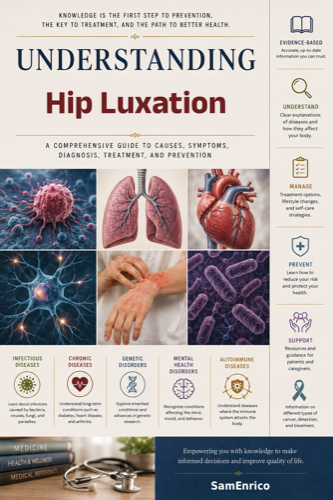
Understanding Hip Luxation
This disease publication, published by SamEnrico,
This disease publication, published by SamEnrico, covers Understanding Hip Luxation
Formats
About this book
Free sample
Chapter 1: The Architecture of Stability...–- The human hip is a marvel of evolutionary engineering, a joint designed to bear immense loads while allowing graceful movement. Yet, like any masterpiece of mechanical design, its very strength contains the seeds of a specific, devastating vulnerability. To understand hip luxation—the complete displacement of the femoral head from its acetabular home—one must first understand the exquisite architecture that makes this injury possible, and why a joint built for stability can, under the right circumstances, fail catastrophically.Every day, the average person takes between five thousand and ten thousand steps. With each step, the hip joint transmits forces equivalent to two to three times body weight through its articulating surfaces. During a brisk walk, this means a one hundred and fifty-pound person subjects their hip to nearly four hundred pounds of force per stride.
During a run, that force multiplies to five or six times body weight. During a a sudden fall or car accident, the forces can reach ten times body weight or more in a fraction of a second. The hip withstands these repeated, pounding forces not through brute strength alone, but through a sophisticated combination of bony architecture, ligamentous reinforcement, and neuromuscular control. Understanding how these systems work—and how they can fail—is the first step toward understanding dislocation.The Ball and Socket: Nature's Most Stable Joint Design The hip joint, clinically termed the acetabulofemoral joint, represents one of the body's most perfect examples of form following function. Unlike the shoulder, which sacrifices stability for an extraordinary range of motion, the hip prioritizes stability to support upright posture, weight transmission, and locomotion.
The femoral head—a nearly perfect sphere of dense cortical bone covered by a smooth layer of articular cartilage—sits within the acetabulum, a cup-shaped depression in the pelvic bone. This ball-and-socket configuration allows movement in three planes: flexion and extension (forward and backward motion), abduction and adduction (side-to-side motion), and internal and external rotation (twisting motion). Taken together, these movements constitute the hip's approximately one hundred twenty degrees of flexion, forty degrees of extension, forty-five degrees of…
This is the end of the free sample. Get the eBook to keep going. Buy now
Contents
- Chapter 1
- Chapter 2
- Chapter 3
- Chapter 4
- Chapter 5
- Chapter 6
- Chapter 7
- Chapter 8
- Chapter 9
- Chapter 10
- Chapter 11
- Chapter 12
Details
- Author
- Easley Marvis
- Publisher
- SamEnrico
- Language
- English
- Genre
- Non-Fiction, Informative, Educational
- Released
- 2026-05-08
- Pages (approx.)
- 156
- Available as
- eBook, Audiobook

Read better in the ZLOADR app
Your eBooks on your phone or tablet. Sign in with your SamEnrico account and start reading.
More by Easley Marvis
 Therapy For Obstetric FistulaEasley Marvis$11.99
 Last Mile Delivery Performance Based Routing CourseEasley Marvis$11.99
 Stimulant UTI PreventionEasley Marvis$11.99
 Psoriasis Body Image HealingEasley Marvis$11.99
 Tides of the Forgotten: The Last Voyage of the Mary CelesteEasley Marvis$11.99
 The Last Broadcast: The 1983 Soviet Nuclear Submarine DisasterEasley Marvis$11.99
 International ToS Compliance HandbookEasley Marvis$12.99
 Artificial Intelligence Agriculture 2026-2030Easley Marvis$12.99
 Financial Planning ConsultantEasley Marvis$11.99
 How to Become a Chin-strap CutterEasley Marvis$11.99
You may also like
 Hong Kong Handover 1997Dunn Johnnie$11.99
 Zumba For Postnatal Recovery CourseNeal Christian$11.99
 Zumba for BeginnersLadner Nikia$11.99
 YouTube Comment Mining GuideHumes Pandora$12.99
 Worry Box MeditationCarlin Rudy$11.99
 Workplace Stress MeditationNguyen Lynn$11.99
 Workplace Stress and Sleep RepairHawley Ivory$11.99
 Workplace Perfectionism CureDelaney Jeffry$11.99
 Workplace Injustice Anger GuideWallen Isabelle$11.99
 Work Addiction and Burnout LinkGreenwood Ester$11.99
 Women in Yoga and WellnessBeattie Galina$11.99
 Women in Stand Up ComedyChun Evangeline$11.99