
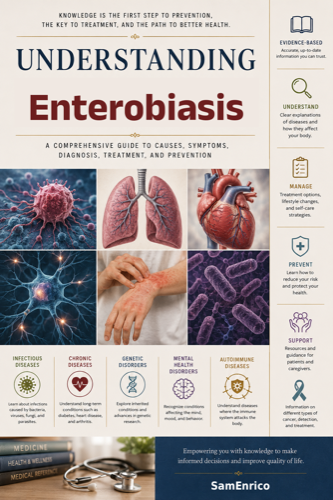
Non-FictionInformativeEducational
Understanding Enterobiasis eBook
This disease publication, published by SamEnrico,
This disease publication, published by SamEnrico, covers Understanding Enterobiasis
Formats
Free sample
Chapter 1: The Night Crawler...--– The first time four-year-old Mia’s mother saw a pinworm, it was 2:47 AM. The bedroom was dark except for the blue glow of a nightlight. Mia had been crying for the third night in a row, clawing at her pajama bottoms, screaming, “Itchy, itchy, Mommy!” Exhausted and out of ideas, her mother pulled down Mia’s underwear to apply more diaper cream—and froze. There, on the perianal skin, moving slowly across the pink, irritated flesh, was a tiny white thread. It was less than half an inch long, thin as a piece of sewing thread, but unmistakably alive.
As she watched, it disappeared back into the anal opening. She screamed. Her husband ran in. They spent the rest of the night on Google, cycling through disgust, fear, and finally recognition: pinworms. The next morning, the pediatrician’s office said, “Oh, that’s common.
Just get some over-the-counter medicine.” They did. Two weeks later, Mia was scratching again. And now her little brother was, too.This scene, or one very much like it, plays out in millions of homes every single night. By conservative estimates, Enterobius vermicularis—the human pinworm—infects over one billion people worldwide at any given time. In temperate climates, including North America and Europe, it is the most common helminth (parasitic worm) infection of humans.
In some communities, prevalence among school-aged children reaches 40% or higher. Yet despite its staggering frequency, enterobiasis occupies a strange, uncomfortable space in both medicine and popular culture. It is simultaneously everywhere and nowhere—ubiquitous but unmentionable, treatable but endlessly recurring, benign in mortality but devastating in its assault on sleep, dignity, and family peace.This chapter introduces you to the organism that causes this quiet epidemic. Not through the filtered lens of a textbook diagram, but as a living, adapting, evolutionarily brilliant creature that has perfected the art of living inside humans. To defeat an enemy, you must first understand it.
And Enterobius vermicularis is an enemy worth understanding—not because it is dangerous in the way of viruses or bacteria, but because it is so exquisitely tailored to exploit our daily habits, our family routines, and even our most private moments. The pinworm has been with us for as long as humans have lived in groups, and it is not going away on its own. This chapter gives you the biological intelligence you need to see it clearly, respect its capabilities, and ultimately, eliminate it from your life.The Taxonomy of a Tiny Terror Before we can understand how pinworms cause disease, we must understand what they are. Enterobius vermicularis (formerly Oxyuris vermicularis) belongs to the phylum Nematoda—the roundworms. This is a vast and ancient group of organisms, containing everything from the microscopic worms that live in soil to the foot-long Ascaris that can cause intestinal obstruction.
Within the nematodes, pinworms occupy the family Oxyuridae, a group characterized by a distinctive feature: the posterior end of the female is elongated into a sharp, pin-like point. This is not an accident of anatomy. That pointed tail, from which the common name “pinworm” derives, serves a specific function in the egg-laying process, as we will explore shortly.The adult female pinworm is a visible creature, measuring 8 to 13 millimeters in length. To visualize this: a grain of white rice is about 5 to 6 millimeters long. The female pinworm is roughly the size of two rice grains placed end to end.
Under magnification, she is translucent white, with a cuticle (the outer protective layer common to all nematodes) that is delicately striated. Her anterior end is equipped with small, wing-like expansions called cervical alae, which help her anchor to the intestinal mucosa. Her digestive system is simple: a mouth, a muscular esophagus with a prominent bulb (the esophageal bulb, a key identifying feature), an intestine, and an anus. Her reproductive system, however, is the dominant feature of her internal anatomy: two long, coiled ovaries and a uterus that, when gravid (egg-bearing), is packed with hundreds of eggs.The male pinworm is a different story. He is smaller, measuring only 2 to 5 millimeters.
His posterior end is curved ventrally (toward his belly), a feature that aids in copulation. Unlike the female, he possesses a single testis and a copulatory spicule. He is rarely seen in clinical practice—not because he is rare, but because he never migrates. The male lives out his entire life in the cecum (the pouch at the beginning of the large intestine) and the appendix, mating with females and then dying. His body is small enough and fragile enough that it is usually digested or passed in feces without notice.
The female, by contrast, must leave the safety of the intestine to accomplish her evolutionary purpose: depositing eggs where they can be transmitted to a new host.This sexual dimorphism—the physical difference between males and females—is extreme in pinworms. But it makes evolutionary sense. The male’s job is to mate, nothing more. The female’s job is to produce eggs and get them out. And in that difference lies everything we need to know about how this parasite causes disease.The Life Cycle: A Masterpiece of Parasitic Adaptation The life cycle of Enterobius vermicularis is a closed loop, exquisitely calibrated to maximize transmission while minimizing the worm’s exposure to the outside environment.
Unlike many parasites that require intermediate hosts (snails, insects, fish), pinworms have a direct life cycle: they go from human to human without any other animal or environmental stage. This is both a strength and a weakness. The strength: they are not dependent on the ecology of other species. The weakness: they must solve the problem of how to survive in the environment long enough to reach a new host.Step 1: Ingestion of the Egg The cycle begins when a human ingests an infective egg. The egg is the only stage in the life cycle that can survive outside the human body.
It is not the worm itself that is transmitted from person to person (except in rare, direct fecal-oral transfers); it is the microscopic egg, invisible to the naked eye, that travels from the perianal skin of an infected person to the mouth of a new host.The route of ingestion is almost always indirect: contaminated fingers (from scratching), contaminated fomites (bedding, clothing, toys, toilet seats), or—less commonly—inhaled eggs that are then swallowed. But the end result is the same: a hard-shelled, embryonated (containing a fully formed larva) egg passes through the mouth, down the esophagus, through the stomach (where the acidic environment does not harm it), and into the small intestine.Step 2: Hatching in the Small Intestine Once in the small intestine, the egg encounters a different environment: alkaline p H, bile salts, and digestive enzymes. These signals trigger the larva inside the egg to hatch. The larva, microscopic at this stage (about 150 micrometers long), emerges and immediately begins to feed. It molts (sheds its outer cuticle) twice over the next several days, growing larger with each molt.Step 3: Migration to the Cecum and Appendix The larvae do not stay in the small intestine.
They migrate downward, carried by peristalsis (the rhythmic contractions of the intestinal muscles), until they reach the cecum—the blind pouch…
This is the end of the free sample. Get the eBook to keep going. Buy now
About this book
Details
- Author
- Cobb Lorraine
- Publisher
- SamEnrico
- Language
- English
- Genre
- Non-Fiction, Informative, Educational
- Released
- 2026-05-09
- Pages (approx.)
- 159
- Available as
- eBook, Audiobook

Read better in the ZLOADR app
Your eBooks on your phone or tablet. Sign in with your SamEnrico account and start reading.
More by Cobb Lorraine
 Chunking for InnovationCobb Lorraine$11.99
 Remote Onboarding PlaybookCobb Lorraine$11.99
 The Anger Journaling ProtocolCobb Lorraine$11.99
 Student Support Network BuildingCobb Lorraine$11.99
 Money Scarcity Mindset CourseCobb Lorraine$11.99
 The Sapphire Serpent Heist: A Thief, a Legend, and a Vanishing CrownCobb Lorraine$11.99
 Icebound Secrets: The Scientists Who Solved Franklin's Arctic MysteryCobb Lorraine$11.99
 How to Start a Automobile Racing Team BusinessCobb Lorraine$11.99
 GlidingCobb Lorraine$11.99
 Redbubble AI Art Group BoardsCobb Lorraine$12.99
 Scrum for Slack StartupsCobb Lorraine$12.99
You may also like
 Hong Kong Handover 1997Dunn Johnnie$11.99
 Zumba For Postnatal Recovery CourseNeal Christian$11.99
 Zumba for BeginnersLadner Nikia$11.99
 YouTube Comment Mining GuideHumes Pandora$12.99
 Worry Box MeditationCarlin Rudy$11.99
 Workplace Stress MeditationNguyen Lynn$11.99
 Workplace Stress and Sleep RepairHawley Ivory$11.99
 Workplace Perfectionism CureDelaney Jeffry$11.99
 Workplace Injustice Anger GuideWallen Isabelle$11.99
 Work Addiction and Burnout LinkGreenwood Ester$11.99
 Women in Yoga and WellnessBeattie Galina$11.99
 Women in Stand Up ComedyChun Evangeline$11.99