
Non-FictionInformativeEducational
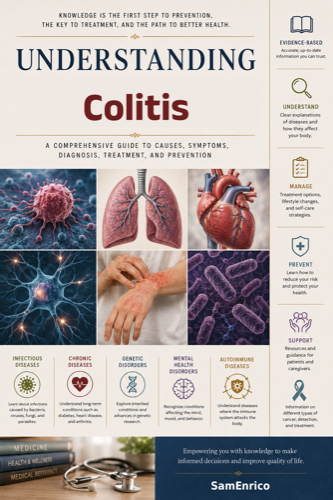
Understanding Colitis eBook
This disease publication, published by SamEnrico,
by Baylor Kevin
This disease publication, published by SamEnrico, covers Understanding Colitis
Formats
Free sample
Chapter 1: Beyond the Bathroom--– The first time you saw blood in your toilet bowl, you probably told yourself it was nothing. Hemorrhoids, maybe. A particularly tough bowel movement. Something you ate that would pass by morning. You wiped, flushed, and tried to forget.
But when it happened again the next day, and the day after that, and then turned into a week of urgent dashes to the bathroom with cramping that doubled you over, you knew—somewhere deep in your gut—that something was very wrong.You are not alone in this. Nearly 1.6 million Americans live with inflammatory bowel disease (IBD), and hundreds of thousands more will experience some form of colitis in their lifetime. But here is the problem that your doctor may not have explained clearly: "colitis" is not one disease. It is a description—like saying you have a "rash" or a "fever." Colitis simply means inflammation of the colon. That is it.
The word tells you where the problem is, but it tells you almost nothing about what is causing it, how long it will last, or what treatment will work.This chapter exists to fix that confusion. By the time you finish reading these pages, you will understand the critical difference between acute colitis (which often resolves on its own) and chronic colitis (which does not). You will know the four major types of chronic colitis—Ulcerative Colitis, Crohn's Disease, Microscopic Colitis, and Ischemic Colitis—and you will be able to match your symptoms, test results, and medical history to the condition that most likely affects you. You will learn why getting the precise diagnosis is not a matter of academic curiosity but the single most important step in your entire treatment journey. A patient with Ulcerative Colitis may be cured by surgery.
A patient with Crohn's Disease cannot. A patient with Microscopic Colitis may respond to a single medication. A patient with Ischemic Colitis needs to see a vascular specialist. The wrong diagnosis leads to months or years of ineffective treatment, unnecessary suffering, and preventable complications.Let us begin by deconstructing the word that has been causing so much confusion.What Colitis Actually Means The colon, also known as the large intestine, is a five-foot-long muscular tube that connects your small intestine to your rectum. Its primary jobs are absorbing water and electrolytes from digested food and compacting waste into formed stool.
The lining of the colon—a single layer of cells called epithelial cells—is remarkably thin, about the thickness of a single sheet of tissue paper. Under that lining lies the lamina propria, a layer of connective tissue rich in blood vessels and immune cells. Beneath that lies the submucosa (containing larger blood vessels and nerves), and finally the muscularis propria, the thick muscle layer that propels stool toward the rectum.Inflammation, or "itis," is the body's response to injury or infection. When your colon becomes inflamed, blood vessels dilate to bring more immune cells to the area, causing redness (erythema). Fluid leaks from those vessels, causing swelling (edema).
Immune cells release chemicals that kill invaders but also damage nearby tissue, leading to ulcerations (erosions in the lining). The result is a colon that is red, swollen, fragile (friable, meaning it bleeds easily), and unable to perform its normal functions.But here is the crucial point: many different things can cause that inflammation. Some are temporary and self-limited. Others are chronic and lifelong. Some require antibiotics.
Others require immunosuppression. Some are emergencies. Others can be managed at home. The word "colitis" does not tell you which category you fall into. You need more information.Acute Colitis: The Short-Term Visitor Acute colitis is inflammation that develops rapidly—usually over hours to days—and resolves completely when the underlying cause is treated.
Patients with acute colitis typically have a clear trigger: an infection, a medication, or a temporary reduction in blood flow. The symptoms can be severe, even terrifying, but the prognosis is excellent with appropriate treatment.The most common cause of acute colitis worldwide is infectious colitis. Bacteria such as Campylobacter, Salmonella, Shigella, E. coli O157:H7, and Yersinia can all cause bloody diarrhea, fever, abdominal pain, and urgency that mimics IBD perfectly. In fact, studies show that up to 30% of patients initially diagnosed with IBD based on symptoms alone turn out to have an infectious cause when stool testing is performed.
The good news is that most bacterial colitis resolves with supportive care (hydration, electrolyte replacement) or targeted antibiotics, though certain strains like E. coli O157:H7 should not be treated with antibiotics (which can increase the risk of hemolytic uremic syndrome, a dangerous kidney complication).Clostridioides difficile deserves special mention. This bacterium causes a particularly severe form of infectious colitis that most commonly affects patients who have recently taken antibiotics (which disrupt the normal gut microbiome, allowing C. diff to overgrow). C.
diff colitis causes profuse watery diarrhea—up to 15-20 times per day—with a distinctive foul odor that some patients describe as "horse stable" or "uniquely disgusting." Fever, abdominal pain, and elevated white blood cell count are common. Severe cases can progress to toxic megacolon (a life-threatening dilation of the colon requiring emergency surgery). The critical warning for readers is this: any patient with a suspected IBD flare who has recently taken antibiotics must be tested for C. diff before receiving steroids. Giving prednisone to a patient with undiagnosed C.
diff colitis suppresses the immune response to the bacteria, allowing the infection to spread unchecked, dramatically increasing the risk of toxic megacolon, perforation, and death. This is not a theoretical risk. It happens. Do not let it happen to you.Antibiotic-associated colitis without C. diff is also possible.
Some antibiotics, particularly amoxicillin-clavulanate, clindamycin, and the fluoroquinolones, can trigger inflammation directly or through microbiome disruption even in the absence of C. diff. This typically resolves within days to weeks of stopping the offending antibiotic.Ischemic colitis is a different category of acute colitis. It occurs when blood flow to a segment of the colon is temporarily reduced, usually due to a drop in blood pressure, dehydration, or a transient blockage in the mesenteric arteries. Ischemic colitis is most common in older adults (over 60) with vascular risk factors like hypertension, diabetes, atrial fibrillation, or known peripheral artery disease.
The hallmark symptom is sudden-onset, left-sided abdominal pain followed within 24 hours by bloody diarrhea. Unlike IBD, which tends to wax and wane, ischemic colitis typically resolves within a week with supportive care (IV fluids, bowel rest) as the blood supply returns. However, in severe cases where blood flow does not recover, the affected segment of colon can die (necrosis), requiring surgical resection. Any patient over 50 with sudden-onset bloody diarrhea and significant abdominal pain should have ischemic colitis on their differential diagnosis, along with infectious causes and IBD.Chronic Colitis: The Long-Term Resident Chronic colitis is defined as inflammation that persists for more than six weeks and follows a relapsing-remitting or progressive course. This is the category that includes the inflammatory bowel diseases (IBD): Ulcerative Colitis and Crohn's Disease, as well as Microscopic Colitis.
These conditions are not caused by infection (though infections can trigger flares in susceptible individuals) and do not resolve with…
This is the end of the free sample. Get the eBook to keep going. Buy now
About this book
Details
- Author
- Baylor Kevin
- Publisher
- SamEnrico
- Language
- English
- Genre
- Non-Fiction, Informative, Educational
- Released
- 2026-05-09
- Pages (approx.)
- 160
- Available as
- eBook, Audiobook

Read better in the ZLOADR app
Your eBooks on your phone or tablet. Sign in with your SamEnrico account and start reading.
More by Baylor Kevin
 Pinterest VA Tax Deduction TrackerBaylor Kevin$11.99
 Email Consolidation StrategyBaylor Kevin$11.99
 Body Image After Breast CancerBaylor Kevin$11.99
 Meditation for MS PainBaylor Kevin$11.99
 Conversation Starters for Comic ConBaylor Kevin$11.99
 Boudicca's Fire: The Celtic Queen Who Burned Rome's EmpireBaylor Kevin$11.99
 The Invisible Web: How a Cold War Scientist and a British Engineer Wired the WorldBaylor Kevin$11.99
 Investor Relations BlockingBaylor Kevin$12.99
 Cross Border Angel InvestmentBaylor Kevin$12.99
 Content SpecialistBaylor Kevin$11.99
 How to Start a Shortline Freight Railways Business (Beginners Guide)Baylor Kevin$11.99
You may also like
 Hong Kong Handover 1997Dunn Johnnie$11.99
 Zumba For Postnatal Recovery CourseNeal Christian$11.99
 Zumba for BeginnersLadner Nikia$11.99
 YouTube Comment Mining GuideHumes Pandora$12.99
 Worry Box MeditationCarlin Rudy$11.99
 Workplace Stress MeditationNguyen Lynn$11.99
 Workplace Stress and Sleep RepairHawley Ivory$11.99
 Workplace Perfectionism CureDelaney Jeffry$11.99
 Workplace Injustice Anger GuideWallen Isabelle$11.99
 Work Addiction and Burnout LinkGreenwood Ester$11.99
 Women in Yoga and WellnessBeattie Galina$11.99
 Women in Stand Up ComedyChun Evangeline$11.99