
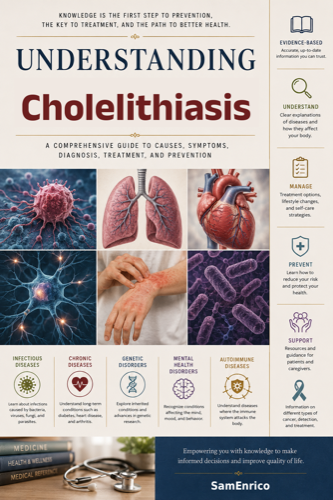
Non-FictionInformativeEducational
Understanding Cholelithiasis eBook
This disease publication, published by SamEnrico,
This disease publication, published by SamEnrico, covers Understanding Cholelithiasis
Formats
Free sample
Chapter 1: The Body’s Graveyard...--The first stone was found in an Egyptian woman who died three thousand years before the birth of Christ. She had been mummified, wrapped in linen, and placed in a tomb with her possessions—jewelry, combs, pottery—all the ordinary artifacts of a life lived along the Nile. But when archaeologists later examined her remains, they found something unexpected inside her abdominal cavity. A small, hard object, roughly the size of a marble, dark brown and faceted like a flawed gemstone. It was not an amulet placed there by priests.
It was not a ritual offering. It was a gallstone. And it had likely killed her.This discovery, made in the early twentieth century during systematic excavations of Egyptian burial sites, changed how medical historians thought about biliary disease. Gallstones were not a product of modern fast food, sedentary office work, or the processed diets of industrialized nations. They were not a punishment for eating too many hamburgers or sitting too long in front of a screen.
They were ancient. They were human. And they were waiting inside the bodies of millions of people alive today, many of whom will never know they carry them—until the pain begins.The woman from the Nile, whose name history has erased, was not alone. Further paleopathological studies have recovered gallstones from ancient Chinese mummies of the Han Dynasty, from pre-Columbian mummies in Chile and Peru, and from medieval skeletons across Europe. In each case, the stones were identical to those surgeons extract from patients in operating rooms every morning: cholesterol stones, pigment stones, large stones and small stones, solitary stones and stones packed like gravel into the gallbladder.
The disease is not modern, but its prevalence has exploded in the industrial era, and understanding why requires us to reexamine everything we think we know about diet, metabolism, and the silent accumulation of crystalline debris inside the human body.Chapter 1 of Understanding Cholelithiasis begins where all medical understanding should begin—with the patient. Not the textbook patient, not the idealized case study, but the real person who presents to an emergency department, urgent care clinic, or primary care office with a complaint that sounds, at first, like indigestion. The story of gallstone disease is the story of missed diagnosis, of pain dismissed as anxiety or gas, of months or years of suffering before someone finally orders the right ultrasound. It is also the story of a surgical revolution that transformed a major open operation into a same-day procedure. And it is, most fundamentally, the story of a small, pear-shaped organ that most people cannot locate on a diagram—until it tries to kill them.This chapter establishes the foundation for everything that follows.
We will trace the historical recognition of gallstones from ancient autopsies to modern epidemiological surveys. We will examine the global distribution of the disease, revealing stark differences between populations that challenge simple genetic explanations. We will deconstruct the outdated "4F" mnemonic—Fair, Fat, Female, Forty—and replace it with a nuanced, evidence-based model of risk that integrates sex hormones, pregnancy, obesity, metabolic syndrome, rapid weight loss, ethnicity, and medications. And we will conclude with a clear, practical takeaway for clinicians and patients alike: gallstone disease is a metabolic barometer of modern lifestyles, and risk assessment must be individualized beyond simple demographics.By the end of this chapter, you will understand not only who gets gallstones and why, but also how the medical community came to know what it knows—the centuries of dissection, the mistaken theories, the gradual accumulation of evidence that turned a mysterious abdominal ailment into one of the most common surgical conditions in the world. The journey from the Egyptian mummy to the modern operating room is long, but every step teaches us something about the human body, the food we eat, and the crystalline seeds that lie dormant in so many of us, waiting for a trigger that may never come.The Paleopathological Record: Stones in Ancient Bones The study of ancient disease, or paleopathology, relies on what remains after centuries of decomposition.
Soft tissue rarely survives. But gallstones, composed of cholesterol, bilirubin, calcium salts, and other relatively stable organic molecules, can endure for millennia under the right conditions. Mummification, whether natural (as in desert climates) or artificial (as in Egyptian practice), preserves gallstones intact. Archaeological excavations in Egypt, Peru, Chile, and China have recovered dozens of specimens, many still encased in the desiccated remains of their gallbladders.In 1924, the British anatomist G. Elliot Smith reported gallstones in several Egyptian mummies from the Twenty-first Dynasty (circa 1000 BCE).
The stones were analyzed chemically and found to be compositionally identical to modern cholesterol stones. This finding astonished the medical community at the time, which had largely assumed gallstones were a disease of civilization—of rich foods, sedentary lifestyles, and the eating habits of the European upper classes. If ancient Egyptians had gallstones, then the disease was not merely a consequence of modern decadence. It was something more fundamental to human biology.Subsequent studies confirmed and extended these findings. In 1975, a research team examining pre-Columbian mummies from the Atacama Desert in northern Chile found gallstones in individuals who lived more than a thousand years before the arrival of Columbus.
These populations consumed diets rich in maize, potatoes, and seafood—very different from the fat-heavy diets of modern Westerners. Yet the stones were there, nestled in the right upper quadrant of their preserved abdomens. Similarly, Chinese mummies from the Han Dynasty (206 BCE – 220 CE) have yielded gallstones, as have medieval remains from Europe, indicating that the disease has been present in diverse populations across multiple continents for at least three thousand years.What the paleopathological record cannot tell us is how many of these individuals suffered symptoms. Did the Egyptian woman with the marble-sized stone experience the classic pattern of postprandial right upper quadrant pain? Did she lie awake at night, unable to find a comfortable position, feeling a dull ache that radiated to her right shoulder?
Or did she die of something else entirely, her gallstone an incidental finding in an autopsy performed by modern scientists? We will never know. But the stones themselves testify to a simple truth: human beings have been making gallstones for as long as we have been human beings, and probably longer.The Global Epidemiology: Cholesterol vs. Pigment Not all gallstones are created equal. The modern understanding of cholelithiasis distinguishes three major types based on composition, etiology, and epidemiology: cholesterol stones, black pigment stones, and brown pigment stones.
The distribution of these stone types varies dramatically across populations, reflecting differences in diet, genetics, infectious disease burden, and environmental factors.Cholesterol Stones: The Western Epidemic Cholesterol stones account for 75–90% of gallstones in Western industrialized nations, including the United States, Canada, Western Europe, Australia, and New Zealand. They are composed primarily of cholesterol monohydrate crystals (>70% cholesterol by weight), often with varying admixtures of calcium salts, bilirubin, and bile acids. On gross examination, they are typically yellow-green, rounded or faceted, and often multiple. When cut open, they reveal a crystalline internal structure that reflects concentric layers of deposition over time.The prevalence of cholesterol gallstones in the United States is striking. According to…
This is the end of the free sample. Get the eBook to keep going. Buy now
About this book
Details
- Author
- Hillman Zetta
- Publisher
- SamEnrico
- Language
- English
- Genre
- Non-Fiction, Informative, Educational
- Released
- 2026-05-11
- Pages (approx.)
- 157
- Available as
- eBook, Audiobook

Read better in the ZLOADR app
Your eBooks on your phone or tablet. Sign in with your SamEnrico account and start reading.
More by Hillman Zetta
 Navigating Custody DisputesHillman Zetta$11.99
 Etsy Digital Planner Income Tax GuideHillman Zetta$11.99
 Segmentation Overlay HandbookHillman Zetta$11.99
 Sleep Memory Improvement PlanHillman Zetta$11.99
 Attention Residue Reduction ProtocolHillman Zetta$11.99
 The Olmec Skywatchers: Cosmic Origins in Ancient MesoamericaHillman Zetta$11.99
 The Algorithm King: How a Math Genius Built a $100B EmpireHillman Zetta$11.99
 Recovery Coach Board RoleHillman Zetta$12.99
 Internal Comms Style Guide GlobalHillman Zetta$12.99
 Lead Quality Assurance AnalystHillman Zetta$11.99
 Ultimate Handbook Guide to Philadelphia : (United States) Travel GuideHillman Zetta$11.99
You may also like
 Hong Kong Handover 1997Dunn Johnnie$11.99
 Zumba For Postnatal Recovery CourseNeal Christian$11.99
 Zumba for BeginnersLadner Nikia$11.99
 YouTube Comment Mining GuideHumes Pandora$12.99
 Worry Box MeditationCarlin Rudy$11.99
 Workplace Stress MeditationNguyen Lynn$11.99
 Workplace Stress and Sleep RepairHawley Ivory$11.99
 Workplace Perfectionism CureDelaney Jeffry$11.99
 Workplace Injustice Anger GuideWallen Isabelle$11.99
 Work Addiction and Burnout LinkGreenwood Ester$11.99
 Women in Yoga and WellnessBeattie Galina$11.99
 Women in Stand Up ComedyChun Evangeline$11.99