
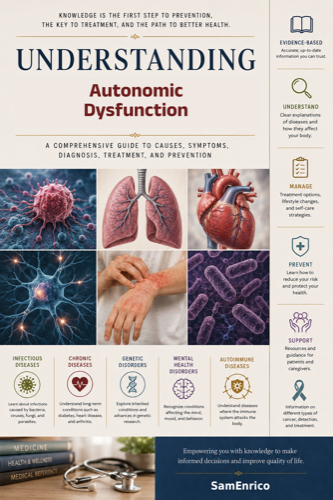
Understanding Autonomic Dysfunction eBook
This disease publication, published by SamEnrico,
This disease publication, published by SamEnrico, covers Understanding Autonomic Dysfunction
Formats
Free sample
Chapter 1: The Silent Conductor--–- Imagine for a moment that you are standing in a crowded orchestra hall. The lights dim, the audience hushes, and the conductor raises their baton. Without a single spoken word, that conductor signals the violins to begin, the cellos to follow, the brass to build, and the percussion to crash at precisely the right moment. You do not see the conductor’s commands, but you hear their effect in every note. Now imagine that conductor suddenly becomes erratic—sometimes too slow, sometimes too fast, sometimes signaling entirely the wrong section.
The music becomes chaos, not because the musicians are untalented, but because the invisible hand guiding them has lost its way.This is the closest analogy we have for the Autonomic Nervous System (ANS). It is the silent conductor of your body, an invisible network of nerves and signals that regulates everything you never have to think about: your heart rate, blood pressure, digestion, body temperature, sweating, pupil dilation, bladder function, and even sexual response. When it works correctly, you never notice it. When it fails, every system it conducts can fall into disarray. And yet, most people—including many physicians—have never been taught how to recognize when the conductor is out of rhythm.Understanding Autonomic Dysfunction begins here because you cannot fix what you cannot name, and you cannot name what you do not understand.
This chapter will introduce you to the silent conductor of your body, explain how its two main branches are supposed to work in harmony, and lay the groundwork for everything that follows in this book. Whether you are a patient searching for answers after years of unexplained symptoms, a caregiver trying to support a loved one, or a clinician hoping to better serve this underserved population, you must first understand the orchestra before you can diagnose why the music has gone wrong.The Autonomic Nervous System: Your Body’s Autopilot Let us begin with a deceptively simple question: What keeps your heart beating while you sleep? What tells your stomach to churn after a meal? What makes you sweat on a hot day without you deciding to do so? The answer is your autonomic nervous system, derived from the Greek word autonomos meaning “self-governing.” Unlike the somatic nervous system, which controls voluntary movements like raising your hand or walking across a room, the ANS operates below the level of conscious awareness.
You cannot will your heart to skip a beat, nor can you decide to stop digesting lunch. These processes happen automatically—or at least, they are supposed to.The ANS is not a single nerve but a vast, branching network that extends from your brainstem down through your spinal cord and out to every organ, gland, and blood vessel in your body. It is composed of millions of nerve fibers, some as thin as a spider’s silk, that carry electrical and chemical signals at remarkable speeds. To understand dysautonomia—the umbrella term for dysfunction of this system—you must first understand the two primary branches of the ANS and how they are meant to balance each other.The Two Conductors: Sympathetic and Parasympathetic Think of the ANS as having two opposing but complementary forces, much like the accelerator and brake pedal in a car. These forces are constantly active, never turning off entirely, but shifting their relative influence based on what your body needs at any given moment.The Sympathetic Nervous System (SNS) is often summarized as “fight or flight.” This is your body’s accelerator, the branch that prepares you for stress, danger, or physical exertion.
When the sympathetic system is activated, your heart rate increases, blood pressure rises, airways open wider to take in more oxygen, blood is shunted away from the digestive tract and toward large muscles, pupils dilate to let in more light, and sweat glands activate to cool the body. In a true emergency—a car swerving toward you, a sudden loud noise, a physical threat—the sympathetic system floods the body with norepinephrine and epinephrine (adrenaline), enabling rapid, life-saving action.The Parasympathetic Nervous System (PNS) is often summarized as “rest and digest.” This is your body’s brake, the branch that promotes calm, repair, and energy storage. Dominated by the vagus nerve (a name derived from the Latin word for “wandering,” as it meanders from the brainstem down through the chest and abdomen), the parasympathetic system slows the heart rate, lowers blood pressure, constricts the airways, directs blood flow to the digestive tract, stimulates salivation and digestion, and promotes bowel movements and bladder emptying. It is the system that allows you to sit quietly after a meal, feel relaxed, and recover.Neither branch is “good” or “bad.” You need both. You need your sympathetic system to get out of bed in the morning, to exercise, to respond to challenges.
You need your parasympathetic system to fall asleep, to digest food, to lower inflammation, and to heal from illness. Health exists in the balance between them.Autonomic Tone: The Baseline Rhythm One of the most important concepts in understanding dysautonomia is autonomic tone. Tone does not mean muscular tension here; rather, it refers to the baseline level of activity within each branch of the ANS. Even when you are completely at rest, both the sympathetic and parasympathetic systems are active, sending low-level signals to your organs. Your heart does not stop when you are relaxed; it simply beats more slowly because parasympathetic tone is dominant.
Your blood vessels do not fully dilate or constrict; they maintain a middle ground, ready to shift in either direction.Autonomic tone is like the idle speed of an engine. In a healthy person, the idle is steady and responsive. When you need to accelerate (sympathetic activation), the system responds quickly and appropriately. When the danger passes, the brake (parasympathetic) engages just as quickly, returning the engine to a calm idle. In dysautonomia, this idle becomes erratic.
The engine may race for no reason (sympathetic overactivity), or it may stall when you need to accelerate (sympathetic underactivity), or the brake may fail to engage when it should (parasympathetic dysfunction).This explains why dysautonomia produces such a wide array of seemingly unrelated symptoms. Because the ANS touches every organ system, a problem in the conductor creates chaos throughout the orchestra. The same underlying dysfunction can cause a racing heart in one moment, fainting in another, digestive distress hours later, and temperature intolerance the next day. This is not “in your head”; it is the predictable consequence of a system that has lost its ability to regulate.The Vagus Nerve: The Body’s Superhighway No discussion of the ANS would be complete without a closer look at the vagus nerve, the tenth cranial nerve and the primary highway of the parasympathetic system. The vagus is not just one nerve but a paired bundle of thousands of fibers that originate in the brainstem and travel down through the neck, chest, and abdomen, innervating the heart, lungs, esophagus, stomach, pancreas, liver, gallbladder, small intestine, and part of the large intestine.
It is the longest nerve in the autonomic nervous system and one of the most important.The vagus nerve carries two…
This is the end of the free sample. Get the eBook to keep going. Buy now
About this book
Details
- Author
- Best Leighann
- Publisher
- SamEnrico
- Language
- English
- Genre
- Non-Fiction, Informative, Educational
- Released
- 2026-05-25
- Pages (approx.)
- 158
- Available as
- eBook, Audiobook

Read better in the ZLOADR app
Your eBooks on your phone or tablet. Sign in with your SamEnrico account and start reading.
More by Best Leighann
 Violent Sibling ChildhoodBest Leighann$11.99
 The Negotiation Table MapBest Leighann$11.99
 Food Addiction Twelve Step GuideBest Leighann$11.99
 The Gambling Thought Log CourseBest Leighann$11.99
 Remote Social Anxiety GuideBest Leighann$11.99
 The Janitor Overdose SurvivorBest Leighann$11.99
 Pilates Mat Stretching Integration GuideBest Leighann$11.99
 Anticipatory Grief SuccessBest Leighann$11.99
 Hearst Harper's BazaarBest Leighann$11.99
 The Lion King’s Wisdom: The Royal Beasts of the Ancient African CourtBest Leighann$11.99
 The Great Pi Race: How a 17-Year-Old Beat the World’s Smartest MathematiciansBest Leighann$11.99
 The Celestial Compass: Ancient Khmer Astronomy and the Angkor Wat AlignmentBest Leighann$11.99