
Non-FictionInformativeEducational
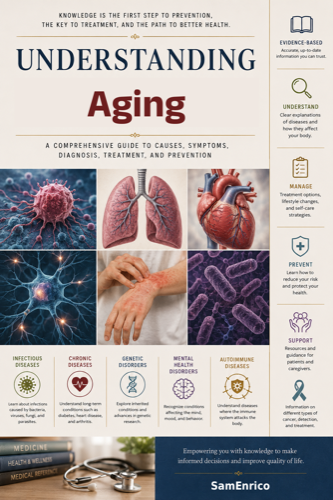
Understanding Aging eBook
This disease publication, published by SamEnrico,
by Grimm Estell
This disease publication, published by SamEnrico, covers Understanding Aging
Formats
Free sample
Chapter 1: The Silent Hijacker...–- Most people believe they will wake up one day, look in the mirror, and finally see an old person staring back. That is not how it happens. Aging does not announce itself with a knock on the door. It does not wait for a birthday, a retirement party, or a diagnosis. Instead, it slips into your biology like a silent hijacker—slowly, quietly, and without permission—long before any wrinkle appears or any joint creaks.Consider this: by the time you notice a decline in your physical endurance, your mitochondria—the tiny power plants inside every cell of your body—have already lost roughly forty percent of their efficiency.
By the time you struggle to remember a name that was once familiar, the connections between your neurons have already been shrinking for years. By the time you feel stiff getting out of a chair, your muscle fibers have already been replaced by fat and fibrous tissue, a process that began silently in your thirties. The visible signs of aging are not the beginning. They are the final stage of a long, invisible process—a process that this book will teach you to see, understand, and ultimately control.This is not another book about wrinkle creams, magical supplements, or the latest celebrity detox. This is a book about the biology of aging—what it actually is, why it happens, and most importantly, what you can do about it starting tonight.
For decades, the scientific community treated aging as an inevitable and untouchable fact of life, like gravity or the setting sun. The prevailing theory, known as the "wear and tear" model, suggested that our bodies simply break down over time like a clock running down or a car accumulating miles. According to this view, aging was not a medical condition; it was a natural process to be accepted, not treated.That view is wrong. And it is not just wrong—it is dangerously wrong, because it has delayed research, discouraged intervention, and convinced generations of people that decline is destiny.Over the past twenty years, a revolution has occurred in the field of geroscience, the study of aging. Scientists have discovered that aging is not a single, mysterious process but a collection of discrete, identifiable, and—this is the crucial part—modifiable biological mechanisms.
These mechanisms can be measured. They can be slowed. And in some cases, they can even be reversed. Leading gerontologists now argue that aging should be classified as a disease—or more accurately, a set of interlocking disease processes—that can be diagnosed, treated, and prevented. The World Health Organization added "aging-associated decline" to its International Classification of Diseases in 2019.
This was not a philosophical statement. It was a regulatory earthquake, one that opened the door for clinical trials targeting aging itself rather than individual age-related diseases like heart disease or Alzheimer's.This book is built on three foundational insights that will reshape everything you think you know about growing older.The first insight is the distinction between lifespan and healthspan. Lifespan is the total number of years you live. Healthspan is the number of years you live free from chronic disease and functional decline. For most of human history, these two numbers were nearly identical.
You lived, you remained relatively healthy, and then you died quickly. That is no longer true. Modern medicine has become extraordinarily good at extending lifespan without improving healthspan. We can keep a heart beating for years after the brain has deteriorated. We can surgically repair joints while the rest of the body declines.
We can manage blood pressure, cholesterol, and blood sugar with medications while the underlying aging process continues unabated. The result is a prolonged period of frailty, dependency, and suffering at the end of life that has become so normal that we barely question it. The average American now spends the last ten to fifteen years of life in declining health. This book rejects that outcome as unacceptable. The goal is not simply to live longer but to live better—to compress morbidity into the shortest possible period before a rapid, peaceful death.The second insight is that aging is not a mystery.
It is a set of specific, identifiable failures at the cellular and molecular level. Scientists have identified nine distinct hallmarks of aging, which we will explore in depth in Chapter 2. These include genomic instability (damage to your DNA), telomere attrition (shortening of the protective caps on your chromosomes), epigenetic alterations (errors in the software that reads your genes), loss of proteostasis (accumulation of misfolded and damaged proteins), mitochondrial dysfunction (failure of your cellular power plants), cellular senescence (the accumulation of "zombie cells" that poison their neighbors), stem cell exhaustion (depletion of your body's repair crews), and altered intercellular communication (inflammatory signaling gone haywire). Each of these hallmarks is a specific problem with a specific set of causes and—crucially—specific interventions that can slow or reverse it. None of them are inevitable.
All of them are influenced by how you live.The third insight is the most empowering and the most radical: your biological age is not the same as your chronological age, and you have far more control over it than you have been led to believe. Chronological age is simply the number of times you have traveled around the sun. Biological age is a measure of how well your cells, tissues, and organs are functioning relative to your chronological peers. Two people who are both sixty years old can have vastly different biological ages. One may have the cellular health of a forty-five-year-old, while the other has the decline of a seventy-five-year-old.
These differences are not purely genetic. In fact, twin studies have shown that only about twenty to thirty percent of the variation in human lifespan is explained by genetics. The remaining seventy to eighty percent is determined by environment, lifestyle, and chance. In other words, the vast majority of how you age is not written in your DNA. It is written in how you live, what you eat, how you move, how you sleep, who you surround yourself with, and how you respond to stress.This is not wishful thinking.
This is the conclusion of decades of research, replicated across multiple species and increasingly confirmed in human studies. Caloric restriction extends lifespan in every species in which it has been tested, from yeast to worms to flies to mice to rats to primates, and the evidence in humans is mounting. Exercise improves mitochondrial function, reduces inflammation, and protects telomeres in ways that reverse biological age. Certain dietary compounds—polyphenols, spermidine, NAD+ precursors—activate cellular repair pathways that were previously thought to decline inexorably with age. Emerging drugs like metformin and rapamycin, when used carefully and under medical supervision, appear to mimic the effects of caloric restriction and extend healthspan.
And perhaps most excitingly, senolytic drugs that clear the accumulation of "zombie cells" have reversed cataracts, kidney disease, and frailty in animal studies—and are now in human trials.Do not misunderstand. This book is not selling immortality. It is not promising that you will live to two hundred years old or that you will never experience the loss of…
This is the end of the free sample. Get the eBook to keep going. Buy now
About this book
Details
- Author
- Grimm Estell
- Publisher
- SamEnrico
- Language
- English
- Genre
- Non-Fiction, Informative, Educational
- Released
- 2026-05-11
- Pages (approx.)
- 140
- Available as
- eBook, Audiobook

Read better in the ZLOADR app
Your eBooks on your phone or tablet. Sign in with your SamEnrico account and start reading.
More by Grimm Estell
 Music Therapy for Road RageGrimm Estell$11.99
 The Software UX Creativity GuideGrimm Estell$11.99
 Cost Segregation Study BenefitsGrimm Estell$11.99
 Tongue Scraping GuideGrimm Estell$11.99
 Caregiver Medical AdvocacyGrimm Estell$11.99
 The Stress Cold Sore LinkGrimm Estell$11.99
 Metta for a StepchildGrimm Estell$11.99
 Green Beret HALOGrimm Estell$11.99
 Color Coded Calendar SystemGrimm Estell$11.99
 The Silent Sands: Bedouin Secrets of the Great Southern OceanGrimm Estell$11.99
 The Royal Navigators of the Indian Ocean: The Swahili Sultanates' Maritime EmpireGrimm Estell$11.99
 Operation Midnight Climax: The CIA’s Secret LSD Love HotelGrimm Estell$11.99
You may also like
 Hong Kong Handover 1997Dunn Johnnie$11.99
 Zumba For Postnatal Recovery CourseNeal Christian$11.99
 Zumba for BeginnersLadner Nikia$11.99
 YouTube Comment Mining GuideHumes Pandora$12.99
 Worry Box MeditationCarlin Rudy$11.99
 Workplace Stress MeditationNguyen Lynn$11.99
 Workplace Stress and Sleep RepairHawley Ivory$11.99
 Workplace Perfectionism CureDelaney Jeffry$11.99
 Workplace Injustice Anger GuideWallen Isabelle$11.99
 Work Addiction and Burnout LinkGreenwood Ester$11.99
 Women in Yoga and WellnessBeattie Galina$11.99
 Women in Stand Up ComedyChun Evangeline$11.99