
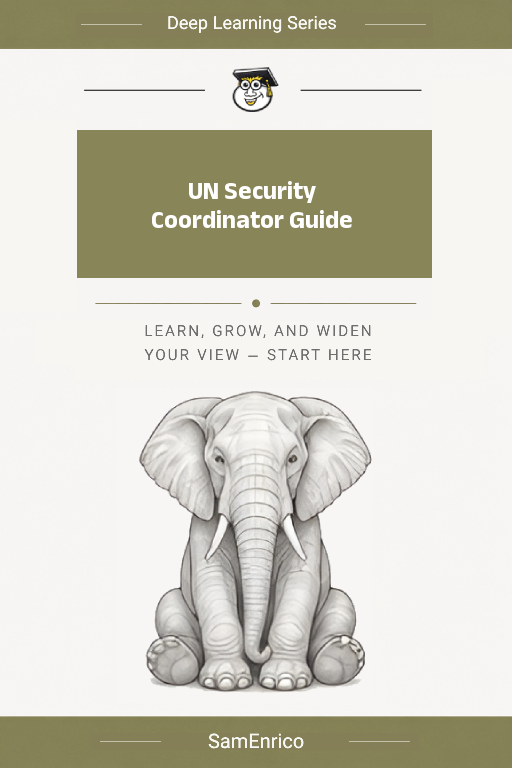
Non-FictionNon-Obvious CareerSecurity
UN Security Coordinator Guide eBook
Become UN security professional including risk ass
by Mullen Eddy
Become UN security professional including risk assessment, close protection, and crisis management.
Formats
Free sample
Chapter 1: Beyond the Blue Beret--The first time someone asks you what you do, and you say "UN Security Coordinator," watch their face. Nine times out of ten, they will nod slowly and imagine a soldier in blue body armor standing behind a concrete barrier. They will picture checkpoints, machine guns, and the kind of security that says "stay out."They will be wrong about everything.The tenth person—the one who has worked in a refugee camp or survived a natural disaster or negotiated access with a warlord—will nod differently. That person knows that the real work of UN security is not about keeping people out. It is about keeping the mission going.
It is about enabling a vaccination campaign to reach a village that three different armed groups claim as their territory. It is about getting a food convoy through a checkpoint where the commander hasn't been paid in four months. It is about making sure that when a humanitarian worker needs to cross a front line, they do so with their life intact and their dignity uncompromised.This chapter is about understanding what that job actually is. Because until you understand the fundamental difference between military force protection, private sector asset protection, and UN mission enablement, you will make decisions that get people killed or—almost as bad—decisions that stop the UN from doing what it came to do.The Three Worlds of Security Before you can be a UN Security Coordinator, you need to understand that you are entering a profession that borrows from three different traditions, follows none of them perfectly, and creates something entirely new from the friction between them.The first tradition is military force protection. In a military context, security means destroying or deterring the enemy.
The battlefield is binary: there is us and there is them. When a military convoy takes fire, the response is to suppress the source of that fire. The goal is to make the enemy incapable of attacking again. This is clear, it is effective within its domain, and it is almost completely irrelevant to UN security because the UN does not have enemies in the military sense. The UN has spoilers, criminals, armed groups, and hostile actors—but it does not have a declared enemy with a flag and a chain of command.
More importantly, the UN cannot simply destroy threats. It operates under host nation consent and international law that prioritize civilian protection and political solutions. The military mindset, applied uncritically to UN operations, leads to escalation, loss of acceptance, and mission failure.The second tradition is private sector asset protection. In a corporate context, security means preventing theft, vandalism, and unauthorized access. The asset is valuable.
The guard is there to protect it. This is straightforward and it works for banks, factories, and office buildings. But the UN is not protecting assets. It is protecting people who are delivering services to other people. When a private security guard stops someone at a gate, the message is "you do not belong here." When a UN security officer stops someone at a gate, the message must be more nuanced: "we need to verify your purpose here because we have a responsibility to the people inside, but we also have a responsibility to the people outside who need our help." The private sector mindset, applied uncritically, turns UN compounds into fortresses that defeat the mission's purpose.The third tradition is humanitarian access and acceptance.
This is the tradition that UN security draws from most heavily, but it is also the least codified. Humanitarian security is about relationships. It is about being known, being trusted, and being useful. It is about the village elder who tells you which road is mined because you treated his daughter's malaria last year. It is about the armed group that lets your convoy pass because you have never taken sides.
This tradition has no manual and no training course that can fully replace field experience. But it is the tradition that separates effective UN security coordinators from those who simply enforce rules from behind a desk.The UN Security Coordinator sits at the intersection of these three traditions, fluent in all of them but loyal to none. You will need the military professional's understanding of tactics and threat assessment. You will need the private sector professional's understanding of standards and compliance. And you will need the humanitarian professional's understanding of relationships and acceptance.
But you will be none of these things. You will be something else entirely.The Three Pillars of Decision-Making Every security decision you make as a UN Coordinator will be evaluated against three competing priorities. The official documents call these "Programme Criticality, Duty of Care, and Host Nation Consent." But those terms are abstract until you see them in action.Programme Criticality is the reason the UN exists in any given location. It is the mission. It is the vaccination campaign that will prevent a measles outbreak.
It is the food distribution that will keep a displaced family alive for another month. It is the protection monitoring that will document human rights violations. Programme criticality is not everything the UN does. It is the subset of activities that justify the risk of being there at all. As a Security Coordinator, you need to know what is truly programme-critical and what is merely desirable.
The difference is not always obvious from the budget lines.A concrete example: In a conflict zone, a polio vaccination campaign is almost always programme-critical. Polio is eradicable. The window for vaccination is narrow. If you do not reach every child in the critical age range, the virus persists and the entire global eradication effort is set back. On the other hand, a mid-level management retreat to discuss strategic planning is almost never programme-critical.
It can be postponed, conducted remotely, or canceled entirely without affecting the mission's core purpose. The Security Coordinator who treats both activities as equally worthy of risk acceptance has failed to do their job.Duty of Care is the legal and moral obligation to keep staff safe. This is not negotiable. It applies equally to international and national staff, though the practical realities of evacuation and relocation create uncomfortable distinctions that we will address in Chapter 9. Duty of care means that you cannot knowingly send staff into situations where the risk of death or serious injury exceeds what is reasonable.
But it also means that you cannot simply say "no" to every risky activity. The UN operates in places where risk is the default state. Saying "no" is easy. Saying "yes, with these mitigations, and here is what we do if things go wrong" is the job.The tension between Programme Criticality and Duty of Care is the central dilemma of UN security. Too much weight on Programme Criticality and you send people into situations that will get them killed.
Too much weight on Duty of Care and you never do anything that matters. The Coordinator's job is not to resolve this tension—it cannot be resolved—but to manage it transparently and with full awareness of the tradeoffs.Host Nation Consent is the third pillar, and it is the one that newcomers to…
This is the end of the free sample. Get the eBook to keep going. Buy now
About this book
Details
- Author
- Mullen Eddy
- Publisher
- SamEnrico
- Language
- English
- Genre
- Non-Fiction, Non-Obvious Career, Security
- Released
- 2026-05-29
- Pages (approx.)
- 125
- Available as
- eBook, Audiobook

Read better in the ZLOADR app
Your eBooks on your phone or tablet. Sign in with your SamEnrico account and start reading.
More by Mullen Eddy
 Peak End Rule PersuasionMullen Eddy$11.99
 Opioid Dependency Goal Setting For Recovery GuideMullen Eddy$11.99
 Gardening Digging StrengthMullen Eddy$11.99
 Loving Kindness for Suicide Prevention LinesMullen Eddy$11.99
 Upwork Freelance Success GuideMullen Eddy$11.99
 Stress and Dizziness OrthostaticMullen Eddy$11.99
 Middle Passage French AbolitionMullen Eddy$11.99
 Overdose Loss of SpouseMullen Eddy$11.99
 The Silent Roar: How 18th-Century Asian Stadiums Shaped the World’s First Global SportMullen Eddy$11.99
 The Maori Warriors of the Gridiron: New Zealand's Ancient Football LegacyMullen Eddy$11.99
 A Collector's Handbook to the Morris 1.8Mullen Eddy$11.99
 How to Produce Welding AccessoriesMullen Eddy$11.99
You may also like
 Hong Kong Handover 1997Dunn Johnnie$11.99
 Zumba For Postnatal Recovery CourseNeal Christian$11.99
 Zumba for BeginnersLadner Nikia$11.99
 YouTube Comment Mining GuideHumes Pandora$12.99
 Worry Box MeditationCarlin Rudy$11.99
 Workplace Stress MeditationNguyen Lynn$11.99
 Workplace Stress and Sleep RepairHawley Ivory$11.99
 Workplace Perfectionism CureDelaney Jeffry$11.99
 Workplace Injustice Anger GuideWallen Isabelle$11.99
 Work Addiction and Burnout LinkGreenwood Ester$11.99
 Women in Yoga and WellnessBeattie Galina$11.99
 Women in Stand Up ComedyChun Evangeline$11.99