
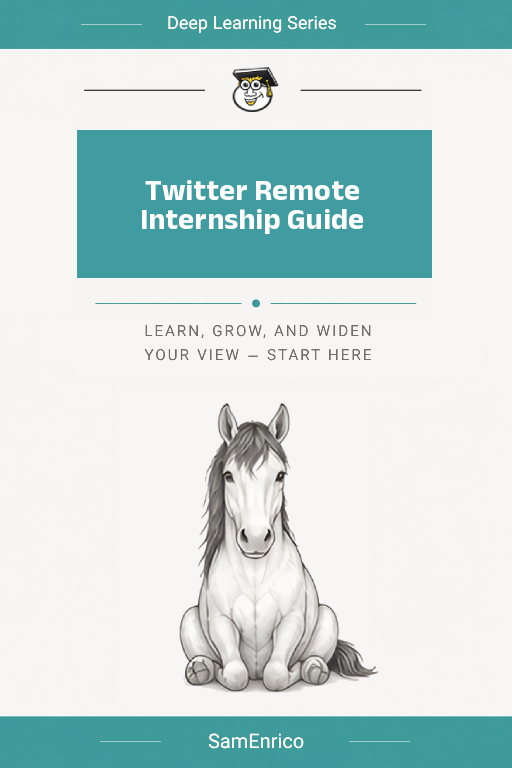
Non-FictionStudent's ShortcutSocial
Twitter Remote Internship Guide eBook
Secure remote internships at Twitter (X) in engine
Secure remote internships at Twitter (X) in engineering, product, or data science teams.
Formats
Free sample
Chapter 1: The 1,500-to-Zero Game--–- The notification arrives at 9:02 AM on a Tuesday. “New application submitted for Remote Software Engineering Intern (Summer).” By 9:05 AM, eleven more. By 10:00 AM, the counter hits 412. By lunchtime, it crosses 1,200. At the two-hour mark, when the first human recruiter finally opens the portal, there are 1,573 applications waiting.
They will spend an average of six seconds scanning each resume before deciding “yes,” “no,” or “maybe.” Six seconds. That is less time than it takes to read this sentence aloud twice. Do the math: 1,573 resumes multiplied by six seconds equals 9,438 seconds, or just over two and a half hours of non-stop screening. No recruiter on earth has two and a half consecutive hours for a single internship posting. They have thirty minutes, maybe forty-five, squeezed between back-to-back meetings.
So they filter. They sort by “relevance score” generated by an algorithm that has never written a line of code. They search for keywords like “Stanford” or “Google” or “Ph D.” They click “reject all” on the bottom 80% without ever opening a single file. Your resume, which you spent twelve hours polishing, which you asked three mentors to review, which you formatted to fit perfectly on one page—your resume just went to /dev/null. It was deleted before a human saw it.
Welcome to the 1,500-to-Zero Game. The rules are simple: you are competing against more than a thousand other candidates for a single remote internship at X (formerly Twitter). Most of them are qualified. Many of them have impressive credentials. A handful will win.
The rest will never know why they lost. This chapter exists to make sure you are not one of them. It will show you, with data, case studies, and hard truths, why the traditional application process is designed to reject you. More importantly, it will introduce the alternative: a method that bypasses the resume black hole entirely, turning your public work into your most powerful application asset. By the end of this chapter, you will understand why “apply and pray” has a 0% success rate for competitive remote roles—and what to do instead.The Anatomy of a Black Hole Let us name the beast.
Every major technology company, including X, uses an Applicant Tracking System (ATS). This is software that ingests, parses, and filters resumes before any human sees them. The ATS is not malicious. It is simply overwhelmed. In 2023, X received over 200,000 applications for fewer than 800 internship positions across all departments.
For remote roles specifically, the ratio was even worse: approximately 1,800 applicants per position. These numbers are not secrets. They are published in aggregate form in annual diversity reports and tech industry surveys. What the reports do not tell you is what happens inside the first two hours of a posting going live. Based on anonymized data shared by former X recruiters in industry forums and confirmed by platform analytics, here is the typical breakdown:First 15 minutes: 300–400 applications.
Mostly automated bots, referral links shared in Discord servers, and applicants using auto-fill browser extensions.15–60 minutes: Another 600–800 applications. The “early birds” who have saved searches and notification alerts set up.1–2 hours: 200–300 additional applications. The “just woke up” crowd and international applicants in later time zones.After 2 hours: Applications slow to a trickle, but the damage is done. The recruiter now faces a queue of 1,500+ candidates.At this point, the ATS applies a series of filters. The exact algorithm varies by company and is considered a trade secret, but former X engineers have confirmed common factors: keyword matching (does your resume contain “X API,” “real-time systems,” “distributed computing”), degree requirements (Bachelor’s minimum, Master’s preferred), and years of experience (even for internships, “prior internship” is often a hidden filter).
Each filter cuts the pool by 50–70%. After three filters, less than 10% of original applications remain. That is 150 candidates. A human recruiter now scans those 150 resumes for an average of six seconds each. They are looking for a “hook”: a brand-name previous employer, a prestigious university, a Git Hub link with green squares, a specific project that matches an open team’s needs.
If you do not have a hook, you are rejected. If you have a hook but it is poorly presented, you are rejected. If you have a hook but someone else has a shinier hook, you are rejected. This is not a conspiracy. It is simple supply and demand.
When you have 1,500 people applying for 10 interview slots, you can afford to reject qualified people. You can afford to be lazy. You can afford to miss diamonds in the rough. And the system does, every single day.The data scientist who taught herself Python at a community college? Rejected because her resume said “Associate’s Degree” instead of “Bachelor’s.” The product manager who launched a viral feature at a startup no one has heard of?
Rejected because the ATS did not recognize the company name. The engineer who built a Twitter clone as a passion project but listed it under “Projects” instead of “Experience”? Rejected because the keyword filter prioritized “work” over “personal.” These are not hypotheticals. They are documented cases from public forums like Blind, Reddit’s r/cscareerquestions, and Linked In posts from recruiters who admitted the system’s flaws. One former X recruiter wrote, “I probably rejected at least 50 people who would have been great hires because their resumes didn’t survive the automated screen.
I knew it was happening. I couldn’t stop it. There just wasn’t enough time.”The Magnetism Method: A Different Physics If the traditional method is “push” (you push your resume into the void), the alternative is “pull” (you pull opportunities toward you by becoming visible). This book calls it the Magnetism Method. The principle is simple: instead of competing in the 1,500-to-zero game, you change the game entirely.
You stop applying to jobs and start attracting offers. How? By building public, shareable, undeniable proof of your skills. By making it easier for a recruiter to find you than to ignore you. By turning your application from a one-page PDF into a living, breathing portfolio that does your talking for you.
The Magnetism Method has three pillars, which will be explored in depth throughout this book:Visibility: You cannot be hired if you cannot be found. This means optimizing your digital presence—Git Hub, Linked In, X—so that recruiters searching for “X intern” or “Twitter API developer” see you before they see anyone else. (See Chapter 3 for the technical audit.)Value: You cannot attract opportunities if you only take. This means contributing to the community—sharing code, writing insights, fixing small bugs in public repositories, answering questions on X—before you ever ask for anything. (See Chapter 6 for the DM strategy and Chapter 4 for the 30-day building challenge.)Proof: You cannot claim skills you have not demonstrated.
This means building projects that are impossible to ignore—real-time dashboards, data analyses, product requirement documents—and showcasing them so well that recruiters feel compelled to reach out. (See Chapter 7 for the three portfolio blueprints.)The Magnetism Method is not faster than applying online. In fact, it requires more upfront effort. But it is dramatically more effective. While the traditional applicant spends 12 hours tailoring a resume and…
This is the end of the free sample. Get the eBook to keep going. Buy now
About this book
Details
- Author
- Hutchison Reginia
- Publisher
- SamEnrico
- Language
- English
- Genre
- Non-Fiction, Student's Shortcut, Social
- Released
- 2026-06-01
- Pages (approx.)
- 135
- Available as
- eBook, Audiobook

Read better in the ZLOADR app
Your eBooks on your phone or tablet. Sign in with your SamEnrico account and start reading.
More by Hutchison Reginia
 Real Estate Precedent CompilationHutchison Reginia$11.99
 Binge Eating and Skin Picking LinkHutchison Reginia$11.99
 Western Front Literature GuideHutchison Reginia$11.99
 Positive Mood InfluenceHutchison Reginia$11.99
 Sales Tax FreedomHutchison Reginia$11.99
 Caffeine BipolarHutchison Reginia$11.99
 Iceberg Navigation PrecautionsHutchison Reginia$11.99
 The Blood Covenant: Colombia's Forgotten Cult of the New DawnHutchison Reginia$11.99
 The Tower of the Moonlit FoxesHutchison Reginia$11.99
 Service Providers Guide to Firewood DeliveryHutchison Reginia$11.99
 How to Become a Strickler AttendantHutchison Reginia$11.99
 Nordic Swan Export CertificationHutchison Reginia$12.99
You may also like
 Hong Kong Handover 1997Dunn Johnnie$11.99
 Zumba For Postnatal Recovery CourseNeal Christian$11.99
 Zumba for BeginnersLadner Nikia$11.99
 YouTube Comment Mining GuideHumes Pandora$12.99
 Worry Box MeditationCarlin Rudy$11.99
 Workplace Stress MeditationNguyen Lynn$11.99
 Workplace Stress and Sleep RepairHawley Ivory$11.99
 Workplace Perfectionism CureDelaney Jeffry$11.99
 Workplace Injustice Anger GuideWallen Isabelle$11.99
 Work Addiction and Burnout LinkGreenwood Ester$11.99
 Women in Yoga and WellnessBeattie Galina$11.99
 Women in Stand Up ComedyChun Evangeline$11.99