
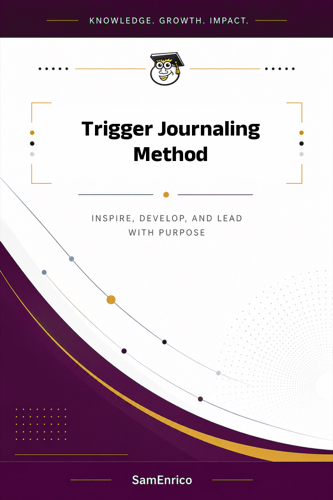
Trigger Journaling Method eBook
Use structured writing to identify patterns, early
Use structured writing to identify patterns, early warning signs, and effective interventions.
Formats
Free sample
Chapter 1: The Venting Trap--–- You have been told to “just write it out” your entire life. Journaling, you were promised, would unlock your feelings, clear your head, and set you free. So you bought a beautiful notebook, poured your heart onto the page after every argument, every disappointment, every wave of anxiety. And yet, here you are, reading this book, because something is not working. The same triggers keep exploding.
The same fights keep happening. The same shame keeps circling back. You are not alone. And the problem is not you. The problem is what you were taught journaling is supposed to be.For decades, the self-help world has promoted a simple, seductive idea: get it out of your head and onto paper.
Vent. Release. Catharsis. The image is powerful—a pressure valve opening, steam escaping, peace descending. But neuroscientists and clinical psychologists have discovered something unsettling.
Unstructured emotional venting does not always heal. Sometimes, it hurts. Sometimes, it rewires your brain to stay stuck in the very patterns you are trying to escape.This chapter is not an argument against journaling. It is an argument against lazy journaling. It is an invitation to understand why your current practice might be failing you, and what to do about it.
By the time you finish these pages, you will see the difference between describing a wound and treating it. You will understand the two neurological mechanisms that make structured writing one of the most powerful tools in mental health. And you will take the first step toward turning your journal from a confessional into a laboratory.The Myth of Catharsis The idea that venting anger reduces anger is called the catharsis hypothesis. It dates back to Aristotle, who wrote about drama purging strong emotions in audiences. In the twentieth century, Sigmund Freud and Josef Breuer suggested that “talking out” repressed memories could release pent-up emotional energy.
This idea seeped into popular culture and never left. Punch a pillow. Scream into a void. Write a furious letter you will never send. Let it out.Here is the problem: a mountain of research contradicts catharsis.
In a landmark series of studies, social psychologist Brad Bushman had participants become angry—by having someone insult their writing—and then gave them different outlets. Some sat quietly. Some punched a punching bag while thinking about the person who insulted them. Some punched a bag while thinking about getting fit. Some did nothing.
The results were clear: the people who vented while ruminating on the insult became significantly more aggressive afterward, not less. They had rehearsed their anger, embedded it deeper, and primed their nervous systems for the next trigger.Vent writing operates on the same principle. When you sit down after a trigger and write, “I can’t believe she said that. I’m so angry. This always happens.
Why does everyone treat me this way?”—you are not releasing emotion. You are practicing a story. You are strengthening the neural pathway that connects that trigger to that reaction. Each time you rehearse the narrative without adding new information, without structure, without analysis, you are teaching your brain that this is the correct response.This is not your fault. No one told you there was another way.
No one explained that the brain does not distinguish between “venting for relief” and “rehearsing for automaticity.” To your neurons, repetition is repetition. What fires together, wires together.The Two Brain Systems at War To understand why structured writing works and venting fails, you need a basic map of your brain in moments of emotional distress. Neuroscientists divide the brain’s response to triggers into two primary systems: the limbic system and the prefrontal cortex.The limbic system includes the amygdala, often called the brain’s alarm bell. Its job is speed, not accuracy. When the amygdala detects a potential threat—a tone of voice, a slamming door, a memory—it floods your body with cortisol and adrenaline in milliseconds.
Your heart races. Your breathing quickens. Your digestion slows. Your attention narrows. You are ready to fight, flee, or freeze.
This is the triggered state.The prefrontal cortex (PFC) sits behind your forehead. It is the brain’s CEO. It handles planning, reasoning, impulse control, and self-awareness. The PFC is slow but accurate. It asks questions like, “Is this actually dangerous?” and “What would be helpful right now?”Here is the critical insight: when the amygdala is activated, it literally reduces blood flow and glucose to the prefrontal cortex.
Your CEO gets locked out of the control room. This is why, in the middle of a trigger, you cannot think straight. You cannot find the right words. You cannot “logic your way out” of the feeling. The neurological architecture of the triggered brain is designed to act, not reflect.Vent writing happens in this state.
You are still flooded. You are still limbic-dominant. When you write a furious, unstructured rant, your amygdala stays activated. Your prefrontal cortex never gets a chance to re-engage. You are not processing the trigger; you are marinating in it.Structured writing, by contrast, is designed to reactivate the prefrontal cortex.
Specific prompts, data fields, and analytical frames force your brain to shift from “feeling” mode to “observing” mode. And that shift changes everything.Affect Labeling: How Naming Tames the Alarm The first neurological mechanism that makes structured writing powerful is called affect labeling. It sounds technical, but it is remarkably simple: putting words to emotions changes how the brain processes them.In a landmark neuroimaging study led by Matthew Lieberman at UCLA in 2007, participants viewed photographs of faces showing strong emotional expressions—fear, anger, sadness. While in an f MRI scanner, they were asked to do two different tasks. First, they matched the faces by emotion (e.g., picking which of two faces looked afraid).
This required recognizing the emotion but not naming it. Second, they chose a word that labeled the emotion (e.g., “angry” or “scared”).The results were striking. When participants simply matched faces, their amygdalae lit up brightly. When they labeled the emotion with a word, amygdala activity dropped significantly. At the same time, activity increased in the right ventrolateral prefrontal cortex (rvl PFC)—a region associated with cognitive control and emotional regulation.
Lieberman’s team concluded that affect labeling creates a “braking effect” on the amygdala. Naming an emotion does not suppress it. It modulates it. It turns down the volume.This is why the Trigger Tracker you will learn in Chapter 3 includes a field for “Automatic Thought.” Simply writing down the thought that flashed through your mind—even in fragments, even in all caps—engages the affect labeling system. You are not fixing the thought.
You are not arguing with it. You are just naming it. And that act of naming reduces its grip.But affect labeling alone is not enough. You also need narrative coherence.Narrative Coherence: From Chaos to Sequence The second mechanism is narrative coherence. When you experience a trigger, your memory of the event is often fragmented.
You remember the worst moment. You remember the feeling. You remember the aftermath. But the sequence is jumbled, and the cause-and-effect relationships are murky. This fragmentation…
This is the end of the free sample. Get the eBook to keep going. Buy now
About this book
Details
- Author
- Fenton Crysta
- Publisher
- SamEnrico
- Language
- English
- Genre
- Non-Fiction, Self-Help, Journaling
- Released
- 2026-06-08
- Pages (approx.)
- 135
- Available as
- eBook, Audiobook

Read better in the ZLOADR app
Your eBooks on your phone or tablet. Sign in with your SamEnrico account and start reading.
More by Fenton Crysta
 Anger In Blended FamiliesFenton Crysta$11.99
 Hand Rejuvenation Age Spot ManualFenton Crysta$11.99
 Craft Supply Chemical ExposureFenton Crysta$11.99
 Alcohol Recovery and WeddingsFenton Crysta$11.99
 Gaming Industry InvestmentFenton Crysta$11.99
 The Executive Presence CourseFenton Crysta$11.99
 Parts Therapy Scripting GuideFenton Crysta$11.99
 Clinton Arkansas GovernorFenton Crysta$11.99
 The Silk Road of the Mind: Ibn Battuta’s Lost Anthropological ChroniclesFenton Crysta$11.99
 Magellan’s Gambit: The First Circumnavigation of the GlobeFenton Crysta$11.99
 Order Types and Execution MechanicsFenton Crysta$11.99
 Workbook Two Week Creation GuideFenton Crysta$12.99
You may also like
 Stress Journaling for TwoPoirier Melodie$11.99
 Workaholism Recovery JournalParis Cheyenne$11.99
 The Self Esteem Journal for WorkStock Cherrie$11.99
 The Mindset Shift JournalForman Marine$11.99
 The Assertiveness Journal MethodEdgar Ruthanne$11.99
 Sugar Addiction Recovery Journal WorkbookHelms Letitia$11.99
 Student Journaling for StressWagoner Joetta$11.99
 Procrastination Journal PromptsDover Delmar$11.99
 Procrastination Journal MethodShank Dona$11.99
 Pet Bereavement JournalEuler Ross$11.99
 Loneliness Journal WorkbookLoveless Rosanne$11.99
 Habit Journaling WorkbookLancaster Valentine$11.99