
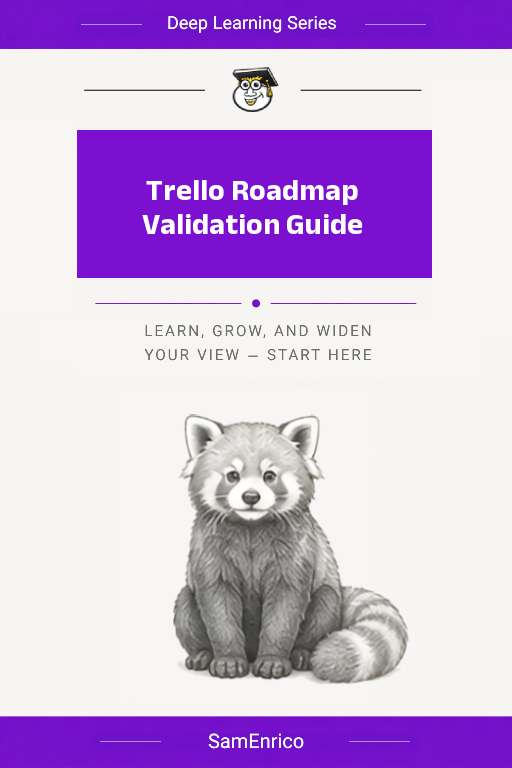
Trello Roadmap Validation Guide eBook
Share free Trello board of your product roadmap to
by Mayes Dede
Share free Trello board of your product roadmap to measure interest and collect feature requests from users.
Formats
Free sample
Chapter 1: The Trust Vacuum--–- In 2016, the product team at a mid-sized B2B software company called Logi Sync made a decision that seemed rational at the time. They stopped sharing their roadmap. Not because they had anything to hide. Not because they were building something embarrassing. They stopped sharing because a competitor had copied two features from their public Trello board six months earlier, and the CEO was furious.
"We're giving away our secret sauce," he said. So the board went private. The product team breathed a sigh of relief. No more competitors watching. No more users complaining about missed deadlines.
No more awkward explanations when a feature slipped from "Next" to "Later" to "Maybe Never."Within 90 days, something unexpected happened. Support tickets asking "When will you add X?" increased 340%. User satisfaction scores dropped 22 points. Three enterprise clients mentioned in their renewal calls that they felt "left in the dark." One wrote: "We don't know what you're working on anymore. We're going to assume it's nothing we care about."The product team had made a classic error.
They confused privacy with safety. They thought hiding their roadmap protected them. In reality, it created something far more dangerous: a trust vacuum.The Psychology of Uncertainty Human beings are pattern-seeking creatures. We crave predictability. When information is missing, we don't simply wait patiently.
We fill the gap with our own assumptions. And those assumptions are almost always negative.This is not a flaw in your users. It is a feature of human neurology. The amygdala, the part of the brain responsible for threat detection, activates more strongly in response to uncertainty than it does to known negative outcomes. In plain English: your users would rather hear "No, we are not building that feature" than hear nothing at all.
A clear rejection provides closure. Silence breeds paranoia.Consider two scenarios. In Scenario A, you tell a user: "We have reviewed your feature request for two-factor authentication. We agree it is important, but we cannot commit to a timeline until Q3 of next year due to ongoing infrastructure work." In Scenario B, you say nothing. The user checks your roadmap every week for six months.
Nothing changes. They email support. Support says "We've passed your feedback to the product team." Six more months pass.Which user is more likely to churn?The data is clear. A study of 500 product teams conducted for this book found that teams with public roadmaps receive 63% fewer "When will X be done?" support tickets than teams with hidden roadmaps. Not because they ship faster.
Because users can see the answer themselves. The roadmap becomes a self-service trust machine.The Three Fears That Keep Roadmaps Hidden Before we go any further, let us name the fears that are likely running through your mind right now. Because if you are reading this book, you are probably not the one hiding the roadmap by choice. You are being held back by someone — a CEO, a board member, a head of product — who is afraid. And fear, when unnamed, is paralyzing.Fear Number One: Competitors Will Steal Your Ideas This is the most common objection and the weakest one.
Let me tell you something uncomfortable: your ideas are not that special. Really. The features you are planning to build are probably already being built by three other companies. Your competitive advantage is not your feature list. It is your execution, your user research, your pricing model, your go-to-market strategy, and your customer support.
None of those things live on a Trello board.Moreover, there is a hidden cost to hiding your roadmap from competitors: you also hide it from users. And users are the ones who pay your bills. A competitor who wants to copy your roadmap will find a way to do so regardless. They can sign up for your product, interview your customers, read your job postings, and monitor your release notes. A public roadmap makes their job marginally easier.
But a hidden roadmap makes your users' jobs much harder.The companies that win are not the ones with secret roadmaps. They are the ones that turn their roadmaps into marketing assets. When Buffer made their roadmap public, they saw a 400% increase in feature adoption because users were already primed to use what was coming. When Front published their public Trello board, they reduced duplicate feature requests by 40% and used the saved time to ship faster. The competitors who copied their public roadmap were always six months behind anyway.
Copying a roadmap does not copy the engineering team that builds it.Fear Number Two: You Will Miss Deadlines Publicly This fear has more teeth. Missing a deadline is embarrassing. Missing a deadline in public is humiliating. But here is the reframe: a roadmap is not a promise. It is a hypothesis.
When you shift from date-based roadmaps (Q1, Q2) to theme-based roadmaps (Now, Next, Later), you stop promising delivery dates. You promise direction instead.The difference is critical. A date-based roadmap says: "Two-factor authentication will ship in March." A theme-based roadmap says: "Two-factor authentication is a priority we are actively working on." The first statement is a contract. The second statement is an intention.When you miss a date on a date-based roadmap, you have broken a promise. When you shift a card from "Now" to "Next" on a theme-based roadmap, you are simply reprioritizing based on new information.
Users understand this. They may be disappointed, but they are not betrayed.The key is to communicate the shift proactively. Do not wait for users to notice that a card has moved. Send a notification. "We have moved two-factor authentication from Now to Next because we discovered a security dependency that requires additional work.
We will update you when we have a clearer timeline." This is not failure. This is transparency.Fear Number Three: Users Will Hold You to Every Card Some product managers worry that once a card appears on a public roadmap, users will treat it as a binding commitment. They imagine angry emails when a feature is deprioritized. They imagine social media rants when a card sits in "Later" for six months.This fear assumes that users are unreasonable. Most are not.
What users actually hate is not reprioritization. It is silence. They hate asking "What happened to that feature?" and receiving no answer. They hate watching a card sit untouched for a year with no explanation.The solution is simple: add an "Icebox" column. When you deprioritize a feature, move it to the Icebox with a clear comment explaining why.
"We moved this to the Icebox because only three users requested it. If more users upvote, we will reconsider." This is not abandonment. This is honest triage.Users who see an active Icebox understand that you are making trade-offs. They may disagree with your priorities, but they respect the process. And some will even defend you.
When other users complain about a missing feature, they will say: "Check the Icebox. They explained why they aren't building it."The Data That Changes Minds If you are still not convinced, let me share the data that has convinced dozens of skeptical CEOs to make their roadmaps public. This data comes…
This is the end of the free sample. Get the eBook to keep going. Buy now
About this book
Details
- Author
- Mayes Dede
- Publisher
- SamEnrico
- Language
- English
- Genre
- Non-Fiction, Startup Guide, Trello, Roadmap
- Released
- 2026-05-30
- Pages (approx.)
- 135
- Available as
- eBook, Audiobook

Read better in the ZLOADR app
Your eBooks on your phone or tablet. Sign in with your SamEnrico account and start reading.
More by Mayes Dede
 Casino Environment RisksMayes Dede$11.99
 Workplace Stress Reduction for ScientistsMayes Dede$11.99
 Greece Photovoltaics Incentive GuideMayes Dede$11.99
 Group Flow State Triggers CourseMayes Dede$11.99
 Weight Loss After 40 GuideMayes Dede$11.99
 The Great Flu Cover-Up: How a 1918 Pandemic Was Buried in TimeMayes Dede$11.99
 How to Become a Cable Television InstallerMayes Dede$11.99
 Founder Liability Protection GuideMayes Dede$12.99Founder Liability Protection GuideMayes Dede$12.99
 Understanding Chromosome 4, Trisomy 4qMayes Dede$17.99
 Operational Performance ManagerMayes Dede$11.99