
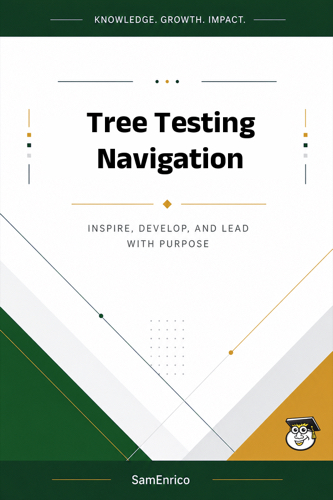
Tree Testing Navigation eBook
Tests findability of information.
Tests findability of information.
Formats
Free sample
Chapter 1: The $100 Million Mistake...--It was 3:47 PM on a Tuesday when Sarah, the VP of Product at a mid-sized e-commerce company called Bloom & Vine, watched a recording that made her stomach drop.The customer—a woman in her late fifties, judging by the hesitant way she moved her mouse—had arrived on the site with a clear mission. Her search terms, captured in the session replay, read: "anniversary gift for husband who likes gardening." Bloom & Vine sold gardening supplies, planters, seeds, and tools. This should have been an easy conversion.For the next eleven minutes and thirty-two seconds, the customer clicked. She hovered over "Shop by Plant Type." She clicked "Gifts Under $50." She opened "New Arrivals." She scrolled through "Seasonal Favorites." She typed "gift for men" into the search bar, which returned a mix of trowels, gloves, and—inexplicably—a pink ceramic watering can shaped like a flamingo.She never found the "Curated Gift Sets for Gardeners" page. That page existed.
It had been designed at considerable expense, photographed by a professional stylist, and loaded with high-margin products. But it was buried three levels deep under "Collections" → "Limited Edition" → "Gift Sets."She abandoned her cart after adding a single $12 packet of seeds—the only thing she could confidently locate.Sarah calculated the loss. Not just the $38 gift set this customer would have bought, but the lifetime value of a customer who now associated Bloom & Vine with frustration rather than delight. Then she multiplied that by the 47% of users who, according to her analytics, attempted to find a gift in the past month and failed.The number was over $100,000 in missed revenue. Per month.This book exists because of Sarah, and because of the thousands of product managers, designers, and developers who have had their own version of that 3:47 PM realization.
You cannot fix what you cannot measure. And for most of the history of digital product design, we could not measure the single most important driver of user success: findability.The Invisible Crisis on Your Website Right Now Let me ask you a question that will make you uncomfortable.When was the last time you tried to find something on your own website using only the navigation—no search bar, no direct URL, no internal link from a blog post, no "I know exactly where it is because I built it" insider knowledge?Not as a test. Not with a script. But the way a real customer would: with a genuine need, limited time, and no patience for confusion.Most people who work on websites cannot answer this question honestly because they have never experienced their own product as a stranger would. And that is not a character flaw—it is a structural blind spot.
You know too much. You know that "Press Releases" lives under "Newsroom" because you argued about that naming decision in a Slack channel eighteen months ago. You know that "API Documentation" is in the footer because engineering insisted. You know that "Cancel Subscription" is under "Account Settings" → "Billing" → "Manage Plan" because regulatory compliance required a confirmation modal.Your customers know none of this. And every time they fail to find what they need, your business pays a price that almost never appears on a profit and loss statement.Findability Versus Searchability: The Distinction That Changes Everything Before we go any further, we need to establish a vocabulary for the problem.
Most people conflate two fundamentally different behaviors: finding and searching.Searchability is what happens when a user types words into a text box and receives a list of results. Search is reactive. It assumes the user can articulate what they want, spell it correctly, and recognize the correct result among ten or twenty options. Search is a rescue mechanism—a sign that navigation has already failed.Findability is what happens when a user looks at a menu, predicts where something should live, clicks confidently, and arrives at the correct destination without ever touching a keyboard. Findability is proactive.
It aligns with how the human brain actually works: through categorization, pattern recognition, and mental models built from thousands of previous experiences with other websites, stores, libraries, and filing systems.Here is the uncomfortable truth that the data makes clear: users prefer finding over searching by a margin of nearly three to one.A 2022 study by the Nielsen Norman Group analyzed 2,347 task sessions across 50 different websites. When users could successfully navigate to a piece of content without searching, their task completion rate was 89%. When they were forced to search, that rate dropped to 62%. And when they switched between navigation and search multiple times—the digital equivalent of walking in circles—completion fell to 31%.The implication is brutal but liberating: most of the time, when users cannot find something, it is not because your search engine is broken. It is because your navigation is lying to them.The Real Cost of "Lost" Users Let me put numbers on this problem so that the next time a stakeholder asks "why should we spend time on this?" you have an answer that does not involve the words "user experience" or "information architecture"—phrases that, to a CFO, sound like vague aspirations rather than business metrics.Cost One: Abandoned Conversions Every e-commerce manager knows the statistic: the average cart abandonment rate is 69.8%.
Most of the conversation around that number focuses on shipping costs, payment friction, or comparison shopping. But a significant slice of abandonment—between 15% and 25%, depending on the sector—is purely navigational.Consider a user who wants to buy a replacement filter for their air purifier. They know the model number. They have their credit card ready. They arrive on your site and click "Shop," then "Appliances," then "Air Purifiers," then "Accessories." The replacement filters are not there.
They try "Parts." They try "Support." They try "Product Registration." They give up and buy from Amazon, where the navigation is simpler because Amazon has spent billions of dollars making "finding" feel like magic.That user was not price-sensitive. They were not comparison shopping. They were simply unable to complete a task your site was designed to support.Cost Two: Exploded Support Tickets Every support ticket costs money. The average cost of a live chat interaction is $5–$10. A phone call runs $15–$25.
An email costs $2–$5. These numbers multiply across thousands of interactions.But here is the killer: between 30% and 50% of all support tickets are navigational. The user is not reporting a bug or requesting a refund. They are asking "where do I find X?" or "how do I do Y?" Every one of those tickets is a failure of findability masquerading as a customer service problem.A Saa S company I consulted with had 12,000 support tickets per month. A simple tree test revealed that 4,200 of those tickets (35%) were from users trying to find "Cancel Subscription." The navigation path to cancellation required five clicks.
The company moved it to the top level of account settings, added a confirmation modal (to satisfy legal), and watched support tickets drop by 3,800 per month. At $8 per ticket, that change paid for itself in the first week.Cost Three: Eroded Brand Trust This cost is invisible on dashboards but devastating over time.When a user fails to find something…
This is the end of the free sample. Get the eBook to keep going. Buy now
About this book
Details
- Author
- Lehmann Breanne
- Publisher
- SamEnrico
- Language
- English
- Genre
- Non-Fiction, Self-Help, Tree Testing
- Released
- 2026-06-05
- Pages (approx.)
- 142
- Available as
- eBook, Audiobook

Read better in the ZLOADR app
Your eBooks on your phone or tablet. Sign in with your SamEnrico account and start reading.
More by Lehmann Breanne
 Postpartum Self Care Rituals GuideLehmann Breanne$11.99
 Pet Cremation Urn GuideLehmann Breanne$11.99
 Eisenhower For Life BalanceLehmann Breanne$11.99
 B12 for NeuropathyLehmann Breanne$11.99
 Hypnosis Script Writing BasicsLehmann Breanne$11.99
 Alcohol Recovery Exercise GuideLehmann Breanne$11.99
 Sam Sheppard Post Conviction ReliefLehmann Breanne$11.99
 Dreaming for Writers BlockLehmann Breanne$11.99
 The Skyward Pioneers: Mapping the Atlantic from the Air (Prehistoric)Lehmann Breanne$11.99
 The Last Breath: The Miracle of Flight 1549Lehmann Breanne$11.99
 The Frozen Gambit: Charles XII and the Siege of Riga (1700)Lehmann Breanne$11.99
 The Dancer's Guide to Slow WaltzLehmann Breanne$11.99