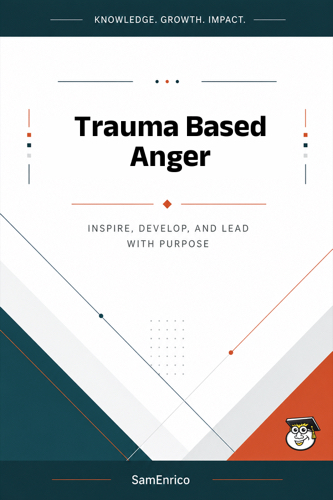
Trauma Based Anger eBook
Teaches identifying triggers rooted in past abuse,
by Cloud Ossie
Teaches identifying triggers rooted in past abuse, neglect, or PTSD hyperarousal.
Formats
Free sample
Chapter 1: The Explosion Payoff--The first time you lost control, you probably told yourself it would never happen again.You stood in the wreckage—shattered glass, a slammed door, a partner in tears, your own voice still echoing in your ears—and you made a silent promise. I'll do better. I'll walk away next time. I'll count to ten. And for a while, maybe you did.
You swallowed the heat rising in your chest. You bit your tongue until it bled. You told yourself that white-knuckling your way through every irritation was the same as healing.But then something small happened. A tone of voice. A partner scrolling on a phone while you were speaking.
A change in plans that no one warned you about. And before you knew what hit you, the explosion was back—bigger than before, as if your restraint had only fed the fire.If this sounds familiar, you have likely been told, at some point, that you have an "anger problem." Maybe a therapist suggested Intermittent Explosive Disorder. Maybe a partner begged you to try anger management. Maybe you have read books about breathing techniques and "assertive communication" and wondered why none of them worked. You tried.
You really tried. But the rage kept coming, and with it came a shame so heavy you could barely look at yourself in the mirror afterward.Here is the truth that no anger management class ever told you: your anger is not a behavioral problem. It is not a failure of self-discipline. It is not a character flaw. And it is certainly not a sign that you are secretly a bad person.Your anger is a survival program.
It was installed in your nervous system long ago, during a time when you genuinely needed to fight, flee, or freeze to stay alive. The fact that it now goes off in response to a distracted spouse or a critical boss or a friend who showed up late does not mean you are broken. It means your brain learned a set of rules for survival that no longer fit the world you live in. And no amount of counting to ten will rewire those rules, because counting to ten assumes the part of your brain that does the counting is still online when the rage hits.It is not.This book is not another anger management manual. It will not ask you to "choose to be calm" or to "think before you act." Those strategies fail for trauma survivors not because you are lazy or unwilling, but because they fundamentally misunderstand what trauma-based anger is.
This book is a map of the underground wiring of your nervous system—the ancient, automatic, lightning-fast circuits that hijack your brain before your conscious mind even knows there is a threat. And it will give you tools that work not by fighting those circuits, but by redirecting them.Before we go any further, let me name something that may be hard to hear. This book operates from a premise that might challenge what you have been told about yourself. The premise is this: your anger is not random, not meaningless, and not simply destructive. It is functional.
It does something for you. It produces a payoff. And until you understand what that payoff is, you will keep exploding, no matter how many breathing exercises you memorize.This is not an accusation. It is an invitation to stop hating yourself for a pattern you did not choose.The Myth of the "Bad Person"Let us begin by dismantling the most damaging lie about trauma-based anger: the lie that explosive rage means you are fundamentally bad, dangerous, or unworthy of love.You have probably internalized this lie deeply. After an explosion, the shame arrives almost as fast as the rage itself.
What is wrong with me? Why can't I just be normal? I am a monster. These thoughts are not just painful—they are neurologically counterproductive. Shame activates the same threat circuits as physical danger, which means that shaming yourself for exploding actually makes you more likely to explode again.
Your brain learns: "I am under attack (by my own shame), therefore I must defend myself (by raging again)." This is the shame-rage cycle, and we will return to it in depth in Chapter 9.For now, understand this: the fact that you are reading this book, that you have sought answers, that you feel remorse after you explode—all of this is evidence that you are not a monster. Monsters do not feel guilt. Monsters do not search for help at 2 a.m. Your presence here is proof of your humanity.The people who need to worry are the ones who never feel bad after they hurt someone. That is not you.Instrumental vs.
Reactive Anger: A Crucial Distinction To understand trauma-based anger, you must first understand a fundamental distinction that most anger management resources ignore: the difference between instrumental anger and reactive anger.Instrumental anger is goal-directed. It is a tool. A person uses instrumental anger to get something: control, compliance, respect, or material gain. The classic example is a boss who yells to intimidate employees into working harder, or a partner who uses rage to win an argument. Instrumental anger is calculated, even if it appears explosive.
The person experiencing it is still in the driver's seat—they are using anger as a strategy. And crucially, instrumental anger is not driven by fear. It is driven by desire.Reactive anger is something else entirely. Reactive anger is a survival reflex. It is the same response a cornered animal has when it snarls and bites.
The nervous system detects a threat—real or perceived—and bypasses conscious thought entirely. The explosion is not a strategy. It is a automatic defense mechanism designed to do one thing: make the threat go away as quickly as possible.Trauma-based anger is almost always reactive. This is why it feels so different from the calculated cruelty of an abuser. After a reactive explosion, you are often confused.
Why did I do that? That didn't even make sense. You might have blown up at someone you love over something trivial. You might have scared your own children. And in the aftermath, you genuinely cannot explain why that particular thing—a tone of voice, a look, a forgotten text—set you off.The reason you cannot explain it is that the reactive anger circuit bypasses the explaining part of your brain.
It runs on the oldest, most primitive hardware you have: your brainstem and limbic system. These structures do not speak English. They do not understand logic. They understand only one thing: danger or safety.When your reactive anger fires, it is because your nervous system has classified the present moment as dangerous. Whether the danger is real or not is irrelevant to your brainstem.
It does not wait for a risk assessment. It acts first, asks questions never.Why Standard Anger Management Fails Trauma Survivors If you have ever tried standard anger management, you already know it did not work. Maybe it helped a little, temporarily. Maybe you learned to walk away from arguments or to use "I feel" statements. But when…
This is the end of the free sample. Get the eBook to keep going. Buy now
About this book
Details
- Author
- Cloud Ossie
- Publisher
- SamEnrico
- Language
- English
- Genre
- Non-Fiction, Self-Help, PTSD Recovery
- Released
- 2026-06-08
- Pages (approx.)
- 148
- Available as
- eBook, Audiobook

Read better in the ZLOADR app
Your eBooks on your phone or tablet. Sign in with your SamEnrico account and start reading.
More by Cloud Ossie
 Sleep Apnea Management for SeniorsCloud Ossie$11.99
 The Overcontrolled ChildCloud Ossie$11.99
 Baby Toxin PreventionCloud Ossie$11.99
 Caravaggio: Light and Fury in the Baroque RevolutionCloud Ossie$11.99
 A Beginners Guide to Powerbocking (Volume 1)Cloud Ossie$11.99
 Coffee Pest and Disease Export RulesCloud Ossie$12.99
 Security DeveloperCloud Ossie$11.99
 How to Produce Citrus FruitsCloud Ossie$11.99