
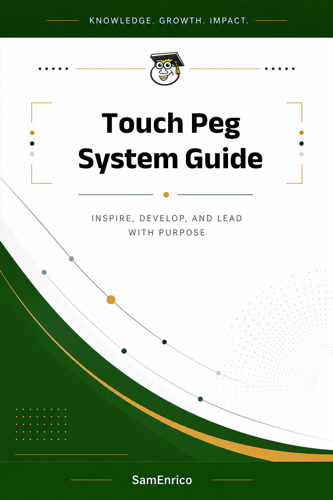
Touch Peg System Guide eBook
Uses tactile textures (rough, smooth) as pegs for
by Stovall Son
Uses tactile textures (rough, smooth) as pegs for haptic learners.
Formats
Free sample
Chapter 1: The Pressure-Surface Diagnostic--Your memory is not broken. Your method is.Pick up any book on memory improvement, and you will find the same hidden assumption: that you think in pictures. The authors will instruct you to build a "memory palace"—a grand mental mansion where you place vivid, colorful images. They will tell you to convert numbers into cartoon-like characters. They will assume, without ever asking, that your mind’s eye functions like a high-definition television.For approximately thirty percent of the population, this assumption is a disaster.Not because you are incapable of learning.
Not because your memory is defective. But because you do not think primarily in images. You think in sensations. You feel your way through the world. You remember the grit of a handshake, the cool smoothness of a stone you held as a child, the way a well-worn tool fits against your palm.
You are a tactile learner—a haptic thinker—and every visual memory system you have ever tried has been fighting against your natural wiring.This chapter has one job: to prove to you, beyond any doubt, that your tactile memory is already extraordinary, and to show you exactly which type of tactile learner you are. By the time you finish reading, you will have completed a diagnostic that tells you whether you are a Pressure Learner or a Surface Learner. You will understand why your past attempts at memorization felt like pushing a boulder uphill. And you will have your first evidence—your own evidence—that this system works for you.Let us begin with a simple experiment. Close your eyes for a moment.
Do not visualize anything. Instead, think back to the last time you shook someone’s hand. Do not try to see their face. Focus only on the sensation. Was their grip firm or limp?
Was their skin rough or soft? Was their hand dry or clammy? Did you feel the bones of their fingers pressing against yours?If you could answer those questions, you have just accessed a tactile memory. And here is the astonishing thing that most memory experts never mention: that handshake memory, stored through touch alone, is more durable than most visual memories. Your brain’s somatosensory cortex—the region responsible for processing touch—evolved hundreds of millions of years before your visual cortex.
It is older, more primal, and directly tied to survival. You do not forget the feeling of a hot stove because your ancestors who forgot did not live to pass on their genes.You already possess a powerful memory system. You have simply been trained to ignore it.The Lie of the Visual Default Every major memory system sold to the public over the past two thousand years has been built for visual thinkers. The Method of Loci, developed by the Greek poet Simonides of Ceos in 477 BCE, assumes you can mentally walk through a familiar building and “see” objects placed along the way. The Major System, created in the seventeenth century, converts numbers into consonant sounds that you are supposed to visualize as images.
Dominic O’Brien’s legendary memory systems, used to memorize fifty-two decks of cards, rely on turning every card into a vivid, moving, cartoon-like character.These systems work beautifully for people who think in pictures. For the rest of us, they feel like learning to write with your non-dominant hand while blindfolded.The problem is not the systems themselves. The problem is the unspoken assumption that everyone’s mind works the same way. Cognitive neuroscience has known for decades that individuals vary dramatically in their “cognitive style”—the preferred way their brain processes and represents information. Some people are high visualizers, able to see mental images with photographic clarity.
Some people have aphantasia, the complete inability to generate voluntary mental imagery. And a large group in between—approximately thirty percent of the population—are haptic-dominant: they encode and retrieve information most effectively through touch and physical sensation.If you have ever said any of the following phrases, you are likely a haptic thinker:“Let me get my hands on it.”“I need to feel my way through this.”“I don’t picture things in my head. I just know.”“I remember places by how they feel to walk through, not by what they look like.”“Flashcards don’t work for me. Actually doing something does.”You are not alone. You are not broken.
You have been using the wrong tool for the wrong job.The Diagnostic That Changes Everything Before you build a single peg, before you memorize your first list, you need to know which kind of tactile learner you are. The Pressure-Surface Diagnostic is a seven-question assessment developed from research on haptic perception and kinesthetic learning styles. It takes less than three minutes to complete, and it will determine the optimal way for you to use every technique in this book.Take out a piece of paper or open a notes application. For each of the following seven scenarios, answer honestly. Do not overthink.
Your first instinct is your accurate instinct.Question 1: You are learning a new physical skill—tying a knot, using a new tool, playing a musical instrument. Which approach helps you learn faster?A) Watching someone else do it slowly while explaining the steps.B) Taking the tool or instrument yourself and feeling your way through the motion, even if you make mistakes.Question 2: When you need to remember something important, what do you naturally do?A) You write it down or type it out.B) You pick up an object related to the task (keys, a tool, a book) and hold it while thinking.Question 3: Which statement describes your memory more accurately?A) I can close my eyes and “see” my childhood home room by room.B) I can close my eyes and “feel” the texture of my childhood home—the rough porch railing, the smooth kitchen counter, the soft carpet in my bedroom.Question 4: When you meet someone new, what do you remember most clearly an hour later?A) Their face and what they were wearing.B) Their handshake—whether it was firm or weak, warm or cold, rough or smooth.Question 5: You are trying to memorize a speech or presentation. Which method sounds more effective to you?A) Creating a mental story with vivid images for each section.B) Assigning each section to a different pocket on your clothing or a different spot on your body, then physically touching that spot while rehearsing.Question 6: Which type of reminder works best for you?A) A notification on your phone with text to read.B) A physical object placed in an unusual location (keys in the refrigerator, a rubber band on your wrist).Question 7: Think about a time you successfully memorized something without trying. What was the sensation?A) I could “see” the page or screen in my mind.B) I could “feel” the rhythm or sequence in my body.Now score your answers. If you answered B to five or more of these questions, you are a Pressure Learner or a Surface Learner—the two subtypes of haptic thinkers.
To determine which subtype, answer one final question:Final Question: When you touch an object to remember it, do you prefer:A)…
This is the end of the free sample. Get the eBook to keep going. Buy now
About this book
Details
- Author
- Stovall Son
- Publisher
- SamEnrico
- Language
- English
- Genre
- Non-Fiction, Self-Help, Tactile Memory
- Released
- 2026-06-10
- Pages (approx.)
- 160
- Available as
- eBook, Audiobook

Read better in the ZLOADR app
Your eBooks on your phone or tablet. Sign in with your SamEnrico account and start reading.
More by Stovall Son
 Mistaken Identity CasesStovall Son$11.99
 Low Carb Fast Food Cheat SheetStovall Son$11.99
 Refugee Nightmare ProcessingStovall Son$11.99
 Sleep Apnea Memory AgingStovall Son$11.99
 Memory Box CreationStovall Son$11.99
 Public Transport Student GuideStovall Son$11.99
 Common Anger Triggers GuideStovall Son$11.99
 The Split: How the Magic and the Lakers Redefined Basketball—and Divorced ItStovall Son$11.99
 The Phantom Gear: How a Lost WWII Radio Transmitter Sparked a Cold War ConspiracyStovall Son$11.99
 Understanding Superficial SiderosisStovall Son$11.99
 How to Produce Special Purpose Bags and CasesStovall Son$11.99
 Special Use Valuation GuideStovall Son$12.99