
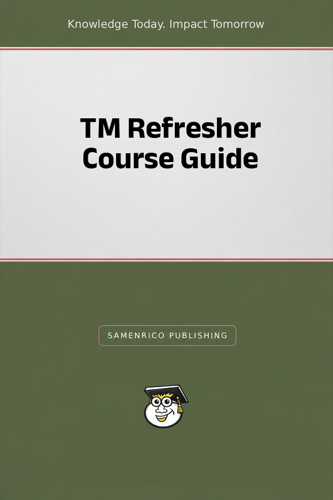
TM Refresher Course Guide eBook
Reviews core principles for long-term practitioner
by Rhoads Jerry
Reviews core principles for long-term practitioners who need renewal.
Formats
Free sample
Chapter 1: The Forgotten Skill...--–- You already know how to do this. That sentence, perhaps more than any other, is the one that long-term Transcendental Meditation practitioners most need to hear—and most consistently forget. Somewhere between the initial enthusiasm of learning the technique and the quiet routine of years of practice, something subtle but profound shifts. The meditation that once felt like a effortless settling into a vast, silent interior begins to feel like... well, like effort.
And that is the first sign that you have forgotten the one skill that makes TM work.This chapter is not an introduction to Transcendental Meditation. If you are reading this book, you almost certainly learned the technique at some point in your past. Perhaps it was five years ago. Perhaps it was twenty. Perhaps you have been practicing consistently every day since then, or perhaps you stopped for a stretch—months or even years—and are now wondering if you can return.
The answer to that question is yes, and the path back is not about learning something new. It is about remembering something you already know.The Forgotten Skill is not a technique within a technique. It is not a secret mantra or a special breathing pattern or a posture adjustment. The Forgotten Skill is simpler and more difficult than all of those things. The Forgotten Skill is the ability to do nothing at all—completely, without reservation, without secretly trying, without monitoring, without hoping for a particular experience, without judging the experience you are having as "good" or "bad" or "deep" or "shallow."Doing nothing, it turns out, is one of the hardest things for a human being to do.
We are wired for action, for problem-solving, for improvement. From childhood, we are rewarded for trying harder, for paying closer attention, for exerting more control. These are valuable skills in the relative world of work and relationships and goals. But they are the absolute enemy of transcending.The Quiet Corruption of Long-Term Practice Let us name something that almost every long-term meditator has experienced but rarely admits aloud. At some point, often after a year or two of consistent practice, the meditation begins to feel different.
The effortless settling that characterized the early months gives way to something that feels like waiting. The mind seems restless. The mantra feels mechanical. You find yourself repeating it with a kind of inward grimace, as if you are turning a crank that has become stiff.What is happening in these moments is not a failure of the technique. It is not a sign that you need a new mantra or a different practice or a retreat.
It is the predictable result of a subtle but profound corruption: you have begun to try to meditate.This corruption happens so gradually that it is almost invisible. It begins innocently enough. One morning, your mind is particularly active—perhaps you did not sleep well, or you have a stressful meeting ahead. The mantra does not settle as easily as usual. Without thinking, you repeat it a little more firmly, a little more quickly.
You are not trying to force anything, exactly. You are just... helping.But that "help" is the wedge. Once effort enters the practice, even in the smallest amount, the natural mechanics of transcending are disrupted. The mind, instead of settling towards greater happiness on its own, becomes divided against itself.
Part of the mind is attending to the mantra. Another part is watching to see if it is working. A third part is evaluating the experience. This fragmentation is the opposite of the unified, coherent state that TM is designed to produce.The tragedy is that the long-term practitioner, precisely because they have been practicing for years, is most susceptible to this corruption. The beginner has no expectations.
They were told to follow the simple instructions, and they do so without second-guessing. But the experienced practitioner has had many deep meditations. They know what is possible. And that knowledge becomes a subtle form of demand: I want that again. I want that depth.
I want that silence. And wanting, in the context of TM, is the obstacle.Concentration, Mindfulness, and the TM Difference To understand why effort is the enemy, it helps to understand what TM is not. The modern meditation landscape is crowded with practices, and most of them operate on principles that are directly opposite to TM. Confusing these practices is one of the primary reasons long-term TM practitioners fall into the effort trap.Concentration practices are the most common form of meditation in the West. In concentration, you choose an object—the breath, a candle flame, a visualized image, a repeated sound—and you hold your attention on that object exclusively.
When the mind wanders, you bring it back. This is a discipline of attention, and it requires effort. With practice, concentration becomes stronger, just as a muscle becomes stronger with repeated use. Concentration practices have benefits, particularly for focus and cognitive control. But they are not TM.Mindfulness practices are the second most common form.
In mindfulness, you do not hold attention on a single object. Instead, you observe whatever arises—thoughts, sensations, emotions—without reacting or judging. This is also a discipline, though a different one. It requires the effort of maintaining meta-awareness, of watching without getting lost. Mindfulness also has substantial benefits, particularly for emotional regulation and reducing rumination.
But it is not TM.TM belongs to a third category, one that is poorly understood in the mainstream meditation world. In TM, you do not concentrate on the mantra. You do not observe the mantra. You do not watch yourself repeating the mantra. You allow the mantra.
The distinction is subtle but absolute.When you concentrate, you hold the object in place with effort. When you observe mindfully, you maintain a witnessing stance with effort. When you allow, you simply let the mantra come and go as it pleases, without any manipulation whatsoever. If the mantra becomes clear, that is fine. If it becomes faint, that is fine.
If it disappears entirely, that is fine. There is no target. There is no correct experience. There is only the process of the mind settling naturally towards greater happiness, like a pond becoming still when left undisturbed.This is why TM is often described as "effortless" rather than "relaxing." Relaxation can be effortful too—think of someone trying to relax before a medical procedure. Effortlessness means the complete absence of doing.
It means trusting the inherent tendency of the mind to move towards silence, just as you trust a ball to fall towards the ground when you drop it.The Principle of Least Action Maharishi Mahesh Yogi, who brought TM to the West, often spoke of what he called the "Principle of Least Action." In physics, least action refers to the observation that natural systems always take the path of least resistance—a beam of light bends in water not because it chooses to but because that path takes the least time. In consciousness, Maharishi argued, the same principle applies. The mind naturally moves towards greater happiness because greater happiness is the path of least resistance.This is a radical…
This is the end of the free sample. Get the eBook to keep going. Buy now
About this book
Details
- Author
- Rhoads Jerry
- Publisher
- SamEnrico
- Language
- English
- Genre
- Non-Fiction, Self-Help
- Released
- 2026-06-07
- Pages (approx.)
- 144
- Available as
- eBook, Audiobook

Read better in the ZLOADR app
Your eBooks on your phone or tablet. Sign in with your SamEnrico account and start reading.
More by Rhoads Jerry
 Women and Imposter SyndromeRhoads Jerry$11.99
 Incubating Solutions For ADHD Focus HandbookRhoads Jerry$11.99
 The IBS Histamine GuideRhoads Jerry$11.99
 The Dog Loss Bereavement GuideRhoads Jerry$11.99
 The Secret Sauce Wars: How a Family Feud Nearly Killed KFCRhoads Jerry$11.99
 Scaling Output Without Hiring a TeamRhoads Jerry$11.99
 Indonesia Invoice Factoring GuideRhoads Jerry$12.99
 Free Cohort Based Course GuideRhoads Jerry$12.99
 10 Ways to Use Dates (Recipe Book)Rhoads Jerry$11.99
 Understanding Thyrocerebrorenal SyndromeRhoads Jerry$17.99
You may also like
 Hong Kong Handover 1997Dunn Johnnie$11.99
 Zumba For Postnatal Recovery CourseNeal Christian$11.99
 Zumba for BeginnersLadner Nikia$11.99
 YouTube Comment Mining GuideHumes Pandora$12.99
 Worry Box MeditationCarlin Rudy$11.99
 Workplace Stress MeditationNguyen Lynn$11.99
 Workplace Stress and Sleep RepairHawley Ivory$11.99
 Workplace Perfectionism CureDelaney Jeffry$11.99
 Workplace Injustice Anger GuideWallen Isabelle$11.99
 Work Addiction and Burnout LinkGreenwood Ester$11.99
 Women in Yoga and WellnessBeattie Galina$11.99
 Women in Stand Up ComedyChun Evangeline$11.99