
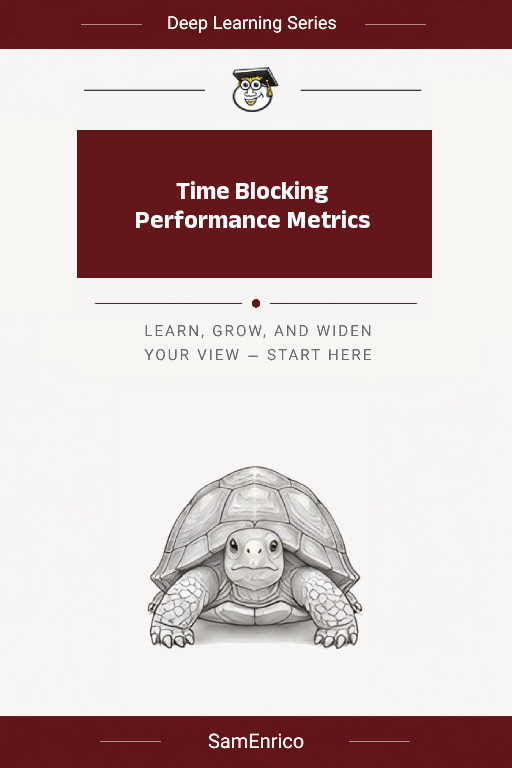
Non-FictionProfessional's Cheat SheetMetrics
Time Blocking Performance Metrics eBook
Track block adherence rate, strategic time percent
by Kraus Aliza
Track block adherence rate, strategic time percentage, and meeting ratio weekly.
Formats
Free sample
Chapter 1: The 4:47 PM Trap--It was Tuesday at 4:47 PM, and you just closed your laptop for the twelfth time today.Not because you were finished. Because you couldn't look at your calendar for one more second without feeling a specific kind of nausea—the kind that comes from knowing you spent eleven hours moving between meetings, emails, Slack messages, and small fires, and yet you have absolutely nothing to show for it. The big project you were supposed to start this week? Still untouched. The strategic initiative your boss asked about on Monday?
You haven't opened the document. The one thing you were hired to do, the work that actually justifies your salary? It is sitting exactly where it was seven days ago: at the bottom of a to-do list that has somehow grown longer despite your exhaustion.You are busy. Everyone agrees you are busy. Your calendar is a mosaic of color-coded blocks.
Your inbox shows that you replied to forty-three messages. You attended seven meetings. You "collaborated." You "aligned." You "circled back."And yet, at 4:47 PM on a Tuesday, you feel like a fraud.This is not a time management problem. You have tried every app, every system, every promise that "this one weird trick" will finally give you control. You have color-coded your calendar until it looks like a pride flag.
You have tried time blocking, only to watch your carefully planned blocks get obliterated by the first unexpected email. You have tried the Pomodoro Technique, only to realize that twenty-five minutes is a joke when your real work takes three hours of uninterrupted focus. You have tried waking up at 5 AM, only to find that the meetings simply moved earlier to fill the space.The problem is not your schedule. The problem is not your willpower. The problem is not that you are lazy or undisciplined or incapable of focus.The problem is that you have never, not once, measured whether you are actually doing what you planned to do.And that changes today.The Busyness Delusion Let us begin with an uncomfortable truth that most productivity books dance around but never say directly: Being busy is easy.
Being effective is hard. And most people mistake the first for the second.There is a reason "busy" has become a status symbol in modern professional culture. When someone asks how you are doing, and you say "crazy busy," you are not reporting a fact. You are signaling importance. You are saying, implicitly: I am needed.
I am in demand. My time is valuable because other people want it.This is the Busyness Delusion, and it is a trap.The research on this is sobering. According to a comprehensive study by the Harvard Business Review, only 30 percent of meetings actually accomplish their stated goal. That means seventy percent of the time you spend in meetings—nearly eight hours of the average knowledge worker's eleven-hour meeting week—is, by the meeting's own definition, wasted. Not slightly inefficient.
Wasted.Let that number land. Seventy percent.The same study found that the global workforce wastes approximately 24 billion hours per year on unproductive meetings. Twenty-four billion. That is not a rounding error. That is a number so large it stops meaning anything until you do the math: 24 billion hours is roughly 2.7 million years of human productivity, vaporized annually because people sit in rooms (or Zoom calls) talking about things that could have been emails or, more often, not discussed at all.But meetings are only the most visible symptom.
The underlying disease is something the author calls Productivity Dysmorphia—a term borrowed and adapted from body dysmorphia, where a person cannot accurately perceive their own body. Productivity Dysmorphia is the persistent, nagging feeling that you should be doing more, even when you are objectively doing enough. It is the voice that says, "You only finished eight things today? You should have finished twelve." It is the anxiety that creeps in at 4:47 PM, whispering that no matter how many tasks you checked off, the one that mattered is still undone.Productivity Dysmorphia has three causes, all of which feed on each other:First, the planning fallacy. Psychologists Daniel Kahneman and Amos Tversky identified this cognitive bias decades ago: humans consistently underestimate how long tasks will take, even when they have direct experience with those same tasks.
You think the quarterly report will take three hours. It has taken six hours every time you have written it, for five years. But you still schedule three hours. And then you feel like a failure when it takes six.Second, the interruption economy. Every Slack message, every email notification, every "quick question" from a colleague is a tiny tax on your attention.
But unlike a financial tax, which you know you are paying, the attention tax is invisible. You do not see the fifteen minutes it takes to recover from an interruption. You only see that your three-hour block somehow produced only ninety minutes of work. And you blame yourself.Third, the activity bias. In the absence of clear metrics for effectiveness, humans default to measuring activity.
If you cannot easily measure outcome (did the project advance?), you will unconsciously measure effort (did I stay busy?). This is why people brag about working twelve-hour days but never about solving a problem in two hours that used to take twelve. The former feels like virtue. The latter feels like laziness—even though it is the very definition of productivity.The result of these three forces is a workforce that is exhausted, overworked, and profoundly ineffective. People are not lazy.
They are drowning in systems that reward activity instead of accomplishment, and they have no way to measure the gap between what they planned to do and what they actually did.That gap is where this book lives.The Measurement Revolution Think about any other domain where humans pursue excellence. Athletes measure everything: split times, heart rate, recovery periods, sleep quality, caloric intake, muscle oxygenation. They do not guess whether they are improving. They look at the data. Chefs measure ingredient ratios, cook times, temperatures, yields.
They do not hope the soufflé rises. They control the variables. Surgeons measure complication rates, infection rates, procedure times, patient outcomes. They do not assume they are getting better. They track it.But knowledge workers?
You measure nothing. You have a calendar, which is a plan. You have a to-do list, which is a wish. You have a vague sense of whether you had a "good week" or a "bad week," based entirely on how you feel at 5 PM on Friday—a feeling heavily influenced by how much sleep you got, whether you ate lunch, and whether your boss was in a good mood.This is insane. Imagine an Olympic sprinter who never looked at a stopwatch.
Imagine a chef who never tasted the sauce. Imagine a surgeon who closed the incision and said, "Well, that felt about right."That is you. That is me. That is every knowledge worker who has been told that productivity is about "finding your passion" or "optimizing your morning routine" or "decluttering your desktop." These things are nice. They are not the answer.The answer is measurement.Not measurement for…
This is the end of the free sample. Get the eBook to keep going. Buy now
About this book
Details
- Author
- Kraus Aliza
- Publisher
- SamEnrico
- Language
- English
- Genre
- Non-Fiction, Professional's Cheat Sheet, Metrics
- Released
- 2026-06-01
- Pages (approx.)
- 135
- Available as
- eBook, Audiobook

Read better in the ZLOADR app
Your eBooks on your phone or tablet. Sign in with your SamEnrico account and start reading.
More by Kraus Aliza
 The Turning the Mind GuideKraus Aliza$11.99
 Negative Self Talk InterruptKraus Aliza$11.99
 Daily Shutdown RitualKraus Aliza$11.99
 Cocaine Anonymous ExplainedKraus Aliza$11.99
 Sales Presentation TechniquesKraus Aliza$11.99
 Alcohol Detox MedicationsKraus Aliza$11.99
 Jimmie Durham Artist ActivistKraus Aliza$11.99
 Identity Based Habits GuideKraus Aliza$11.99
 The Last Masterpiece: How a Forgotten Genius Outbid the WorldKraus Aliza$11.99
 The Art of War: Alexander the Great's Strategic GeniusKraus Aliza$11.99
 How to Produce Eggshell Alkyd Interior PaintKraus Aliza$11.99
 A Collector's Handbook to the Hupmobile Aerodynamic 8Kraus Aliza$11.99
You may also like
 Hong Kong Handover 1997Dunn Johnnie$11.99
 Zumba For Postnatal Recovery CourseNeal Christian$11.99
 Zumba for BeginnersLadner Nikia$11.99
 YouTube Comment Mining GuideHumes Pandora$12.99
 Worry Box MeditationCarlin Rudy$11.99
 Workplace Stress MeditationNguyen Lynn$11.99
 Workplace Stress and Sleep RepairHawley Ivory$11.99
 Workplace Perfectionism CureDelaney Jeffry$11.99
 Workplace Injustice Anger GuideWallen Isabelle$11.99
 Work Addiction and Burnout LinkGreenwood Ester$11.99
 Women in Yoga and WellnessBeattie Galina$11.99
 Women in Stand Up ComedyChun Evangeline$11.99