
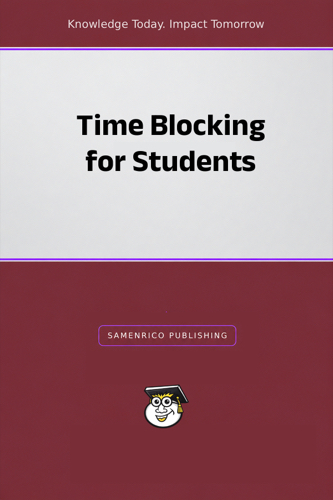
Time Blocking for Students eBook
Balances study, class, and social life.
by Whyte Maegan
Balances study, class, and social life.
Formats
Free sample
Chapter 1: The 2 AM Lie--–- It is 2:17 AM on a Tuesday. You are sitting at a desk cluttered with empty energy drink cans, three highlighters of varying dryness, and a textbook open to a page you have read four times without retaining a single sentence. Your phone has buzzed seventeen times since 10 PM. You have replied to twelve of those messages, opened Tik Tok "just for a minute" eight times, and rewritten the same flashcard twice because you forgot what you wrote the first time. Your exam is in six hours.
Your brain feels like wet cement being stirred by a broken spoon. And somewhere deep in your gut, beneath the caffeine jitters and the self-loathing, you know the truth: this is not working. It has never worked. But you keep doing it anyway because every other student seems to be doing the same thing, and surely, if everyone is suffering together, there must be a reason. There is a reason.
The reason is that you have been sold a lie.The lie is the myth of the all-nighter hero. The belief that suffering equals virtue. The idea that if you are not exhausted, you are not trying hard enough. This lie is whispered by every movie montage of a stressed student clutching coffee, by every older student who brags about surviving on four hours of sleep, by every professor who mentions pulling all-nighters in graduate school as if it were a badge of honor rather than a confession of inefficiency. The lie says that time is something you fight, something you steal from, something you conquer through sheer willpower and caffeine.
The lie says that busy is better, that exhausted is ethical, that if you are not behind, you are not trying. This chapter is going to prove that lie is not just wrong—it is actively destroying your GPA, your mental health, and your ability to actually learn.The Confession You Weren't Expecting Before we dive into the science and the systems, let me confess something that most productivity books hide: I have pulled more all-nighters than I care to admit. I have sat exactly where you are sitting—pixelated eyes, shaky hands, a textbook that seemed to be written in a language I had somehow forgotten since yesterday. I have walked into an exam room having studied for eight consecutive hours and promptly forgotten my own name. I have received a grade that perfectly reflected those eight hours of "hard work": a D.
Not because I was stupid. Not because I didn't try. But because I was using a broken system and calling it dedication.Here is what I learned the hard way: the number of hours you study does not matter nearly as much as what you are doing during those hours. You can study for twelve hours straight and learn absolutely nothing. You can study for two hours and master a week's worth of material.
The difference is not intelligence. The difference is attention. And attention, unlike willpower, is not something you can simply force. Attention is a biological resource governed by rules that evolution wrote long before your professor assigned that 3,000-word essay.This chapter is going to show you those rules. We are going to look at what actually happens inside your brain when you switch between tasks, why constant studying is a trap, and how a counterintuitive approach called time blocking will give you back not just your grades but your sanity.
By the end of this chapter, you will understand why the all-nighter hero is a fiction—and you will be ready to become something far more dangerous: a student who studies less but learns more.The Cognitive Tax You Pay Every Time You Switch Let us start with a number that will probably make you uncomfortable: ten. According to research in cognitive psychology, specifically the work of Dr. Gloria Mark at the University of California, Irvine, every time you switch between tasks, your effective IQ can drop by up to ten points. Ten points. That is the difference between scoring in the top third of your class and scoring below average.
That is the difference between understanding a concept and staring at it blankly. That is the cognitive equivalent of showing up to an exam after a full night of heavy drinking, except you did it to yourself while sober.Here is how the tax works. Imagine your brain as a highway. When you are focused on a single task—say, reading a chapter of your biology textbook—all your cognitive resources are flowing smoothly in one direction. You are processing information, making connections, storing memories.
Then your phone buzzes. You look at the text. That is a lane change. You reply. That is another lane change.
You put the phone down and try to return to the textbook. That is a merge. Every single one of those lane changes costs you time and mental energy. The research shows that after an interruption, it takes an average of twenty-three minutes to return to your original level of focus. Twenty-three minutes.
If you check your phone once per hour, you are spending nearly forty percent of your study time just trying to get back to where you started.But the cost is worse than time. The cost is depth. When you switch tasks constantly, your brain never enters what psychologist Mihaly Csikszentmihalyi called "flow"—the state of complete immersion where time disappears and learning feels almost effortless. Flow is not a mystical experience reserved for artists and athletes. Flow is a neurochemical state characterized by the release of dopamine, norepinephrine, and anandamide, all of which enhance focus, pattern recognition, and memory consolidation.
You cannot reach flow in fifteen-minute fragments. Flow requires sustained attention. And sustained attention requires you to stop switching.Consider this experiment conducted at a major university. Two groups of students were given the same chapter to read. Group A was told to read straight through for one hour without any interruptions.
Group B was told to read for one hour but was interrupted every ten minutes with a simple text message requiring a response. Afterward, both groups were tested on the material. Group A scored an average of eighty-seven percent. Group B scored an average of fifty-four percent. Same material.
Same time. The only difference was the interruptions. The interruptions did not just slow them down—they fundamentally changed how much they learned.Deep Work Versus Shallow Work: The Distinction That Changes Everything Cal Newport, a computer science professor and author of the bestselling book Deep Work, made a distinction that will become the backbone of this chapter and this entire book. He divided all work into two categories. The first is Deep Work: professional activities performed in a state of distraction-free concentration that push your cognitive capabilities to their limit.
These efforts create new value, improve your skills, and are hard to replicate. For students, deep work includes reading complex texts, writing essays, solving problem sets, learning new concepts, and preparing for exams. Deep work is the kind of studying that actually changes your brain.The second category is Shallow Work: logistical, low-intensity tasks that can be performed…
This is the end of the free sample. Get the eBook to keep going. Buy now
About this book
Details
- Author
- Whyte Maegan
- Publisher
- SamEnrico
- Language
- English
- Genre
- Non-Fiction, Self-Help, Student
- Released
- 2026-06-06
- Pages (approx.)
- 142
- Available as
- eBook, Audiobook

Read better in the ZLOADR app
Your eBooks on your phone or tablet. Sign in with your SamEnrico account and start reading.
More by Whyte Maegan
 Political Firsts After FiftyWhyte Maegan$11.99
 Menopause And Creativity GuideWhyte Maegan$11.99
 Telegram Channel Pressure GuideWhyte Maegan$11.99
 Personal Branding for AuthorsWhyte Maegan$11.99
 Inner Strength HypnosisWhyte Maegan$11.99
 Email Unsubscriber Bot UseWhyte Maegan$11.99
 Career Pivot After Job LossWhyte Maegan$11.99
 The Great Gold Sprint: How Alice Coachman Stole the Show from Hitler's OlympicsWhyte Maegan$11.99
 The Phantom of Park Lane: The $1.5M Ferrari Heist That Shocked MonacoWhyte Maegan$11.99
 Mastering Tobin Tax: Currency Transaction LevyWhyte Maegan$11.99
 Exploring Figure Drawing & Figure Painting: Anatomy & PoseWhyte Maegan$11.99
 Brazil Anti Fraud Address Verification GuideWhyte Maegan$12.99
You may also like
 Hong Kong Handover 1997Dunn Johnnie$11.99
 Zumba For Postnatal Recovery CourseNeal Christian$11.99
 Zumba for BeginnersLadner Nikia$11.99
 YouTube Comment Mining GuideHumes Pandora$12.99
 Worry Box MeditationCarlin Rudy$11.99
 Workplace Stress MeditationNguyen Lynn$11.99
 Workplace Stress and Sleep RepairHawley Ivory$11.99
 Workplace Perfectionism CureDelaney Jeffry$11.99
 Workplace Injustice Anger GuideWallen Isabelle$11.99
 Work Addiction and Burnout LinkGreenwood Ester$11.99
 Women in Yoga and WellnessBeattie Galina$11.99
 Women in Stand Up ComedyChun Evangeline$11.99