
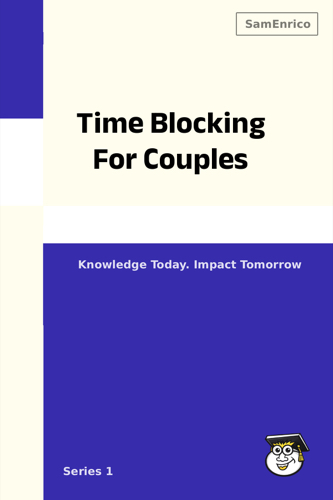
Time Blocking For Couples eBook
Coordinate calendars for date nights and shared re
by Pipkin Regan
Coordinate calendars for date nights and shared responsibilities.
Formats
Free sample
Chapter 1: The Free Weekend Lie--–- The Saturday morning unfolded like a bad dream. Emily had imagined sleeping in until 9:00 AM, maybe making pancakes with her husband David while the autumn light filtered through their kitchen windows. Instead, she was standing in the laundry room at 7:15 AM, holding a wet sweatshirt that smelled of mildew, trying to remember if she had started the wash cycle before bed or only thought about starting it. David appeared in the doorway, coffee in hand, and asked, “What do you want to do today?” The question landed like a small grenade. She didn’t know what she wanted to do.
She wanted to not be asked. She wanted to not be standing in the laundry room. She wanted a weekend that felt like a weekend instead of an endurance test.This scene, or one remarkably like it, plays out in millions of homes every Friday evening through Sunday night. Two people who genuinely love each other wake up with the promise of forty-eight unstructured hours stretching before them. No work deadlines.
No morning alarms. No mandatory meetings. Just open space, ripe with possibility. And yet, by Sunday evening, something strange and sad has happened. The hours have disappeared.
The laundry is only half done. The grocery shopping turned into a passive-aggressive negotiation about who remembered to buy almond milk. The “date night” they vaguely discussed on Thursday never materialized. They watched two episodes of a show they don’t even like, scrolled their phones in parallel, and now find themselves on the couch at 9:00 PM feeling the familiar weight of Sunday Night Syndrome—that low-grade dread mixed with disappointment, the sense that another weekend has evaporated without leaving anything lasting behind.This chapter exists to name what is happening in those lost hours. It will not offer a full solution—that is what the remaining eleven chapters are for.
But it will do something more important first: it will convince you that the problem is not your relationship, your motivation, or your love for each other. The problem is a structural flaw in how almost every couple approaches free time. And until you see that flaw clearly, no amount of “trying harder” will fix your weekends.The Assumption That Kills Connection Let us name the assumption outright. Most couples operate under a silent, unexamined belief that if they have free time together, quality connection will automatically happen. The logic feels intuitive: work ends, the calendar clears, love fills the space.
This assumption is so deeply embedded in our cultural understanding of relationships that questioning it feels almost cynical. Of course you should be able to relax together on a Saturday afternoon. Of course two people who love each other should be able to generate intimacy without a schedule. Of course spontaneity is the hallmark of a healthy relationship.This assumption is wrong.Not slightly mistaken. Not true for some couples but not others.
Structurally, demonstrably, scientifically wrong. Free time, by itself, does not produce connection. Free time produces unstructured space. And unstructured space, for most busy couples, produces something closer to paralysis than intimacy.Consider what actually happens when two working adults with shared responsibilities arrive at an unplanned Saturday. There are decisions to be made: when to eat, what to eat, who will shop for it, whether the bathroom needs cleaning, whether the child’s soccer uniform is dry, whether the car needs an oil change, whether to call parents back, whether to exercise, whether to feel guilty about not exercising, whether to have sex, whether it’s too late in the day for sex, whether to go out or stay in, whether staying in makes them boring, whether going out makes them tired.
Each decision carries invisible weight. Each decision requires negotiation, even if the negotiation is silent and internal. By the time a couple has navigated the first hour of an unplanned Saturday morning, they have already expended significant cognitive and emotional energy—often without realizing it.What they haven’t done, in most cases, is connect.The research on this phenomenon is striking. Couples who report the most “free time” together are not, on average, the happiest couples. In fact, studies of marital satisfaction show that the sheer quantity of unstructured shared time correlates only weakly with relationship happiness.
What matters far more is what psychologists call “shared intentionality”—the degree to which time together is characterized by mutual awareness, reciprocal engagement, and a sense of joint purpose. In plain English: it matters less how much time you have and more what you do with it. And what most couples do with unstructured free time is drift.Drifting looks peaceful from the outside. Two people on a couch. Two people walking through a grocery store.
Two people sitting at a kitchen table. But drifting is not rest and it is not connection. Drifting is a low-grade state of suspended animation where neither person wants to make a decision, neither wants to impose on the other, and both secretly hope the other will take the lead. Drifting is the enemy of intimacy because intimacy requires direction. You cannot stumble into deep connection any more than you can stumble into a gourmet meal.
The ingredients must be gathered. The space must be prepared. The time must be protected.This is the central argument of this book: love requires structure. Not because love is a project to be managed, but because love is a practice to be protected. And in a world of endless demands, endless distractions, and endless small decisions, the only way to protect a practice is to put it on the calendar.The CVE Framework: What You’re Actually Measuring Before we can fix the problem, we need better language for understanding it.
The relationship literature is full of metrics—quality time, quantity time, time spent together, time spent apart—but most of these measures miss the crucial distinction between presence and engagement.Let me introduce a concept that will run throughout this book: CVE, or Coupled Value of Engagement.CVE is a measure of the quality of any given block of time a couple spends together. Unlike simple metrics (“we spent two hours together on Saturday”), CVE asks a harder question: during that time, were both partners genuinely engaged with each other, or were they merely occupying the same physical space while their attention drifted elsewhere?The formula is simple:CVE = (Mutual Attention × Emotional Presence) / Distractions Let me break this down.Mutual Attention means that both partners are actively oriented toward each other. This does not require staring into each other’s eyes for hours. It means that when one partner speaks, the other hears. When one partner gestures, the other notices.
The attention flows between them rather than toward separate screens, separate thoughts, or separate worries.Emotional Presence means that both partners are available for connection. This does not require performing happiness or suppressing bad moods. It means that the emotional channel between them is open—that feelings, even difficult ones, can be transmitted and received without being blocked by defensiveness, exhaustion, or preoccupation.Distractions are the enemy. Distractions are the phone vibrating on the table. Distractions are the half-remembered work…
This is the end of the free sample. Get the eBook to keep going. Buy now
About this book
Details
- Author
- Pipkin Regan
- Publisher
- SamEnrico
- Language
- English
- Genre
- Non-Fiction, Self-Help, Relationships
- Released
- 2026-06-07
- Pages (approx.)
- 134
- Available as
- eBook, Audiobook

Read better in the ZLOADR app
Your eBooks on your phone or tablet. Sign in with your SamEnrico account and start reading.
More by Pipkin Regan
 Board Composition StudyPipkin Regan$11.99
 Copper Zinc Balance GuidePipkin Regan$11.99
 The Non Native Speaker GuidePipkin Regan$11.99
 The Feather Bed MethodPipkin Regan$11.99
 The IBS Sleep Hygiene PlanPipkin Regan$11.99
 The Forensic Psychologist StressPipkin Regan$11.99
 OCD Success StoriesPipkin Regan$11.99
 Anger And Chronic IllnessPipkin Regan$11.99
 The Ballad of the Dancing Plague: When Europe Lost Its MindPipkin Regan$11.99
 Into the Abyss: The Race to the Mariana Trench in the Age of ExplorationPipkin Regan$11.99
 The Healers of Meroë: The Lost Medical Codex of the Kushite KingdomPipkin Regan$11.99
 How to Become a Almond-cutting-machine TenderPipkin Regan$11.99
You may also like
 New Partner Imposter GuideMarch Tisa$11.99
 Body Language in RelationshipsQuarles Elodia$11.99
 Assertiveness in RelationshipsGuess Elton$11.99
 Assertive Relationship CommunicationCantwell Cecily$11.99
 Active Listening for Couples CommunicationLittleton Nilsa$11.99
 Romantic Boundary SettingLangdon Brice$11.99
 Relationship Priority GuidePeck Takisha$11.99
 Relationship Goal PlanningDowdy Hayden$11.99
 Mindfulness for Couples BeginnersGoulet Jayne$11.99
 Interpersonal Emotion ManagementTanner Mirella$11.99
 DBT For Jealousy In RelationshipsGreene Wendy$11.99
 The Alcohol and RelationshipsFoust Angelia$11.99