
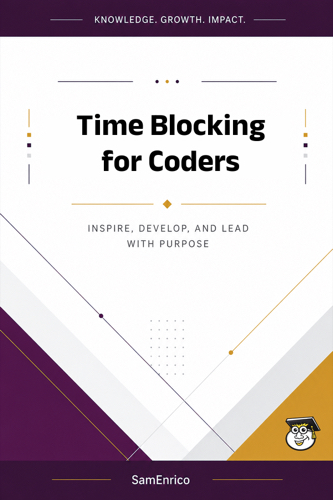
Time Blocking for Coders eBook
Block uninterrupted coding sprints with breaks for
Block uninterrupted coding sprints with breaks for debugging.
Formats
Free sample
Chapter 1: The 25-Minute Tax--–- The Slack notification arrived at 10:17 AM. You were six lines into a complex authentication middleware, the logic finally clicking into place after fifteen minutes of mental wrestling. You glanced at the message: "Hey, quick question about the API endpoint..." You replied, answered the question, and returned to your code. It was now 10:22 AM. You spent the next twenty-three minutes staring at the screen, trying to remember what you were doing, where you had left off, and why that middleware even existed.
By 10:45 AM, you were back in flow. By 10:50 AM, the next ping arrived.This is not a story about laziness. This is not a story about poor attention span. This is a story about the hidden architecture of the modern developer's brain and the relentless assault it faces every single day. You are not distracted because you are weak.
You are interrupted because the systems around you were designed by people who have never had to hold a recursive algorithm in their working memory while a product manager asks about the status of a ticket you closed three days ago.Welcome to the 25-Minute Tax. It is the single greatest unacknowledged drain on software engineering productivity, and it is the foundation upon which this entire book is built.The Myth of the Lazy Developer Let us begin with a radical reframe: software developers are not lazy. In fact, by objective measures, they are among the most cognitively overburdened professionals in the modern economy. A neurosurgeon operates on one patient at a time. An airline pilot flies one plane at a time.
A developer, on any given Tuesday, might be expected to context-switch between three active feature branches, two bug reports, a code review, a technical design document, a Slack thread about deployment pipelines, and a Jira ticket that just got its priority changed from "Medium" to "High" because someone in marketing decided the font on the login button is now critical infrastructure.Yet when developers fail to ship, the assumption is rarely "the system is broken." The assumption is "you need better focus." The assumption is "close your tabs." The assumption is "stop watching You Tube at work." These assumptions are not just wrong—they are harmful. They place the blame on the individual while ignoring the environmental chaos that makes deep focus nearly impossible.The research is unequivocal. A landmark study by Gloria Mark at the University of California, Irvine, tracked knowledge workers in their natural environments. The findings were staggering: the average worker switched tasks every three minutes and five seconds. Once interrupted, it took an average of twenty-three minutes and fifteen seconds to return to the original task with full cognitive engagement.
Let that sink in. A five-second interruption—a Slack DM that says "Hi" with no follow-up—costs twenty-three minutes of productivity. That is not a distraction. That is a tax.Hence the name. The 25-Minute Tax.Why Twenty-Five?
The Mathematics of Fragmentation You might be wondering why this chapter's title specifies twenty-five minutes rather than twenty-three. The answer is simple: rounding for memorability, but also for the harsh reality that the tax is almost always worse than the research suggests.The Mark study measured return to the original task. It did not measure the quality of that return. It did not measure the likelihood of introducing a bug because you resumed halfway through a mental model. It did not measure the additional five to ten minutes required to rebuild the full context of a complex system—the database schema, the authentication flow, the edge cases you had already accounted for.
When you add these factors, a five-minute interruption easily consumes thirty minutes of productive capacity. Twenty-five minutes is a conservative estimate. For senior developers working on distributed systems, the tax can exceed forty-five minutes.Consider the mathematics of a typical day.You arrive at 9:00 AM. By 9:15, you have checked email and Slack. At 9:20, you begin your first deep work block.
At 9:27, a teammate messages you about a broken test. You answer. You return. You spend until 9:50 rebuilding context. You get twenty minutes of actual work before the standup at 10:15.
Standup runs twenty minutes. You return to your desk at 10:35. You spend until 11:00 rebuilding context. You work for thirty minutes. Lunch at 11:30.
You return at 12:15. You spend until 12:45 rebuilding. You work for forty-five minutes. A 1:30 PM meeting. The meeting ends at 2:00.
You spend until 2:25 rebuilding. You work for one hour. Another meeting at 3:30. The meeting ends at 4:00. You spend until 4:20 rebuilding.
You work for forty minutes. The day ends at 5:00.Add the numbers. Total context-switch recovery time: approximately 220 minutes—nearly four hours. Total deep work achieved: approximately 135 minutes—just over two hours. You were "at work" for eight hours.
You were productive for two. The other six hours were consumed by the 25-Minute Tax.This is not an outlier. This is the median experience for developers in open-plan offices with chat-based communication cultures. The tax is not your fault. But it is your problem to solve.The Two Types of Work: Coding vs.
Debugging Before we can build a solution, we must understand the nature of the problem at a deeper level. Not all development work is created equal. The 25-Minute Tax applies differently depending on what you are doing, and this distinction will echo through every subsequent chapter of this book.Coding—the generative act of writing new functions, designing architecture, building features, creating tests—requires what psychologists call creative immersion. This is a state of associative thinking, where your brain connects disparate concepts, recalls patterns from past projects, and weaves them into novel structures. Creative immersion is fragile.
It requires loading a complex mental model into working memory and holding it there while you translate thoughts into syntax. Interruptions during creative immersion are catastrophic because the mental model evaporates. Returning means rebuilding from scratch.Debugging—the investigative act of finding and fixing bugs—requires what cognitive scientists call analytical detachment. This is a state of hypothesis testing, systematic elimination, and evidence gathering. Debugging is less fragile than coding because you are following a logical process rather than holding a creative structure.
However, debugging is more vulnerable to tunnel vision—the tendency to fixate on a single hypothesis while ignoring contradictory evidence. Interruptions during debugging can actually be beneficial if they force a reset. But uncontrolled interruptions are still destructive.The critical insight is this: mixing coding and debugging in the same time block leads to what developers call "spaghetti logic." You write code, encounter a bug, switch to debugging, lose the creative context, fix the bug incompletely, return to coding, introduce a new bug, and repeat. The 25-Minute Tax is worse when you mix modes because each switch requires rebuilding both the creative and analytical contexts simultaneously.This book will teach you to separate these modes into distinct time blocks. But first, you must understand the cost of not separating them.The Greats Did Not Work More Hours—They Worked More Intentionally A common objection to time blocking is that the most productive developers in history did not need such rigid systems.
This objection is based on a misunderstanding of how the greats actually worked.Consider Bill Gates. During his most productive years…
This is the end of the free sample. Get the eBook to keep going. Buy now
About this book
Details
- Author
- Clifford Jann
- Publisher
- SamEnrico
- Language
- English
- Genre
- Non-Fiction, Self-Help, Programming
- Released
- 2026-06-06
- Pages (approx.)
- 133
- Available as
- eBook, Audiobook

Read better in the ZLOADR app
Your eBooks on your phone or tablet. Sign in with your SamEnrico account and start reading.
More by Clifford Jann
 Elective Share Spousal Rights HandbookClifford Jann$11.99
 TikTok Mental Health AwarenessClifford Jann$11.99
 Global Tech Talent Migration GuideClifford Jann$12.99
 Workplace Stress Management HandbookClifford Jann$11.99
 Menopause and Interstitial Cystitis GuideClifford Jann$11.99
 The Billion-Dollar Bet That Broke a Nation: Iceland's Financial ApocalypseClifford Jann$11.99
 Understanding Kantaputra–gorlin SyndromeClifford Jann$17.99
 Public Relations AssistantClifford Jann$11.99
 How to Become a Securities ClerkClifford Jann$11.99
 Money Worship Override WorkbookClifford Jann$12.99Global Tech Talent Migration GuideClifford Jann$12.99
You may also like
 Pomodoro for Coding PracticePearson Enrique$11.99
 Growth Mindset In CodingBray Silas$11.99
 Method of Loci For Software CodeStine Alva$11.99
 Coding Syntax CardsElias Rusty$11.99
 Emotional Intelligence for ProgrammersMcneill Shantae$11.99
 Dream Incubation For Coders Programmers WorkbookSalas Cori$11.99
 Coding Syntax PegsHook Ina$11.99
 The Working Memory for Coding GuideEscalante Gabriele$11.99
 Anki For Coding SyntaxCoates Carlyn$11.99
 Pattern Recognition in DebuggingGould Ellie$11.99
 Programmer Coding BlocksStanfield Chanda$11.99
 Dream Incubation for Coding BugsKimbrell Wilhelmina$11.99