
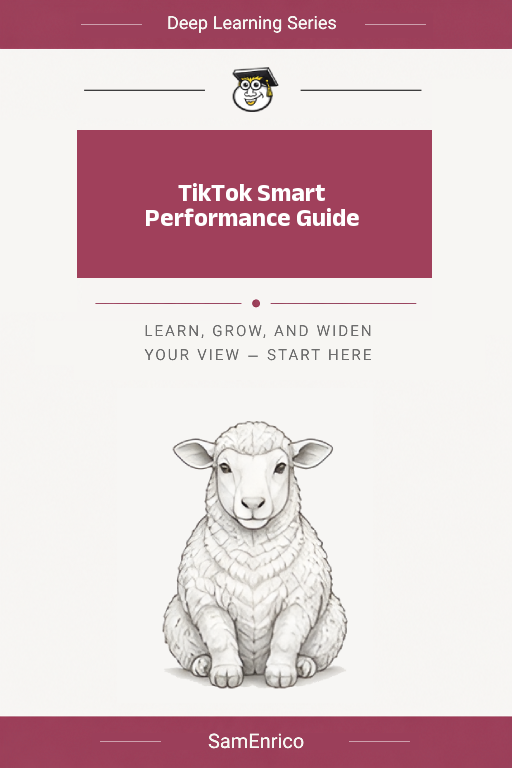
Non-FictionAnnual CheckupSmart PerformanceAutomation
TikTok Smart Performance Guide eBook
Navigate TikTok Smart Performance campaign policie
by Grubb Felica
Navigate TikTok Smart Performance campaign policies including automated targeting, creative optimization, and budget pacing.
Formats
Free sample
Chapter 1: The Algorithm’s Secret Language...--–- Most advertisers believe they are bidding against other advertisers. They are wrong. On Tik Tok in 2026, you are bidding against boredom. Every time a user scrolls past your creative without watching, the algorithm registers a small but definitive signal: this content failed to compete. Not against another ad.
Against a dancing cat, a recipe hack, a breakup story, or absolutely nothing at all. This fundamental reframing is the difference between struggling with Smart Performance campaigns and mastering them.The old playbook of digital advertising—keyword targeting, lookalike audiences, demographic layering, and manual bid adjustments—was built for a world where platforms acted as matchmakers between advertisers and user profiles. Google Ad Words asked: who is searching for this term? Facebook asked: who fits this interest profile? Tik Tok’s algorithm asks a completely different question: what content will keep this person on the platform for one more second?This chapter dismantles the myths that still plague performance marketers in 2026 and rebuilds your understanding of Tik Tok’s recommender system from first principles.
By the end, you will understand why your best-performing ad might look nothing like a traditional advertisement, why the algorithm ignores most of the data you thought mattered, and why the 7-day creative freshness window is both your greatest opportunity and your most dangerous trap.The Great Misunderstanding: Why Your Facebook Training Hurts You Every week, the author consults with brands who have migrated from Meta to Tik Tok and cannot understand why their proven Facebook creative is failing. They bring catalog ads that worked beautifully on Instagram. They bring demographic targeting that delivered 5x ROAS on Facebook. They bring polished, professionally produced video spots that cost $20,000 to make. And on Tik Tok, these assets achieve a cost per mille that looks reasonable but a conversion rate that is abysmal.The problem is not the quality of the creative.
The problem is the underlying optimization logic.Meta’s algorithm is fundamentally a profile-based optimizer. It builds detailed user profiles based on off-platform activity: websites visited, articles read, products viewed, emails submitted. When you run a conversion campaign on Facebook, the algorithm asks: which of our profiled users have demonstrated purchase intent in this category? It then matches your ad to those profiles. This works because Meta has spent two decades building the most comprehensive user interest graph outside of Google.Tik Tok’s algorithm is fundamentally a content-based optimizer.
It knows surprisingly little about users’ off-platform behavior, and intentionally so. Instead, it observes real-time engagement: which videos a user watches to completion, which they replay, which they skip within the first half-second. The algorithm does not ask “who is this user?” It asks “what does this user’s thumb do?” When you run a Smart Performance campaign on Tik Tok, the algorithm is not searching for people who match a profile. It is searching for people whose real-time behavior suggests they will watch your specific creative to the end.This distinction explains the most common failure pattern in Tik Tok advertising: a brand uploads what they believe is a high-quality ad, the algorithm serves it to thousands of users, and the campaign generates plenty of impressions but very few conversions. The advertiser blames targeting.
The real problem is that the creative itself is not earning attention. The algorithm is dutifully showing the ad to people, and those people are scrolling past it. The algorithm learns that this creative does not hold attention. It stops showing it. The advertiser raises the bid.
The algorithm shows it to more people, who also scroll past it. The campaign dies slowly, expensively, and confusingly.The Two Signals That Actually Matter Tik Tok’s 2026 recommender system has simplified dramatically from its earlier iterations. Where the algorithm once weighed dozens of signals—shares, comments, saves, profile visits, sound usage, effects usage, duets, stitches—the current architecture prioritizes exactly two primary signals above all others.Signal One: Total Watch Time Total watch time is exactly what it sounds like: the sum of seconds a user spends watching your video. But the algorithmic weighting is non-linear. The first second of watch time is worth significantly less than the tenth second.
The thirtieth second is worth significantly more than the tenth. And crucially, re-watch time—seconds watched after a user intentionally replays the video—is weighted at approximately 3x the value of first-time watch time.This creates a strategic imperative that contradicts nearly every other advertising platform. On You Tube, the first five seconds determine ad success. On Tik Tok, the last five seconds are often more important. Why?
Because a user who watches to the end has demonstrated sustained attention. A user who watches to the end and then replays has demonstrated intense engagement. The algorithm interprets both as powerful signals that your content deserves wider distribution.The practical implication is that your creative must reward continued viewing. If your video is fifteen seconds long, seconds ten through fifteen must be the most compelling, interesting, or surprising part of the creative. Many advertisers front-load their best content—the hook, the product reveal, the discount code—in the first three seconds.
This generates initial attention but fails to sustain it. Users watch the hook, get the offer, and scroll away before the video ends. The algorithm sees low total watch time relative to video length and penalizes the creative.Signal Two: Search Intent The second major signal in Tik Tok’s 2026 algorithm is search intent, and it represents a fundamental shift from the platform’s early “entertainment-first” positioning. Tik Tok now processes over 15 billion searches per month globally, and the platform has aggressively integrated search behavior into its ad optimization.When a user types a query into Tik Tok’s search bar—e.g., “best moisturizer for dry skin,” “how to clean white sneakers,” “Tokyo travel tips”—the algorithm takes note. But it does not simply serve ads against those search terms like Google.
Instead, it uses search queries to build intent vectors that inform future content distribution. A user who searches for “meal prep containers” may see organic recipe content for the next several days, and that organic content becomes the training ground for ad delivery.For Smart Performance campaigns, search intent matters because the algorithm will prioritize showing your ad to users whose recent search behavior aligns with your product category, even if those users have never heard of your brand. This is why keyword-rich captions, text overlays, and even spoken words in your video matter. The algorithm is listening and reading, not just watching.The practical application is straightforward: include the specific problem your product solves in your video’s text overlay. If you sell a stain remover, the phrase “red wine stain removal” should appear as on-screen text.
If you sell a productivity app, the phrase “ADHD focus timer” should appear in your caption. These keywords train the algorithm to connect your creative to relevant search intent.The Anti-Ad Principle Perhaps the most difficult concept for experienced performance marketers to accept is what this book calls the Anti-Ad Principle: Tik Tok’s algorithm systematically penalizes content that feels like a traditional advertisement and rewards content that behaves…
This is the end of the free sample. Get the eBook to keep going. Buy now
About this book
Details
- Author
- Grubb Felica
- Publisher
- SamEnrico
- Language
- English
- Genre
- Non-Fiction, Annual Checkup, Smart Performance, Automation
- Released
- 2026-05-29
- Pages (approx.)
- 150
- Available as
- eBook, Audiobook

Read better in the ZLOADR app
Your eBooks on your phone or tablet. Sign in with your SamEnrico account and start reading.
More by Grubb Felica
 DIY Project Comparison TrapGrubb Felica$11.99
 Opioid Use Disorder DiagnosisGrubb Felica$11.99
 Congress Member Spouse RoleGrubb Felica$11.99
 Office Aromatherapy GuideGrubb Felica$11.99
 Opioid Recovery Exercise Lazy GuideGrubb Felica$11.99
 The Unbreakable Streak: The Day Baseball Stood StillGrubb Felica$11.99
 The Jungle Alchemist: Yellapragada Subbarow and the Birth of AntimetabolitesGrubb Felica$11.99
 Understanding Cortes–lacassie SyndromeGrubb Felica$17.99
 Cisco Network EngineerGrubb Felica$11.99
 Influencer Outreach Zero BudgetGrubb Felica$12.99
 How to Start a Felt Hat Finishing Business (Beginners Guide)Grubb Felica$11.99
You may also like
 Hong Kong Handover 1997Dunn Johnnie$11.99
 Zumba For Postnatal Recovery CourseNeal Christian$11.99
 Zumba for BeginnersLadner Nikia$11.99
 YouTube Comment Mining GuideHumes Pandora$12.99
 Worry Box MeditationCarlin Rudy$11.99
 Workplace Stress MeditationNguyen Lynn$11.99
 Workplace Stress and Sleep RepairHawley Ivory$11.99
 Workplace Perfectionism CureDelaney Jeffry$11.99
 Workplace Injustice Anger GuideWallen Isabelle$11.99
 Work Addiction and Burnout LinkGreenwood Ester$11.99
 Women in Yoga and WellnessBeattie Galina$11.99
 Women in Stand Up ComedyChun Evangeline$11.99