
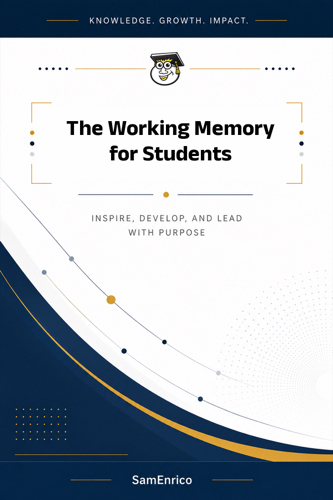
The Working Memory for Students eBook
Apply memory training to academic performance and
Apply memory training to academic performance and exam success.
Formats
Free sample
Chapter 1: The Empty Chair--Imagine a chair. It is in the middle of an empty room, no windows, one door. You are told that in exactly sixty seconds, someone will walk through that door and sit in the chair. You will have to remember that person's name, their job, and one fact about their childhood. That is all.
Three pieces of information. You can do that, right? Of course you can. Three things is nothing.Now imagine the same chair, but the room is different. There are fifty other people in it, all talking.
Your phone is buzzing in your pocket. You are hungry because you skipped breakfast. You are worried about a text message you sent three hours ago that has not received a reply. You are trying to listen to a lecture, take notes, remember an upcoming deadline, and mentally rehearse what you will say to your professor after class. The chair is still there.
Someone still walks through the door. What was their name?This is the reality of student life. Your working memory—the cognitive system that holds and manipulates information in real time—is not designed for the modern classroom. It was designed for a world of immediate physical threats and simple social dynamics. A lion.
A berry bush. A trail back to camp. Your ancestors did not need to remember the Krebs cycle, the date of the Treaty of Versailles, the conjugation of irregular French verbs, and the professor's policy on late assignments simultaneously. They needed to remember one thing at a time, act on it, and move on.You are asking your working memory to do something it was never built to do. And then you blame yourself when it fails.This chapter is an intervention.
It will show you that your so-called "bad memory" is almost certainly a perfectly normal working memory being asked to do the impossible. It will introduce you to the three components of your cognitive workbench—the phonological loop, the visuospatial sketchpad, and the central executive—and explain how they work together (and against each other). You will learn the single most important number in all of cognitive psychology: four. And you will walk away with a thirty-second practice that will change how you study forever, starting today.Let us begin.The Most Important Number in This Book You can hold approximately four things in your working memory at once. Not forty.
Not fourteen. Four.This number comes from decades of research using tasks like digit span (repeating back increasingly long sequences of numbers) and operation span (solving math problems while remembering words). The average young adult has a working memory capacity of three to five items. If you are in the top one percent of the population, you might hold six. Almost no one holds seven without extensive training in mnemonic techniques.Let me say this again, because it is the foundation of everything that follows: Four slots.
That is it. That is your entire mental workbench.Think about what you are usually trying to hold at any given moment during a study session. You are holding the sentence you just read. You are holding the question you want to answer. You are holding the distraction of your phone buzzing.
You are holding the worry that you are falling behind. That is four slots already, and you have not even processed any actual content yet. The moment you try to remember a definition, a formula, or a sequence of steps, something has to drop. You will not notice it dropping. You will only notice its absence later when you reach for it and find nothing.Most students respond to this limit by trying harder.
They furrow their brows. They reread the same paragraph three times. They tell themselves to focus. This is like trying to fit a couch through a doorway by pushing harder when the couch is clearly too wide. The doorway does not expand.
Your working memory does not expand. You are asking a biological system to violate its own physics.The only way to work with your working memory is to respect its limits. Stop trying to hold five things. Stop trying to hold six. Accept that you have four slots, and learn to use them with surgical precision.The Three Components of Your Workbench Working memory is not a single bucket that fills up.
It is more like a small workshop with three different workstations. Each workstation has its own specialized function, its own separate capacity, and its own energy requirements. If you understand these three workstations, you can use them simultaneously—effectively tripling your available mental workspace.The Phonological Loop (Your Inner Voice)The first workstation is the phonological loop. This is your inner voice. When you read silently, you are using your loop.
When you repeat a phone number to yourself, you are using your loop. When you rehearse what you are going to say in a conversation, you are using your loop. The loop handles all auditory and verbal information—spoken words, written words (converted to inner speech), names, numbers, lists, and sequences.The loop has a brutal limitation. It holds information for only about 1.5 to 2 seconds unless you actively rehearse it. That means if you hear a definition and do not repeat it to yourself within two seconds, the definition is not stored somewhere else in your brain for later retrieval.
It is gone. Vanished. Your brain treated it like background noise and discarded it.This explains a common student experience: you listen to a lecture, you understand every word in the moment, and ten minutes later you cannot recall a single specific claim the professor made. You were not rehearsing. You were passively receiving.
Your loop was filling and emptying, filling and emptying, like a bathtub with the drain open and the faucet running. The water passed through, but it never accumulated.The solution is active rehearsal. Every two seconds, you must press "repeat" on your inner voice. This does not mean mindlessly parroting. It means actively maintaining the information in your loop by saying it to yourself.
Students who learn to rehearse actively remember 300 to 400 percent more from lectures than students who listen passively.The Visuospatial Sketchpad (Your Mind's Eye)The second workstation is the visuospatial sketchpad. This is your mind's eye. When you visualize a graph, you are using your sketchpad. When you mentally rotate a molecule, you are using your sketchpad. When you imagine the layout of a historical battlefield, you are using your sketchpad.
The sketchpad handles images, diagrams, spatial relationships, and physical movement.The sketchpad has a separate capacity from the loop. This is crucial. You can listen to a lecture (using your loop) while drawing a diagram (using your sketchpad) without interfering with either system. In fact, using both channels simultaneously—a technique called dual coding—can double your effective working memory because you are not competing for the same resource.But the sketchpad has its own limits. You cannot hold a complex diagram and mentally rotate it at the same time without losing detail.
You cannot track the spatial relationships among five moving objects. The sketchpad is not a high-resolution screen; it is a…
This is the end of the free sample. Get the eBook to keep going. Buy now
About this book
Details
- Author
- Burns Claudia
- Publisher
- SamEnrico
- Language
- English
- Genre
- Non-Fiction, Self-Help
- Released
- 2026-06-08
- Pages (approx.)
- 138
- Available as
- eBook, Audiobook

Read better in the ZLOADR app
Your eBooks on your phone or tablet. Sign in with your SamEnrico account and start reading.
More by Burns Claudia
 Alcohol and Grief Recovery GuideBurns Claudia$11.99
 Noting Technique for NervesBurns Claudia$11.99
 Notion Button Automation ToolbarBurns Claudia$11.99
 Islamic Astronomy GuideBurns Claudia$11.99
 Legacy Conversation GuideBurns Claudia$11.99
 Child Loss Exercise TherapyBurns Claudia$11.99
 Divorce and Child SupportBurns Claudia$11.99
 Track & Glory: The Fashion Revolution of the 1968 OlympicsBurns Claudia$11.99
 The Last Circus: How a Forgotten Ringmaster Defied the NazisBurns Claudia$11.99
 A Collector's Handbook to the Riley KestrelBurns Claudia$11.99
 Transfer Pricing Documentation with AIBurns Claudia$12.99
 Overloaded Boss Support GuideBurns Claudia$12.99
You may also like
 Hong Kong Handover 1997Dunn Johnnie$11.99
 Zumba For Postnatal Recovery CourseNeal Christian$11.99
 Zumba for BeginnersLadner Nikia$11.99
 YouTube Comment Mining GuideHumes Pandora$12.99
 Worry Box MeditationCarlin Rudy$11.99
 Workplace Stress MeditationNguyen Lynn$11.99
 Workplace Stress and Sleep RepairHawley Ivory$11.99
 Workplace Perfectionism CureDelaney Jeffry$11.99
 Workplace Injustice Anger GuideWallen Isabelle$11.99
 Work Addiction and Burnout LinkGreenwood Ester$11.99
 Women in Yoga and WellnessBeattie Galina$11.99
 Women in Stand Up ComedyChun Evangeline$11.99