
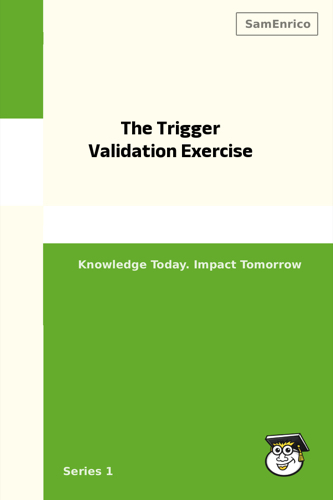
The Trigger Validation Exercise eBook
Legitimizes anger triggers while separating them f
Legitimizes anger triggers while separating them from proportional response.
Formats
Free sample
Chapter 1: The Gaslight Within--–- You are about to learn that the worst gaslighter in your life is not your partner, your parent, or your boss. It is the voice inside your own head that says, “You shouldn’t be so angry.”That voice sounds reasonable. It sounds mature. It sounds like the person you want to be—calm, forgiving, above the fray. But that voice is lying to you.
And every time you believe it, you drive a small wedge between what your nervous system knows is true and what your conscious mind will allow itself to feel.This wedge is not harmless. It is the slow accumulation of self-betrayal that turns a legitimate spark of anger into a months-long grudge, a sudden explosion over nothing, or a low-grade depression you cannot explain. The wedge is why you apologize for feelings you still believe were justified. It is why you say “I’m fine” when you are not fine. It is why you lie in bed at night replaying an argument from three years ago, your heart racing as if it happened thirty seconds ago.The wedge is the cost of gaslighting yourself about your own anger.This book is called The Trigger Validation Exercise because its central premise is radical and, to many readers, uncomfortable: You are always allowed to feel the trigger.
You are not always allowed to act on it. That sentence is the Golden Rule of this entire work. It will appear in every chapter, in different forms, because it is the single most important distinction you will ever learn about anger.Most anger management books teach you to calm down. They teach you to breathe, to count to ten, to walk away. These are not bad tools.
But they are incomplete tools, because they fail to honor the information contained in the trigger. When you tell someone “just calm down,” you are implicitly telling them that their anger is the problem. But anger is not the problem. Anger is the messenger. The problem is what the messenger is trying to tell you.The problem is the boundary violation, the unfairness, the threat, the old wound that never healed.
Anger is just the alarm system. And if your first instinct is to smash the alarm system instead of looking for the fire, you will spend your life in a burning building, convinced that the problem is the noise.The Myth of the “Overreaction”Let us begin with the most damaging phrase in the English language: “You’re overreacting.”If you have ever been told this—and you have—you know the specific shame that follows. It is not just disagreement. It is invalidation dressed as observation. The speaker positions themselves as the objective judge of proportional reality, and they position you as the hysterical, irrational, too-much person who cannot handle normal life.But here is the truth that the phrase conceals: “Overreaction” is not a measure of your feeling.
It is a measure of the gap between your feeling and the observer’s comfort. When someone says “You’re overreacting,” what they really mean is “Your emotional response is larger than I am willing to accommodate right now.” That is a statement about their capacity, not your validity.Consider two identical events. A woman cries at a funeral. No one says she is overreacting. A woman cries when her boss publicly humiliates her.
Someone might say she is “too sensitive.” The event is not the variable. The observer’s permission is.This is not to say that all responses are proportional. They are not. Screaming at a cashier for a pricing error is disproportionate. Punching a wall because your favorite sports team lost is disproportionate.
There are real gaps between trigger and response, and this book will give you the tools to measure and narrow those gaps.But the phrase “overreaction” conflates two completely separate things: the validity of the trigger and the proportionality of the response. A trigger can be entirely legitimate—someone truly wronged you, violated a boundary, or threatened something you value—and your response can still be disproportionate. Those are two different questions. The gaslighting occurs when someone (including yourself) answers the second question and pretends they answered the first.So let us separate them now, permanently, and never collapse them again.The Three-Part Definition of an Anger Event Every anger event has three components. Learn them.
Name them. They are the skeleton of every explosion, every grudge, every silent treatment, and every assertive boundary you will ever set.The Hurt: The boundary violation or perceived threat. This is the objective (or subjective) event that triggered your nervous system. Example: “My partner dismissed my concern when I tried to talk about our finances.”The Feeling: The rush of anger energy. This is hormonal, physical, and involuntary.
Your amygdala floods your body with cortisol and adrenaline. Your heart rate increases. Your muscles tense. Your face flushes. You did not choose this.
It happened to you.The Behavior: What you actually do with that energy. This is where choice lives. You can yell. You can withdraw. You can plan revenge.
You can speak assertively. You can take a walk. You can cry. The behavior is the only part of the three that is under your conscious control.Most people collapse these three into one. They say “I got angry” as if the feeling and the behavior are the same thing.
They are not. The feeling is a biological event. The behavior is a moral and practical choice. You cannot stop the feeling from arriving. You can absolutely shape what you do with it.The Golden Rule of this book, which we will state and restate, is this: You are always allowed to feel it; you are not always allowed to do it.The Neuroscience of Trigger vs.
Choice To understand why the Golden Rule is not just philosophy but biology, we need to look inside your skull.Your brain has two systems that matter for anger. The first is the amygdala, a small almond-shaped cluster of nuclei deep in the temporal lobe. The amygdala is your threat-detection system. It does not think. It does not reason.
It does not ask questions about proportionality, context, or whether the person who just cut you off in traffic is rushing to the hospital. The amygdala asks one question: “Is this a threat?”If the answer is yes—and the amygdala has a very low threshold for “yes”—it triggers a cascade of hormones. Cortisol and adrenaline flood your system. Your heart rate spikes. Your breathing quickens.
Blood moves away from your digestive system and toward your large muscles. Your pupils dilate. Your hearing sharpens. You are now in fight-or-flight mode, and the “fight” part comes with a powerful surge of anger energy.All of this happens in milliseconds. You do not decide to feel angry.
You notice that you are angry, usually after the fact. The feeling arrives like weather—unbidden, uncontrollable, and sometimes inconvenient.The second system is the prefrontal cortex (PFC) , the part of your brain just behind your forehead. The PFC is the executive. It plans, considers consequences, inhibits impulses, and makes choices. But…
This is the end of the free sample. Get the eBook to keep going. Buy now
About this book
Details
- Author
- Goodrich Ligia
- Publisher
- SamEnrico
- Language
- English
- Genre
- Non-Fiction, Self-Help, Validation
- Released
- 2026-06-08
- Pages (approx.)
- 135
- Available as
- eBook, Audiobook

Read better in the ZLOADR app
Your eBooks on your phone or tablet. Sign in with your SamEnrico account and start reading.
More by Goodrich Ligia
 McClintock Forgotten Genius Documentary GuideGoodrich Ligia$11.99
 Team Creative Time Boxing GuideGoodrich Ligia$11.99
 Sugar Addiction Recovery GuideGoodrich Ligia$11.99
 SEAL Combat Swimmer InsigniaGoodrich Ligia$11.99
 The Dragon’s Gambit: A Knight’s Shadow WarGoodrich Ligia$11.99
 The Vanishing Heiress: The 1983 Disappearance of Sheryl Ann SeaverGoodrich Ligia$11.99
 Understanding Galactokinase DeficiencyGoodrich Ligia$17.99
 Microsoft AI for Health ManualGoodrich Ligia$12.99
 One on One ESL GuideGoodrich Ligia$12.99
 How to Become a Museum TechnicianGoodrich Ligia$11.99
 Clinical Social WorkerGoodrich Ligia$11.99
You may also like
 The Exhaustion Validation GuideOrozco Willena$11.99
 Validating Anger Without AgreementHightower Earleen$11.99
 Validating Anger Response GuideMares Lizbeth$11.99
 Self Validate Emotion GuideHamrick Clementina$11.99
 X and the Approval FixScroggins Freida$11.99
 The Validation Under Stress PrimerNguyen Homer$11.99
 The Validation Technique CourseHwang Lucius$11.99
 Pet Loss Certificate GuideGilman Marx$11.99
 Emotional Validation GuideHefner Wynell$11.99
 Emotion Validation Skills GuideMclaurin Kristeen$11.99
 Being Ignored TriggersHamm Suzie$11.99
 Self Validation HypnosisShelley Julene$11.99