
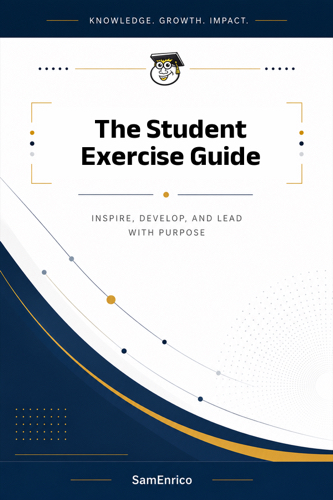
The Student Exercise Guide eBook
Use physical activity to reduce stress and boost c
by Paris Aisha
Use physical activity to reduce stress and boost cognitive function.
Formats
Free sample
Chapter 1: The Chair Is a Quiet Bully--–- You are not lazy. You are not broken. You are sitting yourself stupid—and your anxiety is a side effect of a body that has forgotten how to move.Marcus, a sophomore majoring in biology, did everything his professors told him to do. He attended every lecture. He took handwritten notes in blue ink because a study said color improved recall.
He highlighted his textbooks in four different colors, each representing a different level of importance. He made flashcards. He reviewed those flashcards. He formed a study group. He showed up to that study group.
He drank two cups of coffee before his organic chemistry final, ate a protein bar for sustained energy, and arrived at the exam hall twenty minutes early to center himself.He sat down, opened the test booklet, read the first question, and his mind went completely, terrifyingly blank.Not the normal "I need a moment to recall this" blank. Not the "I studied this but I'm nervous" blank. The kind of blank where the words on the page looked like they were written in a language he had never seen before. His heart pounded. His palms soaked the edges of the paper.
He could hear his own breathing—shallow, fast, wrong. He spent the next forty-five minutes staring at the same three questions, writing nothing, erasing nothing, because there was nothing to erase. When the proctor called time, Marcus turned in a test with his name and absolutely nothing else.He walked back to his dorm, lay down on his bed, and thought: What is wrong with me?Here is the answer nobody had ever taught Marcus: nothing was wrong with him. He was not stupid. He was not anxious because he was weak.
He was not a bad test-taker. He was not lazy. He was, quite simply, suffering from a body that had spent the entire semester sitting down—and his brain was paying the price.This book exists because students like Marcus are failing not for lack of effort, but for lack of movement. And the solution is not more caffeine, more study hours, or more self-help platitudes. The solution is understanding that your chair is a quiet bully, and the only way to fight back is to get up.The Average Student Is a Professional Sitter Let us run the numbers.
The typical undergraduate student wakes up, walks (or more often, scrolls in bed) for thirty minutes, then walks to class. That walk might be ten minutes. Then they sit through a seventy-five-minute lecture. Then they walk ten minutes to the library. Then they sit for two hours to study.
Then they walk ten minutes to another class. Then they sit for another seventy-five minutes. Then they walk to the dining hall, sit for thirty minutes to eat. Then they return to the library, sit for another two to three hours. Then they return to their dorm, sit to watch Netflix or scroll Tik Tok for another hour or two.
Then they lie down—horizontal sitting—and do it all again the next day.Add it up. Between class time, study time, eating time, commuting time (even walking counts as movement, but most campus commutes are under fifteen minutes), and screen time, the average student spends between eight and twelve hours per day seated. Some students, particularly those in heavy reading or STEM majors, log fourteen or more hours of sitting on weekdays.To put that number in perspective: humans evolved over two hundred thousand years to move. Our ancestors walked between six and ten miles per day. They squat, they climbed, they carried, they ran, they lifted, they dug, they built, they gathered.
The human body, including the human brain, was designed and refined over millennia for one consistent condition: regular, varied, frequent physical activity. The chair, in evolutionary terms, arrived approximately five minutes ago. And we are not adapted for it.Sitting is not neutral. It is not the absence of harm. Sitting is an active stressor on the body and brain.
When you sit for more than thirty minutes continuously, a cascade of physiological changes begins. Your large leg muscles—the glutes, the quadriceps, the hamstrings—go electrically silent. Those muscles are not just for walking; they are metabolic regulators. They help clear glucose from the bloodstream and release anti-inflammatory signaling molecules. When they go silent, blood sugar rises.
Inflammation ticks upward. And here is the part that matters most for students: your brain interprets physical stillness, after a certain threshold, as a signal that the environment is safe enough to power down alertness.But here is the paradox. While your brain powers down alertness, your stress system does not power down with it. In fact, prolonged sitting raises baseline cortisol levels by fifteen to twenty percent, even in students who report feeling "calm." You become less alert and more stressed at the same time. That is the biology of the exhausted-but-wired state.
That is the student who has studied for six hours and cannot remember a single thing. That is Marcus, staring at a blank test booklet, his body screaming in a language he did not know how to translate.The Myth of Passive Rest If you are like most students, your strategy for recovering from a long study session is to stop studying. You close the book. You open your phone. You watch a twenty-minute episode of a show.
You scroll through Instagram. You lie down and stare at the ceiling. You call this "rest."It is not rest. At least, not the kind your brain needs.The confusion is understandable. We use the word "rest" to mean two entirely different things: rest as in cessation of active work (stop studying, stop thinking hard) and rest as in physiological recovery (lowered cortisol, replenished neurotransmitters, cleared metabolic waste).
The problem is that these two things are not the same. You can stop working while your body remains in a low-grade stress state. In fact, for many students, passive activities like watching Netflix or scrolling social media do not lower cortisol at all. They often increase it.Consider what happens when you scroll through Tik Tok or Instagram for twenty minutes. Your brain is not resting.
It is processing rapid-fire visual and auditory stimuli. It is making rapid social comparisons between your life and the curated highlights of strangers. It is receiving unpredictable rewards (the next video might be funny, might be sad, might be a ad, might be a trigger), which activates the same dopamine circuits as gambling. Your eyes are exposed to blue light, which suppresses melatonin and tells your brain that it is still daytime. Your posture is typically worse than when you are studying—slumped, neck craned forward, shoulders rounded—which increases the cognitive load of proprioception, as we will explore in Chapter 7.
By the end of twenty minutes of "rest," your cortisol may be higher than when you started, your attention more fragmented, and your mood more variable.This is not a moral failing. It is a design flaw in the modern environment. Our brains were not built to be fed a firehose of content while sitting…
This is the end of the free sample. Get the eBook to keep going. Buy now
About this book
Details
- Author
- Paris Aisha
- Publisher
- SamEnrico
- Language
- English
- Genre
- Non-Fiction, Self-Help, Fitness
- Released
- 2026-06-07
- Pages (approx.)
- 150
- Available as
- eBook, Audiobook

Read better in the ZLOADR app
Your eBooks on your phone or tablet. Sign in with your SamEnrico account and start reading.
More by Paris Aisha
 Attorney Billable Hour StressParis Aisha$11.99
 Dreams After Paralysis TraumaParis Aisha$11.99
 DBT For Law EnforcementParis Aisha$11.99
 The Climate Tech Customer SuccessParis Aisha$11.99
 The Iron Horse and the American Dream: How the Transcontinental Railroad United a NationParis Aisha$11.99
 Pop Up Locations NYC GuideParis Aisha$12.99
 Post Baccalaureate ProgramsParis Aisha$12.99
 Understanding Systemic Necrotizing AngeitisParis Aisha$17.99
 IT Infrastructure SpecialistParis Aisha$11.99
 How to Start a Palm Oil (wholesale) Business (Beginners Guide)Paris Aisha$11.99
You may also like
 Hong Kong Handover 1997Dunn Johnnie$11.99
 Zumba For Postnatal Recovery CourseNeal Christian$11.99
 Zumba for BeginnersLadner Nikia$11.99
 YouTube Comment Mining GuideHumes Pandora$12.99
 Worry Box MeditationCarlin Rudy$11.99
 Workplace Stress MeditationNguyen Lynn$11.99
 Workplace Stress and Sleep RepairHawley Ivory$11.99
 Workplace Perfectionism CureDelaney Jeffry$11.99
 Workplace Injustice Anger GuideWallen Isabelle$11.99
 Work Addiction and Burnout LinkGreenwood Ester$11.99
 Women in Yoga and WellnessBeattie Galina$11.99
 Women in Stand Up ComedyChun Evangeline$11.99