
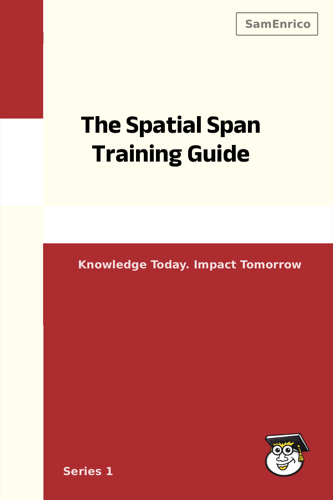
The Spatial Span Training Guide eBook
Improves visual spatial working memory using Corsi
by Winn Tisha
Improves visual spatial working memory using Corsi block tapping.
Formats
Free sample
Chapter 1: Beyond the Grocery List--–- Imagine, for a moment, that you are driving home from work. You are not using a GPS. You glance at the setting sun, note the familiar shape of the old water tower on your left, and instinctively turn right two streets early because you remember that the usual route is closed for construction. You park your car in a crowded lot and, without a second thought, walk directly to your parking spot the next morning. You pack a suitcase for a week-long trip, fitting a jacket, three pairs of shoes, and a laptop into the remaining gap between the wheel well and the hard-shell case, using every cubic inch of space.
You watch a child’s soccer game and, seconds before the ball is kicked, you know exactly where it will land.None of these actions involve a grocery list. None of them involve a mnemonic for a name or a number shape for a phone number. Yet each of these actions – navigation, spatial planning, packing, and predicting motion – is a miracle of cognition. They are the quiet, unheralded work of your visuospatial working memory. And for decades, the self-help memory industry has largely ignored them.Open any best-selling book on memory improvement.
You will find chapters on the “method of loci” (building a memory palace), the “major system” for memorizing numbers, and elaborate routines for remembering people’s names at parties. These are valuable skills. But they are almost exclusively verbal or sequential strategies. They treat memory as a list. They assume that the most important things to remember are words, digits, and faces.This book makes a radical, evidence-based counter-argument: your ability to remember where things are in space is just as important – and for many real-world tasks, more important – than your ability to remember a list of groceries.
And unlike verbal memory, which has been trained to death in the popular literature, visuospatial memory has a secret weapon: the Corsi Block Tapping Task, a neuroscientific tool so precise that it is used in hospitals to predict the onset of dementia up to twenty years in advance, and so effective that a single twenty-minute session has been shown to improve mental rotation speed by over 120 milliseconds.This chapter is not a training exercise. It is a reorientation. Before you touch a single block, before you log your first span, you must understand what you are training, why the standard memory advice has failed you, and how a simple board of nine wooden blocks became the gold standard for measuring the hidden half of your mind.The Great Blind Spot of Self-Help Memory The self-help memory industry is, to put it charitably, lopsided. Its roots lie in ancient Greek and Roman rhetoric, where orators needed to memorize hours-long speeches without notes. Their solution was the method of loci: mentally placing each topic in a familiar location (a temple, a house) and then “walking through” it.
This is a spatial technique, ironically – but modern adaptations have stripped it of its spatial essence, turning it into a verbal tagging system. The result is that most popular memory books teach you how to encode items, not relationships.Take a typical grocery list: milk, eggs, bread, apples, butter. The verbal mnemonist creates a story (“the milk cow kicked the egg into the bread basket…”). The spatial mnemonist, using a true visuospatial approach, would place each item in a different room of a mental house, noticing the layout of the items relative to each other. But even that is a static map.
The Corsi task trains something more dynamic: the ability to hold a sequence of locations in mind, update it in real time, and manipulate it under pressure.The blind spot is not accidental. Verbal memory is easy to test (just ask for the list back). It is easy to teach (mnemonics are formulaic). And it sells books because people feel frustrated when they forget a name. But visuospatial memory is harder to articulate.
You do not feel yourself forgetting a spatial sequence in the same way you feel a name slip off your tongue. You just… turn the wrong way. You pack the suitcase poorly. You misjudge the gap in traffic. You blame the GPS, the suitcase design, or the other driver.
You never blame your visuospatial working memory because you did not know you had one.This book ends that ignorance.What Is the Corsi Block Tapping Task? A Brief History In the early 1970s, a neuropsychologist named Philip Corsi was working at Mc Gill University in Montreal. He was interested in a simple question: is the memory for where something happened independent of the memory for what something was? At the time, the dominant test of short-term memory was the digit span – a researcher reads a list of numbers (e.g., “7, 3, 8, 2”), and the participant repeats them back. Corsi wanted a nonverbal, spatial analog.
So he created a board with nine identical wooden blocks arranged in an apparently random pattern. He would tap a sequence of blocks with his finger, and the participant had to tap the same sequence in the same order.The innovation was subtle but profound. By using identical blocks, Corsi removed any verbal label (you cannot say “the red block” or “the corner block” because all blocks are the same). By scattering them irregularly, he prevented the use of a memorized grid pattern (like a phone keypad). The participant could only rely on the relative spatial positions of the blocks.
The task became a pure measure of what psychologists now call the visuospatial sketchpad – a component of working memory separate from the phonological loop that handles language.Corsi found that the average person could repeat a sequence of about five blocks in the correct order. This became known as the Corsi span. Importantly, when he asked participants to repeat the sequence backward (reverse order), the average span dropped by about one to two items. The backward span required not just storage but manipulation – a function of a third component of working memory, the central executive.Decades later, the Corsi Block Tapping Task (CBTT) is used in virtually every neuropsychological assessment battery. It has been translated into dozens of languages.
It appears in the diagnostic criteria for Mild Cognitive Impairment (MCI), Alzheimer’s disease, Parkinson’s disease, ADHD, and traumatic brain injury. And in the past ten years, it has emerged as a training tool – not just a diagnostic one.Why Spatial Memory Matters More Than You Think If you are reading this book, you have likely already intuited that spatial memory is important. But the scale of its impact may surprise you. Let us review three domains of real-world function that are directly predicted by Corsi span – and that cannot be improved by memorizing a grocery list.Navigation and Wayfinding In 2018, a team of neuroscientists at University College London scanned the brains of London taxi drivers. They found that the drivers had significantly larger posterior hippocampi (the region responsible for spatial mapping) than control subjects.
More importantly, the taxi drivers’ Corsi spans were, on average, a full two items higher than the general population. The drivers did not get better at…
This is the end of the free sample. Get the eBook to keep going. Buy now
About this book
Details
- Author
- Winn Tisha
- Publisher
- SamEnrico
- Language
- English
- Genre
- Non-Fiction, Self-Help, Spatial Memory
- Released
- 2026-06-07
- Pages (approx.)
- 132
- Available as
- eBook, Audiobook

Read better in the ZLOADR app
Your eBooks on your phone or tablet. Sign in with your SamEnrico account and start reading.
More by Winn Tisha
 The Spanking Alternative GuideWinn Tisha$11.99
 Validation For Postpartum MoodWinn Tisha$11.99
 ED in Older MenWinn Tisha$11.99
 Step Two Practical SanityWinn Tisha$11.99
 The Lion Kings of Aksum: Africa's Forgotten Naval EmpireWinn Tisha$11.99
 How to Become a Loft Worker ApprenticeWinn Tisha$11.99
 .us Nexus Requirement GuideWinn Tisha$12.99
 PR for Nonprofit StartupsWinn Tisha$12.99
 The Breeder's Guide to Persian Rumpless ChickensWinn Tisha$11.99
 MopedsWinn Tisha$11.99
You may also like
 Visuospatial Working Memory DrillsSwafford Tiana$11.99
 Journey Method MasteryBean Rodrick$11.99
 Roman Room Technique GuideMckee Isa$11.99
 Memory Palace Construction HandbookStrange Ashanti$11.99
 Dream Setting GeographyFish Dalene$11.99
 Chunking Addresses And DirectionsNugent Vallie$11.99
 The Name Place Association MethodBryan Danny$11.99
 The Roman Room TechniqueWeeks Danyel$11.99
 The Journey Method HandbookLanglois Shaun$11.99
 Dream Location TrackerChan Krystyna$11.99
 Journey Method Locations GuideSegura Lina$11.99