
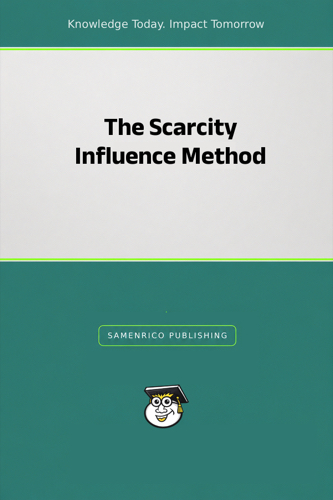
Non-FictionSelf-HelpBehavioral Economics
The Scarcity Influence Method eBook
Uses limited availability to increase perceived va
Uses limited availability to increase perceived value and urgency.
Formats
Free sample
Chapter 1: The Ancient Alarm...--–- Imagine you are standing on the African savanna, roughly two hundred thousand years ago. You haven't eaten in two days. Your tribe has been following a herd of antelope for a week, and now, finally, the animals have stopped to drink from a shrinking waterhole. You watch from behind a acacia tree as the largest male—muscle and fat enough to feed your entire tribe for a week—separates from the group. Your hand tightens around a wooden spear.
Your heart rate climbs. Your pupils dilate. In that moment, you are not thinking about philosophy or poetry or the price of grain at the market. You are thinking about one thing only: that animal will not be here forever. Take it now, or starve.That moment—the instant when limited resources meet the threat of loss—is the single most powerful driver of human decision-making.
It predates money, writing, agriculture, and even language. It lives in the oldest, deepest parts of your brain, and it activates every single day, in ways you almost never notice, whenever someone tells you that something you want is about to run out.This book is about that moment. It is about how to use limited availability ethically and effectively to increase perceived value, drive action, and build lasting customer loyalty. But before we can talk about strategy, tactics, or ethics, we have to understand the machinery underneath. And that machinery is ancient, automatic, and astonishingly powerful.The Superfood of Influence In the world of persuasion science, scarcity has a peculiar status.
In his landmark book Influence: The Psychology of Persuasion, social psychologist Robert Cialdini identified six universal principles that cause people to say yes: Reciprocity, Liking, Social Proof, Authority, Consistency, and Scarcity. Of these six, Cialdini later called scarcity the "superfood" of influence—not because it is always the strongest, but because it amplifies all the others.Think about how that works. When a product is scarce and recommended by authority figures, that scarcity feels more urgent. When it is scarce and selling quickly to other people (social proof), that scarcity feels more legitimate. When it is scarce and consistent with your self-image as a savvy shopper, you feel even more compelled to act.
Scarcity is not just a standalone lever; it is an accelerant poured onto every other fire of persuasion.But here is the crucial insight that most books get wrong: scarcity is not a marketing trick. It is not something you "add" to a product like a coat of paint. Scarcity is a fundamental feature of how the human brain perceives value. Neuroscientists have scanned brains while subjects viewed products labeled as "limited edition" versus "unlimited." The results are unambiguous: the amygdala (the brain's threat detection center) and the striatum (its reward center) activate simultaneously when people see scarce items. Your brain literally experiences the possibility of missing out as a threat and the possibility of securing a scarce item as a reward—at the exact same time.
That neurological double-hit is why scarcity feels so compelling and why it can drive people to act against their own rational self-interest.But here is the question that will define this entire book: What happens when that ancient alarm system is triggered by something that isn't actually scarce?The Great Deception Walk into any furniture store during a "going out of business" sale that has been running for three consecutive years. Open your email inbox during any major shopping holiday and count how many "last chance" messages you receive. Browse an e-commerce site and watch a countdown timer reset to twenty-four hours the moment you refresh the page. These are not examples of scarcity influence. They are examples of scarcity theater—performances of limitation designed to trigger your ancient alarm system with no underlying reality.And they are destroying your ability to use scarcity effectively.The problem is simple and brutal: the human brain learns.
When you see a countdown timer expire only to reset, your brain updates its model of reality. The first time, you felt urgency. The second time, less. By the tenth time, the timer becomes visual noise—easily ignored, barely noticed. This is called urgency fatigue, and it is the inevitable consequence of false scarcity.
Customers who have been burned by fake "limited time offers" develop antibodies. They become skeptical, resistant, and eventually immune.Worse, when customers discover that you have lied about scarcity, the damage extends beyond that single interaction. They will distrust your future scarcity claims. They will tell others. And in the age of social media and review sites, one exposed lie about inventory levels can destroy years of trust-building.Consider the cautionary tale of a major online retailer that was sued for displaying "Only 2 left!" messages on thousands of products that had warehouses full of inventory.
The class-action lawsuit alleged that the company had systematically misled customers into making faster purchasing decisions based on false information. The settlement cost millions. But the reputational cost—the quiet erosion of trust that never appears on a balance sheet—was likely far higher.This is the central tension that this book will resolve. Scarcity is one of the most powerful influence tools available. But it is also one of the most abused.
And that abuse has made customers wary, regulators attentive, and ethical practitioners frustrated. The question is not whether scarcity works. The question is how to use it in a way that is true—true to your product, true to your customers, and true to your own integrity.The Distinction That Changes Everything To use scarcity ethically and effectively, you must master a single distinction: genuine scarcity versus artificial scarcity.Genuine scarcity arises from real, verifiable limits that exist independently of your marketing. A vineyard produces only as much wine as that year's weather allows. A craftsman can make only fifty pieces per year because each one requires two weeks of labor.
A concert venue has only three thousand seats. A flight has only twelve first-class seats. A product uses a raw material that is naturally limited. A service requires the time of an expert who has only twenty-four hours in each day. These are real constraints.
They are not created by marketing; they are discovered by it.Artificial scarcity, by contrast, is manufactured purely to drive action. A "limited edition" of a product that could easily be produced in unlimited quantities. A "flash sale" that recurs every week. A "last chance" email that arrives monthly. A countdown timer that resets.
A "low stock" warning on an item with abundant inventory. These are not discoveries of real limits; they are inventions designed to trigger your ancient alarm system without any underlying fire.Here is the uncomfortable truth: most businesses operate in the gray area between these two poles. A clothing brand can produce ten thousand units of a design but chooses to produce only one thousand to create exclusivity. Is that genuine or artificial? The answer depends on perspective.
The brand could make more, but the decision to stop at one thousand is a real, binding constraint—the units literally do not exist beyond that number. This is called strategic scarcity, and…
This is the end of the free sample. Get the eBook to keep going. Buy now
About this book
Details
- Author
- Block Trenton
- Publisher
- SamEnrico
- Language
- English
- Genre
- Non-Fiction, Self-Help, Behavioral Economics
- Released
- 2026-06-08
- Pages (approx.)
- 142
- Available as
- eBook, Audiobook

Read better in the ZLOADR app
Your eBooks on your phone or tablet. Sign in with your SamEnrico account and start reading.
More by Block Trenton
 Geo Arbitrage for ConsultantsBlock Trenton$11.99
 Opioid Recovery Overdose Prevention CourseBlock Trenton$11.99
 IBS Menopause Transition GuideBlock Trenton$11.99
 The Addiction ConversationBlock Trenton$11.99
 Postpartum Depression and Single MothersBlock Trenton$11.99
 Pelvic Floor and C SectionBlock Trenton$11.99
 The Immigrant Dysfunction MemoirBlock Trenton$11.99
 Body Image For Hearing AidsBlock Trenton$11.99
 The Last Dance of the Blue AngelsBlock Trenton$11.99
 The Marble Muse: Canova and the Soul of NeoclassicismBlock Trenton$11.99
 The Great Train Robbery of 1963: The Untold Inside JobBlock Trenton$11.99
 How to Start a Referees and Umpires BusinessBlock Trenton$11.99
You may also like
 Hong Kong Handover 1997Dunn Johnnie$11.99
 Zumba For Postnatal Recovery CourseNeal Christian$11.99
 Zumba for BeginnersLadner Nikia$11.99
 YouTube Comment Mining GuideHumes Pandora$12.99
 Worry Box MeditationCarlin Rudy$11.99
 Workplace Stress MeditationNguyen Lynn$11.99
 Workplace Stress and Sleep RepairHawley Ivory$11.99
 Workplace Perfectionism CureDelaney Jeffry$11.99
 Workplace Injustice Anger GuideWallen Isabelle$11.99
 Work Addiction and Burnout LinkGreenwood Ester$11.99
 Women in Yoga and WellnessBeattie Galina$11.99
 Women in Stand Up ComedyChun Evangeline$11.99