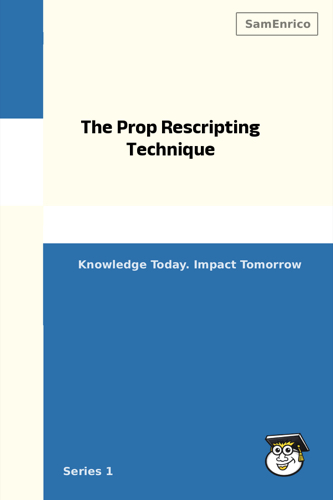
The Prop Rescripting Technique eBook
Uses physical objects to symbolize and change nigh
Uses physical objects to symbolize and change nightmare elements.
Formats
Free sample
Chapter 1: The Horror Loop...–- Sarah was thirty-four years old, a successful architect with a loving partner and a garden she tended every weekend. By all external measures, her life was stable, even enviable. But three or four nights each week, she died in her sleep. Not metaphorically. In the dream, she was back in the basement of her childhood home, the one with the cracked concrete floor and the single bare bulb that swung on a wire.
The door at the top of the stairs would slam. The light would flicker once, twice, then go out. And then the footsteps would begin—slow, heavy, deliberate—descending one creaking step at a time. Sarah would try to run, but her legs were set in wet cement. She would try to scream, but her throat produced only a thin, reedy whisper.
The footsteps reached the bottom. A hand, cold and impossibly large, closed around her neck. She woke gasping, heart hammering, sheets soaked with sweat. The terror followed her into the bathroom mirror, into her coffee, into the morning meeting where she stared blankly at blueprints she had designed herself. She had tried everything: meditation apps, prescription sleep aids, therapy, even a dreamcatcher her sister gave her as a joke.
Nothing worked. The basement always came back.If you are reading this, you may have your own version of Sarah’s basement. Maybe it is a chase through endless hallways, a fall from a collapsing bridge, an examination you have not studied for, a faceless figure standing at the foot of your bed. Maybe it is a replay of something that actually happened—a car accident, an assault, a moment of humiliation that your brain has decided to screen nightly like a broken projector. Whatever form it takes, you know the signature experience: the helplessness, the certainty that this time you will not wake up, and the exhaustion that follows you into daylight like a second shadow.Here is the first thing you need to understand: you are not broken.
The problem is not that you are weak, anxious, or secretly wanting these nightmares to continue. The problem is that your brain is trying to do something useful—protect you from future danger—but it is doing so with obsolete software and a corrupted file. This chapter will explain exactly why your brain keeps replaying the horror movie, why traditional “positive thinking” or “just ignore it” strategies fail, and how a radically different approach—using physical objects to rewrite your dreams from the outside in—can finally break the loop.The Evolutionary Paradox: Why Your Brain Built a Horror Generator To understand why nightmares persist, you must first understand why dreams exist at all. For most of human history, sleep scientists believed dreams were meaningless noise—the brain’s way of cleaning house, like a dishwasher running at night. But over the past three decades, a more compelling theory has emerged, supported by hundreds of studies across neuroscience, evolutionary biology, and clinical psychology.
It is called Threat Simulation Theory (TST) , and its central claim is both simple and startling: dreams, especially negative ones, evolved as a virtual reality training ground for survival.Consider the environment in which the human brain evolved. For millions of years, our ancestors faced predators, hostile tribes, natural disasters, and resource scarcity every single day. The individuals who survived were not necessarily the strongest or fastest; they were the ones who could anticipate danger before it arrived. They were the ones who, having been chased by a lion once, could replay that chase in their minds and rehearse escape routes. They were the ones who could dream of a predator hiding in the tall grass and wake up just a little more vigilant.
Threat Simulation Theory argues that dreams are precisely this: a safe, low-cost simulation of dangerous scenarios that allows the brain to practice threat detection and avoidance without real-world consequences.Here is the evidence. Studies of dream content across cultures have found that negative dreams—being chased, attacked, falling, or failing—are vastly more common than positive ones, regardless of whether the dreamer lives in a high-crime city or a rural village. Children’s nightmares typically begin around age three or four, exactly when the brain’s threat-detection systems come online. And people who report more frequent threatening dreams also perform better on tests of threat recognition—they spot the angry face in a crowd faster, they react more quickly to sudden noises, they are less likely to walk into obvious danger. In other words, a nightmare is not a glitch.
It is a feature. It is your brain running fire drills in the dark.So why do some people get stuck? Why does Sarah’s basement return night after night, year after year, while most people have a scary dream, wake up, and never think of it again? The answer lies in the difference between a functional simulation and a stuck loop.The Stuck Loop: When the Fire Drill Never Ends A functional threat simulation works like this: you have a frightening experience or imagine a possible danger. Your brain encodes that scenario.
During REM sleep, it replays the scenario, but with a crucial twist—it also rehearses a successful avoidance or escape. You dream of being chased, but you find a hiding place. You dream of falling, but you sprout wings. Even if you do not remember the dream consciously, your brain has run a simulation that ends in mastery. The next day, you are slightly better prepared for real-world threats.
The loop closes. The file is archived.A stuck loop works differently. Something prevents the brain from completing the simulation. That “something” is usually trauma, chronic stress, or an anxiety disorder—conditions that keep the brain’s fear circuits permanently dialed up. Instead of archiving the threat, the brain treats it as unresolved and ongoing.
It replays the scenario again. And again. And again. But each time, it replays only the danger part, not the escape part. The simulation never reaches mastery.
The file never closes. You wake up, exhausted and afraid, and the next night the brain says, “We still haven’t solved this. Let’s try again.”This is why Sarah’s nightmare never changes. She is not failing to imagine a better outcome. She is fighting against a neurological system that has lost the ability to imagine anything except the threat.
Her brain is not being malicious. It is being inefficient—like a smoke alarm that keeps beeping long after the fire is out because the battery is dying and the sensor is clogged.Why Positive Thinking Fails During a Nightmare If you have had recurring nightmares for any length of time, you have probably received well-meaning advice: “Just tell yourself it’s not real.” “Imagine the monster turning into a bunny.” “Think positive thoughts before bed.” You have also probably discovered, through bitter experience, that this advice does not work. It is not because you are bad at positive thinking. It is because the part of your brain that does positive thinking is literally offline when a nightmare strikes.Let us look at the neuroscience. During waking hours, your brain operates through…
This is the end of the free sample. Get the eBook to keep going. Buy now
About this book
Details
- Author
- Stanley Lynette
- Publisher
- SamEnrico
- Language
- English
- Genre
- Non-Fiction, Self-Help, Symbolism
- Released
- 2026-06-06
- Pages (approx.)
- 139
- Available as
- eBook, Audiobook

Read better in the ZLOADR app
Your eBooks on your phone or tablet. Sign in with your SamEnrico account and start reading.
More by Stanley Lynette
 Resilience for First RespondersStanley Lynette$11.99
 Immigrant Real Estate MogulStanley Lynette$11.99
 Prolapse Support GuideStanley Lynette$11.99
 Freelance Rate Negotiation ScriptsStanley Lynette$11.99
 Beyoncé FormationStanley Lynette$11.99
 The Trance Depth ScaleStanley Lynette$11.99
 Small Audience SpeakingStanley Lynette$11.99
 When the World Was Sung Into Being: The Cosmic Melody of the Yoruba OrishasStanley Lynette$11.99
 Hina's Celestial Hymn: The Birth of the MoonStanley Lynette$11.99
 Ultimate Handbook Guide to Zhaotong : (China) Travel GuideStanley Lynette$11.99
 Ghana Dropshipping Clearance AgentStanley Lynette$12.99
 Franchise International Payment SystemsStanley Lynette$12.99