
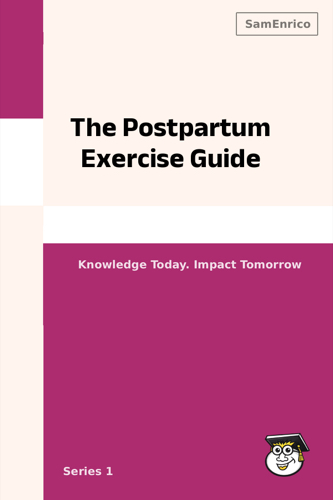
Non-FictionHealth & WellnessExercise
The Postpartum Exercise Guide eBook
Use gentle movement to improve mood and reduce anx
Use gentle movement to improve mood and reduce anxiety.
Formats
Free sample
Chapter 1: The Twelve-Month Window--–- The first time Sarah tried to go for a run, she was twelve weeks postpartum. Her daughter had finally slept a three-hour stretch, and Sarah felt a desperate pull toward something that felt like her old self. She laced up her sneakers, kissed the baby’s forehead, and stepped outside. By the second block, she felt a strange heaviness in her pelvis—not pain, exactly, but a dull, insistent pressure. By the fourth block, she was leaking urine with every footfall.
She turned around, walked home, and sat on the bathroom floor crying while her daughter napped upstairs. She thought: What is wrong with my body?The answer, which no one had told her, was nothing. Nothing was wrong. Her body was exactly where it should be for a woman who had grown and birthed a human only twelve weeks earlier. The problem was not her pelvic floor or her healing core.
The problem was the timeline she had unknowingly absorbed from a culture that treats postpartum recovery as a six-week inconvenience rather than a twelve-month biological process.This chapter reframes everything you think you know about postpartum recovery. It will challenge the myths you have seen in celebrity magazine covers, heard from well-meaning friends, and perhaps even received from medical providers who clear women for “all activities” at a single six-week appointment. You will learn why the fourth trimester is not six weeks but a full year, how gentle movement directly improves mood and reduces anxiety at the level of your brain chemistry, and why “bouncing back” is a harmful fantasy while “bouncing forward” is a transformative reality. By the end of this chapter, you will have permission to heal on your body’s schedule—and a roadmap for doing so.The Great Postpartum Lie Popular culture sells new mothers a dangerous fiction. Open any celebrity gossip magazine six weeks after a famous woman gives birth, and you will see a photograph of her looking thin, toned, and often in a bikini.
The headline will read something like “She’s Back!” or “Post-Baby Body Amazing!” The implicit message is clear: if she can do it, so can you. And if you cannot, you are failing.This is not merely unhelpful. It is medically irresponsible. The term “bouncing back” suggests that pregnancy and childbirth are temporary detours from a woman’s real body—that the goal of postpartum recovery is to erase all evidence of having carried a child. This philosophy ignores basic physiology.
It ignores the fact that the hormone relaxin, which loosens your ligaments to accommodate pregnancy and birth, remains in your system for up to twelve months. It ignores that the wound left by the placenta—a dinner-plate-sized attachment site on the uterine wall—takes six to eight weeks just to heal its surface, and months longer to fully restore tissue integrity. It ignores that the pelvic floor, which supported an additional twenty to forty pounds for months, does not simply snap back into place like an elastic band.The lie serves no one except the fitness industry selling quick-fix programs and the media selling impossible standards. The truth is this: the vast majority of women who appear to have “bounced back” within weeks are either genetically exceptional, surgically assisted, digitally altered, or suffering in silence with symptoms they will not disclose. Meanwhile, ordinary mothers compare themselves to these images and conclude that their own bodies are broken.Your body is not broken.
It has done something extraordinary. And extraordinary healing takes time.The Twelve-Month Healing Window Let us establish a foundational concept that will guide every exercise, every breath, and every decision in this book: the postpartum healing window is twelve months, not six weeks.This is not an opinion. It is a synthesis of evidence from pelvic floor physical therapy, obstetrics, sports medicine, and endocrinology. Consider the following timeline:First six weeks: This is the traditional “postpartum period” defined by obstetrics. During this time, the placental wound heals, the uterus returns to its pre-pregnancy size (involution), and lochia (post-birth bleeding) gradually resolves.
However, being cleared for “normal activity” at a six-week checkup does not mean you are fully healed. It means you are no longer at acute risk of hemorrhage or infection.Six weeks to six months: The hormone relaxin begins to decline but remains present. Connective tissue—including the ligaments of the pelvis, the linea alba (the connective tissue between your abdominal muscles), and the supportive structures of the pelvic floor—continues to remodel. This is a period of vulnerability. Many women feel “better” and return to high-impact activities only to develop new symptoms like pelvic heaviness, leaking, or low back pain.Six months to twelve months: Relaxin levels return to baseline in most women.
The pelvic floor and core can begin to tolerate higher loads. However, complete healing of connective tissue can take up to a year, particularly for women who had diastasis recti, perineal tearing, or C-section incisions. For breastfeeding mothers, hormonal changes (low estrogen) can keep tissues more lax and prone to injury throughout this entire window.The twelve-month window does not mean you cannot exercise. It means the type, intensity, and progression of exercise must respect where you are in this timeline. A woman at three months postpartum is biologically different from a woman at nine months postpartum.
Pushing too hard too early does not speed recovery; it creates setbacks that can last for years.The Physiological Link Between Movement and Mood Now for the good news: gentle, appropriate movement during this twelve-month window is one of the most powerful tools you have for improving mood and reducing anxiety. This is not just a feeling. It is measurable brain chemistry.When you move your body—even in the gentlest ways, such as a slow walk around your living room or a few minutes of diaphragmatic breathing—several things happen in your brain and nervous system:Endorphin Release. Endorphins are your body’s natural painkillers and mood elevators. They bind to the same receptors as opioid drugs but without the risks.
Low-intensity, sustained movement (like walking or restorative yoga) triggers a steady release of endorphins that can last for hours after you stop moving. This is why a ten-minute walk can turn a tearful, overwhelmed afternoon into a manageable one.Cortisol Reduction. Cortisol is the primary stress hormone. It is essential for survival—it helps you respond to danger—but chronic elevation of cortisol, which is common in sleep-deprived new mothers, damages the brain’s hippocampus (memory center), increases abdominal fat storage, and worsens anxiety. Gentle movement lowers cortisol.
High-intensity movement, interestingly, can temporarily raise cortisol. This is one reason why the “gentle” in this book’s title is not optional. During the early months of postpartum recovery, low-intensity exercise is superior for mood regulation.BDNF Increase. Brain-Derived Neurotrophic Factor (BDNF) is a protein that supports the survival of existing neurons and encourages the growth of new ones. Low levels of BDNF are associated with depression and anxiety.
Exercise—even gentle exercise—increases BDNF. Think of BDNF as fertilizer for your brain. When you move, you are literally growing resilience.GABA Modulation. Gamma-aminobutyric acid (GABA) is your brain’s primary…
This is the end of the free sample. Get the eBook to keep going. Buy now
About this book
Details
- Author
- Wesley Dorthey
- Publisher
- SamEnrico
- Language
- English
- Genre
- Non-Fiction, Health & Wellness, Exercise
- Released
- 2026-06-07
- Pages (approx.)
- 156
- Available as
- eBook, Audiobook

Read better in the ZLOADR app
Your eBooks on your phone or tablet. Sign in with your SamEnrico account and start reading.
More by Wesley Dorthey
 Compulsive Spending Visual BoardWesley Dorthey$11.99
 Dementia Anticipatory Grief GuideWesley Dorthey$11.99
 Self Hypnosis for Sleep GuideWesley Dorthey$11.99
 Caffeine Nap Strategy GuideWesley Dorthey$11.99
 Self Hypnosis for ProductivityWesley Dorthey$11.99
 Palace Maintenance GuideWesley Dorthey$11.99
 Jumia Flash Sales StrategyWesley Dorthey$12.99
 Nonverbal Cues in PresentationsWesley Dorthey$11.99
 The Unseen War: How the 1983 Korean Air Lines Flight 007 Disaster Redefined Cold War EspionageWesley Dorthey$11.99
 Charlemagne's Golden Ale: Brewing a RenaissanceWesley Dorthey$11.99
 Meerkats: Mob Social StructureWesley Dorthey$11.99
 How to Produce CroutonsWesley Dorthey$11.99
You may also like
 Hong Kong Handover 1997Dunn Johnnie$11.99
 Zumba For Postnatal Recovery CourseNeal Christian$11.99
 Zumba for BeginnersLadner Nikia$11.99
 YouTube Comment Mining GuideHumes Pandora$12.99
 Worry Box MeditationCarlin Rudy$11.99
 Workplace Stress MeditationNguyen Lynn$11.99
 Workplace Stress and Sleep RepairHawley Ivory$11.99
 Workplace Perfectionism CureDelaney Jeffry$11.99
 Workplace Injustice Anger GuideWallen Isabelle$11.99
 Work Addiction and Burnout LinkGreenwood Ester$11.99
 Women in Yoga and WellnessBeattie Galina$11.99
 Women in Stand Up ComedyChun Evangeline$11.99