
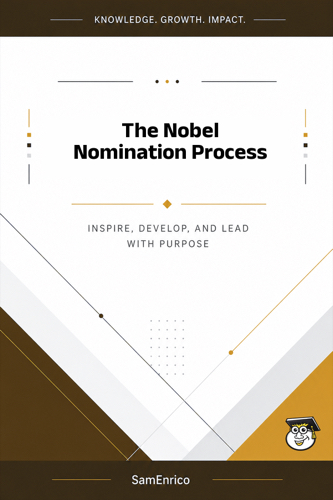
The Nobel Nomination Process
How scientists, professors, and past winners put f
How scientists, professors, and past winners put forward candidates each year.
Formats
About this book
Free sample
Chapter 1: The September Drop...--–- The envelope—or, more commonly now, the encrypted email—arrives without warning. For the 3,000 people who receive it each year, September 15th is not a date circled on calendars. It is a date that rewrites them. One morning, they are ordinary professors, academy members, or retired laureates. By noon, they have become the most powerful talent scouts on Earth.
They hold in their hands the right to nominate someone for a Nobel Prize—a right that most of humanity will never possess, and that the recipients themselves will never be allowed to discuss openly for fifty years.This chapter opens the machine. It reveals how the invitation lists are built, who makes the cut, who is left out, and why the quiet drama of September 15th matters more than the December ceremony. The world watches the laureates on stage in Stockholm and Oslo. But the real story—the one this book tells—begins twelve months earlier, in the private inboxes of strangers.The September 15th Mechanism The Nobel Foundation does not announce the opening of the nomination period. There are no press releases, no social media campaigns, no countdown clocks.
On September 15th of each year—precisely fifteen months before the December ceremony in which the next laureates will be honored—the four Nobel Committees send their invitations in silence.The numbers are precise. For the Physics Prize, approximately 500 invitations go out. For Chemistry, roughly 450. For Medicine or Physiology, about 600. For Literature, the number is smaller and more secretive—often under 300.
For the Peace Prize, the Norwegian Nobel Committee casts the widest net, sending invitations to over 1,000 individuals and organizations, including every current head of state, every university professor of law and political science, and every former Peace Prize laureate. The Economics Prize, added in 1968 by the Swedish central bank, follows the same pattern as the sciences, with around 450 invitations.These numbers are not random. They are the product of decades of institutional refinement. The Royal Swedish Academy of Sciences, which awards the Physics, Chemistry, and Economics prizes, maintains a constantly updated…
This is the end of the free sample. Get the eBook to keep going. Buy now
Contents
- Chapter 1
- Chapter 2
- Chapter 3
- Chapter 4
- Chapter 5
- Chapter 6
- Chapter 7
- Chapter 8
- Chapter 9
- Chapter 10
- Chapter 11
- Chapter 12
Details
- Author
- Mattingly Rosalia
- Publisher
- SamEnrico
- Language
- English
- Genre
- Non-Fiction, Biography, Process
- Released
- 2026-06-07
- Pages (approx.)
- 153
- Available as
- eBook, Audiobook

Read better in the ZLOADR app
Your eBooks on your phone or tablet. Sign in with your SamEnrico account and start reading.
More by Mattingly Rosalia
 Megan McCain View SeatMattingly Rosalia$11.99
 Vague Instructions Anger GuideMattingly Rosalia$11.99
 The Career Setback DisappointmentMattingly Rosalia$11.99
 Veteran Financial Stress GuideMattingly Rosalia$11.99
 The Phantom of the Horseshoe: The Curse of the Texas-OU RivalryMattingly Rosalia$11.99
 Export Payment Reconciliation GuideMattingly Rosalia$12.99
 Zapier PLG GuideMattingly Rosalia$12.99
 Understanding Radial Hypoplasia, Triphalangeal Thumbs and HypospadiasMattingly Rosalia$17.99
 Graduate AssistantMattingly Rosalia$11.99
 How to Start a Ores (commission Agent) Business (Beginners Guide)Mattingly Rosalia$11.99
You may also like
 Hong Kong Handover 1997Dunn Johnnie$11.99
 Zumba For Postnatal Recovery CourseNeal Christian$11.99
 Zumba for BeginnersLadner Nikia$11.99
 YouTube Comment Mining GuideHumes Pandora$12.99
 Worry Box MeditationCarlin Rudy$11.99
 Workplace Stress MeditationNguyen Lynn$11.99
 Workplace Stress and Sleep RepairHawley Ivory$11.99
 Workplace Perfectionism CureDelaney Jeffry$11.99
 Workplace Injustice Anger GuideWallen Isabelle$11.99
 Work Addiction and Burnout LinkGreenwood Ester$11.99
 Women in Yoga and WellnessBeattie Galina$11.99
 Women in Stand Up ComedyChun Evangeline$11.99