
Non-FictionSelf-HelpDream Therapy
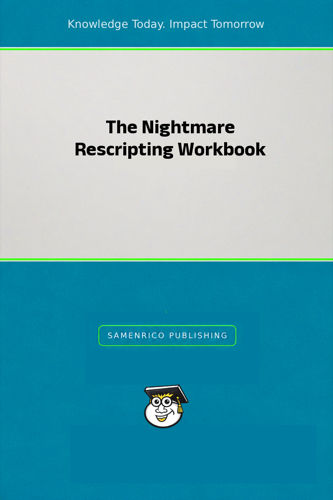
The Nightmare Rescripting Workbook eBook
Teaches rewriting disturbing dream narratives with
Teaches rewriting disturbing dream narratives with empowering endings and safe outcomes.
Formats
Free sample
Chapter 1: The Dream Trap...--Most people believe nightmares are their enemy. They wake up sweating, heart pounding, convinced that something inside them is broken, haunted, or cursed. But here is the truth that changes everything: your nightmare is not trying to destroy you. It is trying to protect you. It is just doing a terrible job.This chapter will reframe everything you think you know about your nightmares.
By the time you finish these pages, you will stop asking "What is wrong with me?" and start asking "What is my brain trying to practice?" That single shift in perspective is the first and most powerful step toward rewriting your dreams. Without it, no technique will stick. With it, you become someone who can look at a nightmare and say, not with bravado but with genuine understanding: "I see what you are trying to do. Now let me show you a better way."The Evolutionary Gift That Went Wrong Let us travel back approximately 200,000 years. You are an early human living on the African savanna.
Your survival depends on your ability to anticipate danger before it arrives. A rustle in the grass could be wind—or a saber-toothed cat. A shadow at dusk could be a tree—or a rival tribe. Your brain faces an impossible problem: it cannot afford to wait for proof. By the time you have proof, you are already dead.The solution evolution arrived at was the threat simulation system.
During sleep, your brain runs practice scenarios. It generates virtual dangers—being chased, falling from a height, losing your tribe, being attacked—and rehearses your response. This is not a bug. It is a feature. Research by Finnish neuroscientist Dr.
Antti Revonsuo and others has shown that mammals who dream more actively have higher survival rates in dangerous environments. The nightmare, in its original evolutionary context, was a flight simulator for survival.Now consider your modern life. You are not being hunted by predators. Your village is not being raided. But your brain does not know that.
Your amygdala, the almond-shaped cluster of neurons that processes threats, reacts to a rude email from your boss with the same biochemical cascade it would use for a lion charging at you. Cortisol floods your system. Your heart rate spikes. Your muscles tense. And at night, your threat simulation system takes the raw material of your daily stress, anxiety, and unresolved trauma and turns it into a nightmare.The problem is not that you have nightmares.
The problem is that your brain's threat simulation system has become stuck in a loop. Instead of running a new scenario each night—being chased, escaping, learning, moving on—it replays the same script over and over. This is called a "repetitive nightmare," and it is the neurological equivalent of a scratched record. The needle skips. The same terror plays again.
And each time it plays, the neural pathway to that fear gets deeper and stronger.Here is the cruel irony: your nightmare is trying to help you survive. But because it is stuck, it is actually making you less likely to survive. Chronic nightmares degrade sleep quality, which impairs immune function, emotional regulation, and cognitive performance. They create sleep dread, which leads to insomnia, which leads to more nightmares. The very system designed to protect you becomes a prison.Processing Trauma vs.
Repeating Trauma: The Crucial Distinction One of the most important concepts you will learn in this book is the difference between processing trauma and repeating trauma. They look similar on the surface but produce opposite outcomes.Processing trauma means that your brain takes a distressing event, integrates it into your life narrative, and reduces its emotional charge. When you process trauma, you might still remember the event, but it no longer hijacks your nervous system. You can think about it without your heart racing. You can talk about it without dissociating.
Processing is what healthy brains do naturally over time, with the help of good sleep, social support, and sometimes therapy.Repeating trauma means that your brain replays the event (or a symbolic version of it) without integration. The emotional charge remains at full intensity. Each replay strengthens the fear memory rather than diminishing it. This is what happens in repetitive nightmares, flashbacks, and intrusive thoughts. The brain is not healing.
It is practicing the wound.Imagine you are learning to play a new song on the piano. If you play the same wrong note in the same place every time, you are not learning the song. You are learning to play the mistake. Your brain is a prediction machine. It builds neural pathways based on repetition.
Every time you have the same nightmare, you are not processing anything. You are drilling the fear.This is why waiting for nightmares to "go away on their own" is usually a failed strategy. For some people, especially after a single traumatic event, nightmares do fade naturally within a few months. But for many others—particularly those with a history of childhood trauma, chronic anxiety, or PTSD—nightmares become entrenched. They become habits.
And habits require active intervention to change.The good news is that the same neuroplasticity that allows you to learn a bad habit also allows you to unlearn it. Your brain can change. It is always changing. The question is not if your brain will change, but in which direction. This book exists to help you point it toward safety.The Shame Trap: Why "What Is Wrong With Me?" Is the Wrong Question Before we go any further, let us address the single biggest barrier to nightmare recovery: shame.Almost every person who suffers from chronic nightmares has asked themselves some version of the following questions: "Why am I still having this dream?
It has been years. What is wrong with me? Am I broken? Am I weak? Did I cause this?"These questions are not just unhelpful.
They are actively harmful. Shame increases cortisol. Cortisol increases nightmare frequency. Nightmare frequency increases shame. You see the loop.Here is what the research actually shows: having chronic nightmares is not a sign of weakness, moral failure, or lack of effort.
It is a sign that your brain's threat simulation system has become stuck. That is a neurological problem, not a character problem. People with the strongest willpower in the world cannot "think their way out" of a nightmare any more than they can "think their way out" of a broken leg. The nightmare is not a thought. It is a neural circuit.Consider this analogy.
If your car's check engine light comes on, you do not conclude that you are a bad person. You conclude that a specific system in your car needs attention. The light is information, not indictment. Your nightmare is the same. It is your brain's check engine light.
It is telling you that your threat simulation system is malfunctioning. That is all. It says nothing about your worth, your strength, or your character.One of the most powerful moments in nightmare therapy occurs when a person stops saying "Why am I having this nightmare?" and starts saying "What is my brain trying to practice?" The first question leads to…
This is the end of the free sample. Get the eBook to keep going. Buy now
About this book
Details
- Author
- Plunkett Edythe
- Publisher
- SamEnrico
- Language
- English
- Genre
- Non-Fiction, Self-Help, Dream Therapy
- Released
- 2026-06-07
- Pages (approx.)
- 160
- Available as
- eBook, Audiobook

Read better in the ZLOADR app
Your eBooks on your phone or tablet. Sign in with your SamEnrico account and start reading.
More by Plunkett Edythe
 Caregiver Social Isolation RecoveryPlunkett Edythe$11.99
 Fertility After Miscarriage GuidePlunkett Edythe$11.99
 Trauma Related Anger Triggers HandbookPlunkett Edythe$11.99
 Anger at Fate or UniversePlunkett Edythe$11.99
 The Iron Crown and the Imperial Dream: Frederick Barbarossa and the Forging of GermanyPlunkett Edythe$11.99
 How to Become a Concrete-mixing-truck DriverPlunkett Edythe$11.99
 Board OperatorPlunkett Edythe$11.99
 Studying PhD in China GuidePlunkett Edythe$12.99
 Eli Lilly SWOT GuidePlunkett Edythe$12.99
 Understanding Oculodentoosseous Dysplasia DominantPlunkett Edythe$17.99
You may also like
 Hong Kong Handover 1997Dunn Johnnie$11.99
 Zumba For Postnatal Recovery CourseNeal Christian$11.99
 Zumba for BeginnersLadner Nikia$11.99
 YouTube Comment Mining GuideHumes Pandora$12.99
 Worry Box MeditationCarlin Rudy$11.99
 Workplace Stress MeditationNguyen Lynn$11.99
 Workplace Stress and Sleep RepairHawley Ivory$11.99
 Workplace Perfectionism CureDelaney Jeffry$11.99
 Workplace Injustice Anger GuideWallen Isabelle$11.99
 Work Addiction and Burnout LinkGreenwood Ester$11.99
 Women in Yoga and WellnessBeattie Galina$11.99
 Women in Stand Up ComedyChun Evangeline$11.99