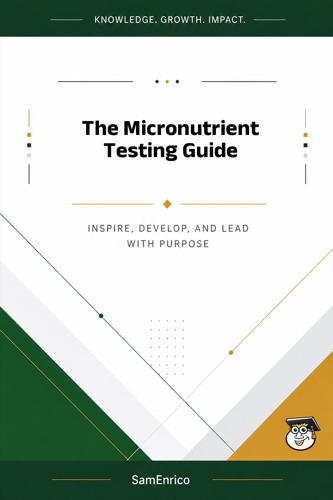
The Micronutrient Testing Guide eBook
Understand blood tests for vitamin and mineral lev
by Erwin Corina
Understand blood tests for vitamin and mineral levels and interpret results.
Formats
Free sample
Chapter 1: The Soil Secret--–- In 2004, a 34-year-old marathon runner named Sarah walked into her doctor's office with a complaint that made no sense. She had logged over 2,000 miles of training that year. Her diet was impeccable—kale salads, wild salmon, fermented vegetables, grass-fed beef. She meditated daily, slept eight hours, and hadn't touched alcohol in six months. By every metric of modern wellness, Sarah was doing everything right.And yet, she could barely climb a flight of stairs.Her legs felt like lead.
Her mind clouded over by 2 p.m. each day. She needed nine hours of sleep just to function, and even then, she woke up groggy. Her hair was thinning. Her skin was pale.
Her running times had slowed by nearly 20 percent. Her doctors ran every test imaginable: complete blood count, thyroid panel, comprehensive metabolic panel, autoimmune markers, even a sleep study. Every result came back "normal."She was told, repeatedly, that nothing was wrong with her. That she should consider stress reduction. That maybe she was overtraining.
That perhaps it was "all in her head."Sarah was not crazy. She was micronutrient deficient.Her ferritin—a measure of iron storage—was 32 ng/m L. Her lab's "normal" range started at 15 ng/m L, so her result was flagged as unremarkable. But functional medicine research has since shown that ferritin below 50 ng/m L in an athletic woman causes profound fatigue, impaired oxygen delivery, and diminished athletic performance. Below 70 ng/m L, many women experience hair loss, brain fog, and cold intolerance.
Sarah was living proof.When she finally found a practitioner who understood functional ranges—not just pathological ones—she was prescribed iron supplementation and dietary changes. Within three months, her ferritin rose to 90 ng/m L. Her energy returned. Her hair thickened. She ran a personal best marathon that fall.Sarah's story is not rare.
It is the rule.The Great Deception of Modern Nutrition We have been told a simple, seductive story: eat well, exercise, and you will be healthy. This story assumes that the food we eat contains the nutrients we need, that our bodies can absorb those nutrients, and that standard medical tests will warn us if something goes wrong.Every single one of these assumptions is collapsing in real time.The truth is that you can eat a perfect diet and still be malnourished. You can take expensive supplements and still be deficient. You can visit the best doctors and still be told that your crushing fatigue, brain fog, depression, and muscle weakness are "normal"—because your lab results fall within an arbitrary statistical range that was never designed to measure health in the first place.This chapter is about the gap. The gap between what we think we know about nutrition and what our blood actually reveals.
The gap between the RDA—the Recommended Dietary Allowance—and what your mitochondria actually require to produce energy. The gap between "not sick" and "thriving."Understanding this gap is the first step toward reclaiming your vitality. And it begins with a hard truth: the food you eat today is not the food your grandparents ate. Not even close.The Three Modern Crises Three simultaneous crises have created the micronutrient gap that leaves millions of people exhausted, inflamed, and confused despite their best efforts to eat well. Each crisis alone would be significant.
Together, they are catastrophic.Crisis One: The Empty Earth Industrial agriculture has systematically stripped the soil of essential minerals over the past seventy years. The mechanism is straightforward: modern farming prioritizes yield, appearance, and shipping durability over nutrient density. Crops are bred to grow faster and larger, which dilutes their mineral content. Soil is depleted by continuous planting without adequate fallowing or composting. Synthetic fertilizers replace only nitrogen, phosphorus, and potassium—the NPK trio—while ignoring the trace minerals like magnesium, zinc, selenium, and copper that plants once drew from rich, living soil.The data is staggering.
A landmark 2004 study published in the Journal of the American College of Nutrition compared USDA nutrient data from 1950 to 1999 and found significant declines in protein, calcium, phosphorus, iron, riboflavin, and vitamin C across forty-three different fruits and vegetables. More recent research from the University of Texas analyzed the mineral content of wheat, barley, and sugar beets over the past 160 years and found that the concentration of copper, magnesium, and zinc had fallen by more than 30 percent.Consider magnesium. This single mineral is involved in over three hundred enzymatic reactions, including ATP production, DNA synthesis, and muscle relaxation. In 1950, a cup of spinach contained approximately 150 mg of magnesium. Today, that same cup contains roughly 70 mg.
You would need to eat twice as much spinach to get the same mineral benefit—and that assumes your soil is average, not below average.A carrot today contains about half the magnesium of a carrot in 1950. An apple contains 60 percent less iron. Broccoli has 75 percent less calcium. We are eating the same volume of food but absorbing a fraction of the nutrients.This is not a conspiracy. It is the unintended consequence of an agricultural system designed to feed billions of people cheaply.
But understanding it is essential: when your doctor tells you to eat more leafy greens to correct a magnesium deficiency, they are operating on nutritional data from a world that no longer exists.Crisis Two: The Body Under Siege Even if the soil were as rich as it was a century ago, modern life actively depletes your nutrient stores faster than any generation in human history. Three drivers are responsible.Chronic Stress. Your body's stress response—the hypothalamic-pituitary-adrenal (HPA) axis—burns through B vitamins and magnesium at an extraordinary rate. When you are stressed, your adrenal glands produce cortisol and adrenaline, a process that requires vitamin B5, B6, B12, and magnesium. Prolonged stress depletes these nutrients so effectively that researchers have proposed magnesium deficiency as a biomarker of chronic stress.
If you feel constantly on edge, if your mind races at 3 a.m., if you cannot seem to relax even on vacation, you are likely burning through your nutrient reserves faster than you can replenish them.Medications. The drugs that millions of people take every day to manage chronic conditions often block nutrient absorption. This is rarely discussed in doctor's offices. Metformin, the most common diabetes medication, depletes vitamin B12 and folate. Proton pump inhibitors like omeprazole and esomeprazole—taken by tens of millions for acid reflux—block the stomach acid needed to absorb B12, calcium, iron, and magnesium.
Oral contraceptives deplete B6, B12, folate, and zinc. Statins deplete Co Q10, a nutrient essential for heart function. Diuretics flush out potassium and magnesium. The list is long and the cumulative effect is profound: many people are nutrient-deficient not because they eat poorly but because their medications are quietly starving their cells.Environmental Toxins. Heavy metals like mercury, lead, and cadmium—present in old paint, contaminated water, certain fish, and industrial pollution—bind to nutrient transport proteins and block absorption.
Your body cannot distinguish between zinc and cadmium; they compete for the same receptors. If cadmium is present, it wins. The same is true for lead and calcium, mercury and selenium. You could be eating a selenium-rich…
This is the end of the free sample. Get the eBook to keep going. Buy now
About this book
Details
- Author
- Erwin Corina
- Publisher
- SamEnrico
- Language
- English
- Genre
- Non-Fiction, Health & Wellness, Testing
- Released
- 2026-06-09
- Pages (approx.)
- 151
- Available as
- eBook, Audiobook

Read better in the ZLOADR app
Your eBooks on your phone or tablet. Sign in with your SamEnrico account and start reading.
More by Erwin Corina
 Anki For History StudentsErwin Corina$11.99
 Workaholic Nutrition GuideErwin Corina$11.99
 Laminate Glass ForensicsErwin Corina$11.99
 Burnout Prevention for VeterinariansErwin Corina$11.99
 Léopold Sédar Senghor Poet PresidentErwin Corina$11.99
 The CPR Skills CheckoffErwin Corina$11.99
 Infant Loss Grief GuideErwin Corina$11.99
 The Magnificent Madam C.J. Walker: The Business Empire That Transformed BeautyErwin Corina$11.99
 Beyond the Summit: The Unseen Ascent of Tamotsu YamadaErwin Corina$11.99
 How to Start a Courier (other Than National Post) Unlicensed Business (Beginners Guide)Erwin Corina$11.99
 Golden Retriever: Eager to PleaseErwin Corina$11.99
 Amazon Buy Box GuideErwin Corina$12.99