
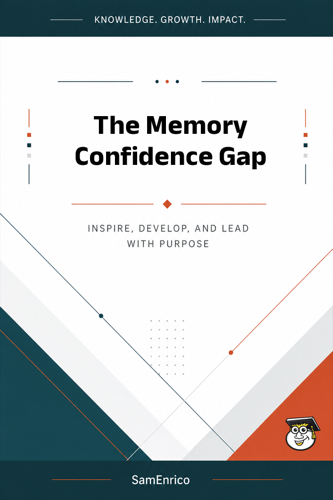
Non-FictionTrue CrimeWitness Pressure
The Memory Confidence Gap eBook
Explains why witnesses with incomplete memories ar
by Dayton Ilana
Explains why witnesses with incomplete memories are pressured into guessing with high confidence.
Formats
Free sample
Chapter 1: The Video Camera--–- The woman’s voice did not waver. She sat in the witness box, forty-three years old, neatly dressed, her hands folded on her lap. She had been an honors student in college. She had never been in trouble. She had no reason to lie.
And when she raised her right hand and swore to tell the truth, the whole truth, and nothing but the truth, she meant it with every fiber of her being.“Do you see the man who attacked you in this courtroom?” the prosecutor asked.She turned. She looked at the defense table. She pointed.“He’s sitting right there,” she said. “The defendant. I’ll never forget that face.”Her voice cracked.
Tears welled in her eyes. The jury leaned forward. They saw her certainty. They saw her pain. They saw a woman who had survived something unspeakable and who was now doing her civic duty to make sure the right man went to prison.There was just one problem.She was pointing at the wrong person.The man she identified spent eleven years in prison for a crime he did not commit.
He lost his youth, his freedom, his reputation. He was exonerated by DNA evidence only after more than a decade. And when the real perpetrator was finally found, the woman—the honest, certain, well-meaning witness—was devastated. She had not lied. She had not been coerced.
She had been absolutely sure.And she had been absolutely wrong.This is not an anomaly. It is not a rare glitch in an otherwise reliable system. According to the Innocence Project, mistaken eyewitness identifications have contributed to approximately seventy percent of wrongful convictions later overturned by DNA evidence. That is not a fringe statistic. It is the leading cause of wrongful convictions in the United States.How can this happen?
How can a sincere, confident, well-intentioned person be so certain and so mistaken at the same time?The answer lies in a dangerous space we call the Memory Confidence Gap.The Myth of the Perfect Recording Ask anyone on the street how memory works, and you will hear a version of the same story: memory is like a video camera. It records events as they happen. It stores them somewhere in the brain. And when you need to recall something, you simply press play and watch the footage. This is the intuitive model of memory.
It feels right because memories often feel vivid and real. But it is catastrophically wrong.The video camera metaphor has been around for decades, but it became particularly entrenched with the rise of digital recording. We now carry devices in our pockets that capture perfect, pixel-for-pixel replicas of reality. It seems natural to assume the brain does the same thing. After all, evolution would have given us perfect recall, would it not?
Wouldn't that be useful for survival?The answer is no. Evolution does not care about perfect recall. Evolution cares about survival. And from an evolutionary perspective, remembering every detail of every experience is inefficient. Your brain processes millions of pieces of sensory information every second.
To store all of it would require impossible amounts of energy and neural real estate. Instead, the brain evolved a different strategy: it stores fragments.Think of it this way. You walk into a coffee shop. You order a latte. You pay.
You leave. What do you remember? You remember the general layout. You remember the barista had dark hair. You remember the latte was hot.
But what color were the barista's shoes? What was playing on the speaker? How many people were sitting at the table by the window? You have no idea. Your brain did not record those details because they were not relevant to your goal of getting caffeine.This is not a flaw.
It is a feature. The brain is a prediction engine, not a recording device. It is designed to notice what matters, ignore what does not, and fill in the gaps later with inference, expectation, and prior knowledge. This works beautifully for everyday life. You do not need to remember the barista's shoes to survive.
But it works disastrously for eyewitness testimony, where every detail suddenly matters and where the witness is asked to reconstruct events that happened weeks, months, or even years ago.Sir Frederick Bartlett and the Birth of Reconstructive Memory The first person to systematically challenge the video camera metaphor was a British psychologist named Sir Frederick Bartlett. In 1932, he published a landmark book called "Remembering: A Study in Experimental and Social Psychology." In it, he described a series of experiments that would change how we think about memory forever.Bartlett gave participants a Native American folktale called "The War of the Ghosts." The story was strange to his British participants: it involved ghosts, canoes, and supernatural elements that did not fit their cultural expectations. Bartlett asked the participants to read the story and then recall it later—not verbatim, but from memory. He then asked them to recall it again, and again, over days and weeks.What he found was remarkable. The participants did not simply forget parts of the story.
They changed it. They systematically altered details to fit their own cultural schemas. The ghosts became less supernatural. The canoes became boats. The unfamiliar became familiar.
Each time they recalled the story, they edited it a little more, until the final version bore only a passing resemblance to the original.Bartlett coined the term "reconstructive memory" to describe this process. He argued that remembering is not a matter of retrieving a fixed file from storage. It is a matter of reassembling fragments—visual, auditory, emotional, semantic—into a coherent story, and then filling in the missing pieces with inference, expectation, and prior knowledge. In other words, memory is an act of construction, not reproduction.Bartlett’s work was largely ignored for decades. The video camera metaphor was too intuitive, too comforting.
But in the 1970s, a young psychologist named Elizabeth Loftus picked up where Bartlett left off and took his insights into the courtroom.Elizabeth Loftus and the Misinformation Effect Elizabeth Loftus did something radical. She did not study memory in a laboratory with neutral stimuli like word lists or geometric shapes. She studied memory for real-world events—car accidents, crimes, and other emotionally charged situations. And she discovered something terrifying: memory is not just reconstructive. It is also profoundly malleable.In her most famous series of experiments, Loftus showed participants videos of car accidents.
Afterward, she asked them a simple question: "How fast were the cars going when they hit each other?" But she varied one word. For some participants, she used the word "hit." For others, she used "smashed," "collided," "bumped," or "contacted."The results were striking. Participants who heard the word "smashed" estimated the speed significantly higher than those who heard "hit" or "contacted." That alone was interesting. But what happened next was astonishing. One week later, Loftus brought the participants back and asked them a new question: "Did you see any broken glass?" There was no broken glass in the original video.
But participants who had heard the word "smashed" were more than twice as likely to falsely remember broken glass as…
This is the end of the free sample. Get the eBook to keep going. Buy now
About this book
Details
- Author
- Dayton Ilana
- Publisher
- SamEnrico
- Language
- English
- Genre
- Non-Fiction, True Crime, Witness Pressure
- Released
- 2026-06-08
- Pages (approx.)
- 140
- Available as
- eBook, Audiobook

Read better in the ZLOADR app
Your eBooks on your phone or tablet. Sign in with your SamEnrico account and start reading.
More by Dayton Ilana
 Identify and Treat Causes GuideDayton Ilana$11.99
 Divorced Dad Recovery GuideDayton Ilana$11.99
 The BPH Symptom Management GuideDayton Ilana$11.99
 Sami Ranaei Healer ReindeerDayton Ilana$11.99
 The Ballad of the Phantom Timekeeper: How a Forgotten Woman Saved the World’s ClocksDayton Ilana$11.99
 Production LeadDayton Ilana$11.99
 Brazil Dropshipping Profit MarginsDayton Ilana$12.99
 Reverse Mentorship on LinkedInDayton Ilana$12.99
 Understanding Schwartz–jampel SyndromeDayton Ilana$17.99
 How to Start a Ph Meters (electronic) Business (Beginners Guide)Dayton Ilana$11.99
You may also like
 Hong Kong Handover 1997Dunn Johnnie$11.99
 Zumba For Postnatal Recovery CourseNeal Christian$11.99
 Zumba for BeginnersLadner Nikia$11.99
 YouTube Comment Mining GuideHumes Pandora$12.99
 Worry Box MeditationCarlin Rudy$11.99
 Workplace Stress MeditationNguyen Lynn$11.99
 Workplace Stress and Sleep RepairHawley Ivory$11.99
 Workplace Perfectionism CureDelaney Jeffry$11.99
 Workplace Injustice Anger GuideWallen Isabelle$11.99
 Work Addiction and Burnout LinkGreenwood Ester$11.99
 Women in Yoga and WellnessBeattie Galina$11.99
 Women in Stand Up ComedyChun Evangeline$11.99