
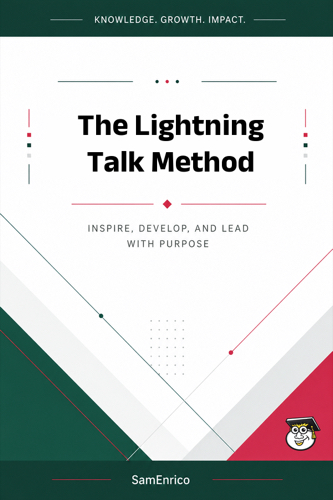
The Lightning Talk Method eBook
Pack powerful messages into ultra-short 5-minute p
Pack powerful messages into ultra-short 5-minute presentation slots.
Formats
Free sample
Chapter 1: The 300-Second Lie...--You have been lied to about public speaking.The lie sounds reasonable, even professional. It goes like this: *“To communicate something important, you need time. A 30-minute keynote. A 45-minute lecture. An hour-long workshop.
Anything less is superficial.”*This lie has ruined more careers than bad coffee and broken projectors combined.It is the reason you have sat through 847 slides in a 20-minute presentation. It is the reason you have watched a colleague read every bullet point aloud, line by line, while the audience silently planned their grocery lists. It is the reason you have walked out of conference rooms thinking, “I understood nothing. And I remember even less.”The lie persists because it feels safe. More time feels more thorough.
More slides feel more prepared. More data feels more convincing.But feelings are not facts. And the facts say something shocking: Your audience stops listening long before you stop talking.This chapter dismantles the 300-second lie. You will learn why five minutes is not a constraint but a superpower. You will discover the neuroscience of the “Deadline Effect”—why the human brain actually wakes up when it knows time is running out.
You will be introduced to the ABT framework (“And, But, Therefore”), the single most reliable narrative engine for ultra-short talks. And you will see, through a forensic case study of a winning Three Minute Thesis presentation versus a failed conference talk, exactly where most speakers lose their audience—usually by the second minute, with irrelevant data that should have been cut before they ever walked on stage.By the end of this chapter, you will never again apologize for having only five minutes. You will guard that five minutes like a dragon guards gold. Because you will understand something that 99 percent of presenters never learn: In communication, brevity is not the enemy of depth. Brevity is the only path to depth.The Cognitive Sweet Spot: Why Five Minutes Is Magic Let us begin with a question that sounds simple but is not: How long can a human being truly pay attention?The answer depends entirely on what you mean by “attention.”If you mean the ability to keep your eyes open and your body facing forward, humans can do that for hours.
We endure long meetings. We survive all-day conferences. We nod along to 90-minute lectures while our minds drift to email, dinner plans, and whether we remembered to lock the car.If you mean the ability to process, retain, and act upon information—the kind of attention that actually matters for communication—the numbers are much smaller.Cognitive psychologists have studied this for decades. The consensus is striking: Sustained, high-quality attention to a single speaker peaks at around 5 to 8 minutes. After that, attention fragments.
The brain begins to wander, not because the listener is lazy, but because the brain is designed to scan for novelty, threat, and reward. A single voice, a single slide deck, a single topic—these become predictable. And the brain’s response to predictability is to tune out.This is not a flaw. It is a feature.Your brain is running a constant cost-benefit analysis: Is this information valuable enough to keep processing? When a speaker is fresh, the brain invests heavily.
After a few minutes, if the pattern of information becomes repetitive or the stakes feel low, the brain reallocates resources elsewhere. You do not decide to stop paying attention. Your brain decides for you.Here is where the 5-minute format becomes magical.Five minutes sits exactly at the boundary where the brain is still fully engaged but beginning to sense the end approaching. It is long enough to establish a problem, develop tension, and deliver a resolution. It is short enough that the brain never has a chance to say, “I’ve seen enough.”Researchers call this the Cognitive Sweet Spot.
It is the Goldilocks zone of human attention: not so short that nothing meaningful can be communicated, not so long that the audience’s neural circuits begin to idle.But there is a second, even more powerful force at work. And it has a name: the Deadline Effect.The Deadline Effect: How a Clock Makes People Smarter In 1976, two psychologists named John Darley and Dan Batson ran a famous experiment at Princeton Theological Seminary. They asked seminary students to prepare a talk on the parable of the Good Samaritan. Then they told half the students they were already late for their recording session. The other half were told they had plenty of time.On the way to the recording studio, each student passed a man slumped in a doorway, coughing and groaning—clearly in distress.The results were shocking.
Among students who believed they had plenty of time, 63 percent stopped to help. Among students who believed they were late, only 10 percent stopped. The parable of the Good Samaritan—the very topic of their talk—had no measurable effect on their behavior. The only thing that mattered was the deadline.This experiment reveals something profound about human cognition: When we perceive time as scarce, we become ruthlessly efficient. We stop dithering.
We stop overthinking. We stop performing optional kindnesses (like helping a stranger) and focus exclusively on what is essential.The same principle applies to audiences.When an audience knows—really knows—that a talk will last exactly five minutes and no longer, their brains shift into a different mode of processing. Neuroimaging studies have shown that the mere presence of a visible timer or a stated time limit triggers the release of norepinephrine, a neurotransmitter associated with focus, arousal, and memory formation. The brain essentially says, “This is urgent. Pay attention.
You will not get another chance.”This is the Deadline Effect, and it is the single most underleveraged force in public speaking.Think about what happens during a typical 30-minute presentation. The audience knows, implicitly, that they have time. They can afford to let their minds wander for a minute or two. They can check their phone. They can look at the window.
They can mentally rehearse an email. The talk will still be there when they return. The stakes feel low.Now imagine a 5-minute lightning talk. The audience knows—because the format is announced, because the timer is visible, because the room has an energy of urgency—that they have exactly 300 seconds. Every second matters.
If they look away for ten seconds, they might miss something critical. The brain responds by tightening its grip on attention.The result is paradoxical but undeniable: You can communicate more meaning in five urgent minutes than in thirty relaxed ones.Not because you talk faster. Because the audience listens harder.The ABT Framework: The Simplest Story Engine Ever Built Knowing that five minutes is a cognitive sweet spot is useful. Knowing that urgency sharpens attention is powerful. But neither tells you what to actually say.This is where most speakers fail.
They have the time constraint right. They have the sense of urgency. But they still deliver a list. A sequence of facts. A data dump with a clock.A data dump is not a talk.
It is a spreadsheet with vocal cords.What separates a memorable lightning talk from a forgettable one is narrative structure. You…
This is the end of the free sample. Get the eBook to keep going. Buy now
About this book
Details
- Author
- Huntley Sondra
- Publisher
- SamEnrico
- Language
- English
- Genre
- Non-Fiction, Self-Help, Brevity
- Released
- 2026-06-11
- Pages (approx.)
- 151
- Available as
- eBook, Audiobook

Read better in the ZLOADR app
Your eBooks on your phone or tablet. Sign in with your SamEnrico account and start reading.
More by Huntley Sondra
 The Talk Show DeathHuntley Sondra$11.99
 Trucker Nap Strategy GuideHuntley Sondra$11.99
 Caregiver for Parent with DementiaHuntley Sondra$11.99
 Attribution Retraining CourseHuntley Sondra$11.99
 Self Hypnosis for Erectile DysfunctionHuntley Sondra$11.99
 Terms by Fund SizeHuntley Sondra$11.99
 Fibromyalgia Pacing PrimerHuntley Sondra$11.99
 Commercial Property ManagementHuntley Sondra$11.99
 The Queen Who Loved Too Much: The Scandalous Romance of Marie Antoinette and Axel von FersenHuntley Sondra$11.99
 The Magyar Storm: Arpad's Raiders and the Birth of HungaryHuntley Sondra$11.99
 Fenrir's Howl: The Wolf Who Swallowed the SunHuntley Sondra$11.99
 African STEM Scholarships GuideHuntley Sondra$12.99
You may also like
 Hong Kong Handover 1997Dunn Johnnie$11.99
 Zumba For Postnatal Recovery CourseNeal Christian$11.99
 Zumba for BeginnersLadner Nikia$11.99
 YouTube Comment Mining GuideHumes Pandora$12.99
 Worry Box MeditationCarlin Rudy$11.99
 Workplace Stress MeditationNguyen Lynn$11.99
 Workplace Stress and Sleep RepairHawley Ivory$11.99
 Workplace Perfectionism CureDelaney Jeffry$11.99
 Workplace Injustice Anger GuideWallen Isabelle$11.99
 Work Addiction and Burnout LinkGreenwood Ester$11.99
 Women in Yoga and WellnessBeattie Galina$11.99
 Women in Stand Up ComedyChun Evangeline$11.99