
Non-FictionSelf-HelpCommunication Skills
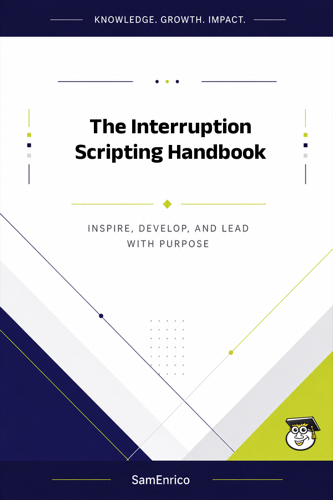
The Interruption Scripting Handbook eBook
Learn precise verbal and written scripts to polite
by Dees Jaunita
Learn precise verbal and written scripts to politely but firmly deflect workplace interruptions.
Formats
Free sample
Chapter 1: The Theft You Authorized--–- The email arrived at 9:14 AM. You opened it, replied, and returned to your project. Then Slack buzzed at 9:22. You answered quickly. Then a colleague appeared in your doorway at 9:31.
By 9:47, you had forgotten what you were doing at 9:13. At 5:00 PM, you left work exhausted, having accomplished exactly one thing on your seven-item list. You told yourself it was a "busy day." You told yourself you'd catch up tomorrow. You told yourself this was normal.It is not normal. It is expensive.
And you have been authorizing it every single day without knowing.This book exists because of a single, uncomfortable truth: interruptions are not something that happen to you. They are something you allow. The colleague who drops by unannounced does not hold a gun to your head. The Slack message that derails your focus does not arrive with a court order. You choose to look.
You choose to reply. You choose to swivel your chair and smile and say "sure, what's up?" And then you choose to spend the next twenty-three minutes—the scientifically verified average recovery time from a single interruption—trying to remember where you left off.You are not lazy. You are not weak. You are untrained. And training is precisely what this book provides.Before you learn a single script, before you deflect a single drop-in visitor, before you silence a single Slack notification, you must understand what you are actually defending.
This chapter is not about solutions. It is about diagnosis. It is about holding up a mirror to your workday and seeing, for the first time, the true cost of every "quick question," every "got a sec?" every "sorry to bother you." Because until you know what you are losing, you will never have the motivation to protect it.The Five Hidden Costs You Cannot Afford to Ignore Most professionals believe interruptions cost "a few minutes." This is like saying a house fire costs "a few matches." The visible flame is the smallest part of the destruction. Below the surface, five hidden costs compound silently, draining your cognitive bank account before lunch.Cost 1: The Restart Tax When you interrupt a task, you do not simply pause it. You kill it.
Neuroscientists have demonstrated that the human brain does not maintain a "pause button" for complex cognitive work. Instead, when you shift attention, the brain unloads the current task context—the relevant data, the emotional tone, the strategic thread—and loads the new context. When you return to the original task, you must reload everything from scratch. This is called "context switching," and it costs an average of 23 minutes and 15 seconds per interruption, according to a University of California, Irvine study of 1,000 knowledge workers.Let us do the math together. If you suffer five interruptions in a single day—a conservative estimate for most office workers—you lose nearly two hours not to the interruptions themselves, but to the act of restarting.
Five interruptions × 23 minutes = 115 minutes. That is not a bad day. That is a stolen morning.Cost 2: The Momentum Tax Restart time is measurable. Momentum loss is not, which makes it more dangerous. Flow state—that magical condition where work feels effortless and time disappears—requires approximately fifteen to twenty minutes of uninterrupted concentration to achieve.
One interruption shatters it. But here is the cruelty: after an interruption, you do not simply return to baseline. You return to a state of frustration, mild anxiety, and cognitive friction. The emotional cost of losing flow is not zero. It manifests as irritability, reduced creativity, and a subtle resentment toward whoever interrupted you—resentment that poisons collaboration over time.Cost 3: The Do-Over Tax When attention splits, errors multiply.
A study published in the Journal of Experimental Psychology found that people who were interrupted during a complex task made twice as many errors as those who completed the task uninterrupted. Twice as many. And here is the kicker: most errors are not discovered immediately. They surface hours or days later, requiring you to redo work you thought was finished. The do-over tax is the cruelest because it is invisible.
You do not know you made a mistake until you are already paying for it.Cost 4: The Distress Tax Interruptions are not neutral events. They trigger a measurable physiological response: cortisol spikes, heart rate increases, and the amygdala—the brain's threat detector—activates as if you had encountered a predator. This is not an overreaction. Your brain cannot distinguish between a saber-toothed tiger and a Slack notification. Both are unexpected intrusions that demand immediate attention.
Over time, chronic interruption creates a low-grade state of vigilance, where you are always waiting for the next disruption. This is not productivity. This is burnout with a smile.Cost 5: The Switch Cost Effect The most devastating cost is also the most hidden. Researchers at Stanford University discovered that heavy multitaskers—people who constantly switch between tasks—perform worse on every cognitive metric than light multitaskers. Worse memory.
Worse attention. Worse ability to filter irrelevant information. The act of switching does not just cost time; it degrades your brain's fundamental architecture. You become less intelligent the more you allow interruptions. The researchers called this the "switch cost effect," and they quantified it: chronic multitaskers effectively lower their IQ by up to fifteen points during switched conditions.
Fifteen points is the difference between "gifted" and "average."The Great Lie You Have Been Told You have been told that availability is a virtue. That the "open door policy" is leadership. That responding quickly to messages makes you a team player. That being interruptible is being helpful.These are lies. They are not merely harmless myths; they are actively destructive ideologies that benefit the interrupter at the expense of the interrupted.
When you are always available, you are never fully present. When you say yes to every request, you say no to your own priorities. When you prioritize the urgent over the important, you build a career of busyness rather than a legacy of impact.The most successful professionals you know are not the most available. They are the most protected. They have systems, scripts, and boundaries that keep the noise at bay while they do their best work.
You have mistaken their unavailability for rudeness. In fact, it is respect—respect for their own time, their own craft, and ultimately the people who depend on their best output.Consider this: when a surgeon is in the operating room, no one walks in to ask a "quick question." When a pilot is landing a plane, no one taps their shoulder to discuss the catering. When a lawyer is preparing for trial, no one drops by to "circle up" on a minor administrative issue. These professionals understand something you have been taught to ignore: some work is sacred. Some work requires uninterrupted attention.
And protecting that work is not selfish; it is professional.The Time Bandit Log: Your First Tool You cannot fix what you do not measure. Before you deploy a single script from this book, you must know exactly how much of your day is being stolen—and by whom. The Time Bandit Log is your diagnostic instrument.For the next three…
This is the end of the free sample. Get the eBook to keep going. Buy now
About this book
Details
- Author
- Dees Jaunita
- Publisher
- SamEnrico
- Language
- English
- Genre
- Non-Fiction, Self-Help, Communication Skills
- Released
- 2026-06-07
- Pages (approx.)
- 142
- Available as
- eBook, Audiobook

Read better in the ZLOADR app
Your eBooks on your phone or tablet. Sign in with your SamEnrico account and start reading.
More by Dees Jaunita
 Second Generation Body ImageDees Jaunita$11.99
 Self Doubt Public Speaking GuideDees Jaunita$11.99
 Anger and IntimacyDees Jaunita$11.99
 Charlie Parker BirdDees Jaunita$11.99
 Whole30 Paleo Weight LossDees Jaunita$11.99
 Sleep Memory For Shift WorkersDees Jaunita$11.99
 REIT Income GuideDees Jaunita$11.99
 The Neon Underground: How a Secret Jazz Club Outlasted the MafiaDees Jaunita$11.99
 Whispers of the Marid: The Djinn of the AbyssDees Jaunita$11.99
 How to Produce Frosting and IcingDees Jaunita$11.99
 Understanding Fisher SyndromeDees Jaunita$11.99
 A Collector's Handbook to the Buick ElectraDees Jaunita$11.99
You may also like
 Hong Kong Handover 1997Dunn Johnnie$11.99
 Zumba For Postnatal Recovery CourseNeal Christian$11.99
 Zumba for BeginnersLadner Nikia$11.99
 YouTube Comment Mining GuideHumes Pandora$12.99
 Worry Box MeditationCarlin Rudy$11.99
 Workplace Stress MeditationNguyen Lynn$11.99
 Workplace Stress and Sleep RepairHawley Ivory$11.99
 Workplace Perfectionism CureDelaney Jeffry$11.99
 Workplace Injustice Anger GuideWallen Isabelle$11.99
 Work Addiction and Burnout LinkGreenwood Ester$11.99
 Women in Yoga and WellnessBeattie Galina$11.99
 Women in Stand Up ComedyChun Evangeline$11.99