
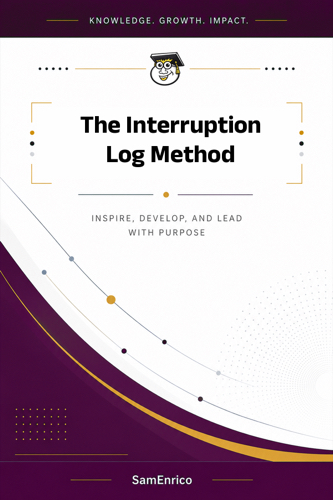
The Interruption Log Method eBook
Track disruptions to identify patterns and elimina
by Watkins Kara
Track disruptions to identify patterns and eliminate sources.
Formats
Free sample
Chapter 1: The Twenty-Three Minute Theft--The notification arrives at 9:14 AM. You have been working on the quarterly report for exactly eleven minutes. Your fingers are moving across the keyboard, the sentences are forming, and for a brief moment, you are in what athletes call the zone—effortless, absorbed, almost invisible to yourself.Then Slack pings.It is a message from a colleague. Nothing urgent. A question about a meeting time next Tuesday.
You glance at it. You tell yourself you will return to the report immediately after replying. It takes twelve seconds to type "2 PM works for me."You close Slack. You look back at the report.And then something strange happens. You stare at the screen.
The paragraph you were writing is still there, but it no longer makes sense. You read the last three sentences. Nothing connects. Where were you going with this? What was the point you were making?
You check the clock. It is 9:16 AM. Only two minutes have passed.Except that is a lie.The lie is the most dangerous lie in the modern workplace. It is the lie that steals three hours from every workday, that leaves you exhausted at 5 PM with nothing to show for it, that makes you feel lazy when you are anything but. The lie is this: the interruption cost you only the twelve seconds it took to reply.The truth is far more unsettling.The truth is that twelve-second interruption just cost you twenty-three minutes of productive focus.
Not twelve seconds. Not two minutes. Twenty-three minutes. And if you experience forty interruptions today—which is below average for most knowledge workers—you have just lost more than fifteen hours of cognitive capacity. That is two full workdays.
Every single day.This chapter will prove to you that your fractured attention is not a moral failure, not a lack of discipline, not a sign that you are somehow broken. It is a physics problem. It is a biology problem. It is an environment problem. And like all such problems, it has a solution.
But first, you need to understand exactly what is being stolen from you, how it is being stolen, and why your brain has been rigged to participate in its own robbery.The Myth of Multitasking Let us begin with a word that has caused more productivity damage than any other: multitasking.The word sounds impressive. It conjures an image of a high-powered executive juggling phones and emails and meetings, somehow doing five things at once. The cultural message is unmistakable: multitasking is a skill. People who can multitask are valuable. People who cannot are behind.Every single word of that is wrong.The human brain does not multitask.
It never has. It never will. What the brain actually does is something called task-switching, and task-switching is not a form of efficiency. It is a form of cognitive tax. Every time you shift your attention from one task to another, your brain must perform a three-step neurological sequence:First, it must disengage from the first task.
This requires suppressing the neural networks that were active—essentially telling your brain, "Stop thinking about that spreadsheet." Second, it must activate the neural networks associated with the new task—"Now think about that email." Third, it must re-orient itself to where it left off, which often requires re-reading, re-finding, or re-remembering.Each of these steps takes time. And the time adds up.The most cited study on this phenomenon comes from the University of California, Irvine, where researchers Gloria Mark and her team observed knowledge workers in their natural environments. They found that the average worker switches tasks every three minutes and five seconds. That is approximately eighteen times per hour. And after every single switch, it takes an average of twenty-three minutes and fifteen seconds to return to the original task with the same level of focus.Twenty-three minutes.Let that number sit with you for a moment.
A one-minute interruption does not cost you one minute. It costs you twenty-three. The interruption itself is the spark. The real fire is the recovery.The Anatomy of a Recovery Why does recovery take so long? The answer lies in what psychologists call "attention residue."When you are working on Task A and you switch to Task B, your attention does not cleanly detach from Task A.
It leaves behind a residue—a lingering cognitive presence that continues to occupy mental bandwidth. You have experienced this: you close your email, return to your report, and for the next several minutes, your brain is still half-thinking about that email. What did they mean by that question? Should I have added more detail? Did I forget to attach the file?That residue is attention residue.
It is the ghost of the interrupted task haunting the new one.The more complex Task A is, the more residue it leaves behind. Writing a report, coding a feature, analyzing a spreadsheet, designing a presentation—these are high-residue tasks. Checking your phone, answering a quick question, glancing at a notification—these are low-residue tasks. But the residue does not care about the value of the interruption. It only cares about the value of the task you left behind.This is the cruel arithmetic of interruption: the more important your work, the more damage an interruption does.A surgeon interrupted during a procedure leaves behind more than a minute of lost time.
A lawyer interrupted during contract review leaves behind more than a minute of lost attention. A software engineer interrupted during debugging leaves behind more than a minute of lost context. The twenty-three minute rule is an average. For deep, creative, or complex work, the recovery time can exceed forty minutes.You are not losing minutes. You are losing the cognitive state required to do your best work.Dopamine and the Addiction to Novelty If the cost of interruption is so high, why do we tolerate it?
Why do we check our phones six times an hour? Why do we reflexively open our email the moment a new message arrives? Why does a Slack notification trigger an almost irresistible pull?The answer is not a lack of willpower. The answer is dopamine.Dopamine is a neurotransmitter that plays many roles in the brain, but its most relevant role here is reward prediction. When your brain encounters something novel—a new email, a new message, a new notification—it releases a small burst of dopamine.
That dopamine feels good. It is a tiny reward. And your brain, like any good reward-seeking machine, learns to crave the trigger that produces the reward.This is the dopamine loop: trigger, behavior, reward, repeat.The trigger is the notification sound, the red badge on your app icon, the buzz in your pocket. The behavior is checking. The reward is the small dopamine hit of novelty.
Your brain does not care whether the email is important. It does not care whether the message requires a response. It only cares about the pattern: notification equals dopamine.Every technology company in the world understands this loop. They have teams of neuroscientists, behavioral psychologists, and user experience designers whose sole job is to make their notifications more compelling, more…
This is the end of the free sample. Get the eBook to keep going. Buy now
About this book
Details
- Author
- Watkins Kara
- Publisher
- SamEnrico
- Language
- English
- Genre
- Non-Fiction, Self-Help, Tracking
- Released
- 2026-06-06
- Pages (approx.)
- 134
- Available as
- eBook, Audiobook

Read better in the ZLOADR app
Your eBooks on your phone or tablet. Sign in with your SamEnrico account and start reading.
More by Watkins Kara
 Ransomware Evolution ReportWatkins Kara$11.99
 Pressure Cooking Meal PrepWatkins Kara$11.99
 Pet Loss Candle RitualWatkins Kara$11.99
 Fear Of Chemicals Treatment GuideWatkins Kara$11.99
 Swimming Relaxation CueWatkins Kara$11.99
 Qi Flow GuideWatkins Kara$11.99
 Parental Stress And DisciplineWatkins Kara$11.99
 The Scarab’s Oath: Nefertem’s Rise in the House of ReWatkins Kara$11.99
 The Invisible Playmaker: How Joe Montana's Calm Led the 49ers to Glory (1989)Watkins Kara$11.99
 Oil & Gas Law: Leases, Drilling Rights & RoyaltiesWatkins Kara$11.99
 How to Produce Rolling PinsWatkins Kara$11.99
 How to Produce Tree FertilizerWatkins Kara$11.99
You may also like
 The Remote Time Tracker GuideWeir Nathanial$11.99
 The Teen Accomplishment LogCallaway Yesenia$11.99
 Listening Log JournalKeeler Georgann$11.99
 Emotion Diary CardStaley Norberto$11.99
 DBT Emotion Diary CardLoper Rebekah$11.99
 The DBT Skill TrackerSwanson June$11.99
 Emotion Log MethodMireles Lane$11.99
 The Pain Monitoring DiaryCottrell Russell$11.99
 Noticing Hypnosis EffectsZeigler Rayna$11.99
 Gambling Urge Log and TrackerSpring Billi$11.99
 Habit Tracking JournalPrentice Dotty$11.99
 Emotion Diary Card WorkbookBraswell Janell$11.99