
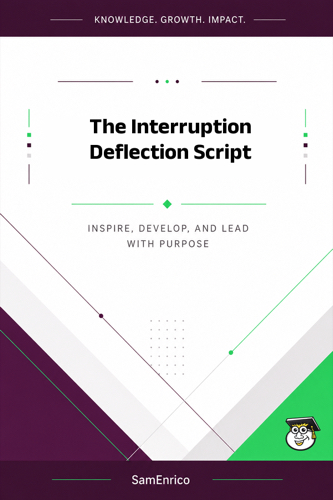
The Interruption Deflection Script eBook
Teaches a single powerful sentence to stop interru
by Luster Billi
Teaches a single powerful sentence to stop interruptions politely and redirect to asynchronous channels.
Formats
Free sample
Chapter 1: The 23-Minute Thief--–- Sarah Chen was a high-performing vice president of engineering at a fast-growing fintech company. She was known for her open door policy, her rapid response times, and her willingness to help anyone who knocked. By all external metrics, she was thriving. Her team shipped on schedule. Her stakeholders loved her.
Her 360-reviews glowed with phrases like "always available" and "incredibly responsive."Then she ran the numbers.Over a quiet weekend, Sarah pulled her calendar data, Slack logs, and email timestamps from the past twelve months. She had been tracking her "focus blocks" using a simple time-tracking tool, mostly out of curiosity. What she discovered stopped her cold. She had scheduled 520 hours of deep work for the year—blocks of 90 minutes or more reserved for complex problem-solving, architecture design, and strategic planning. She had actually completed 73 hours.
The rest had been eaten by interruptions.Not by laziness. Not by poor planning. By people knocking on her door, pinging her on Slack, pulling her into "quick syncs," and asking "just one question." Each interruption, she calculated, cost her an average of 23 minutes of productive time. Not the two minutes of the interruption itself, but the 21 minutes required to find her place, reload context, rebuild concentration, and restart the cognitive engine. Over a year, that added up to nearly 1,200 hours of lost productivity.
At her salary band, the direct cost exceeded $120,000. The indirect cost—missed innovation, slower team growth, her own creeping exhaustion—was incalculable.Sarah had been praised for her responsiveness her entire career. She had been promoted because she said yes. And that very habit, she now realized, had become the ceiling on her effectiveness.She is not alone.The Interruption Epidemic Every knowledge worker knows the feeling. You are finally in flow—that magical state where the code writes itself, the strategy clicks into place, the words pour onto the page.
Then a Slack notification chirps. A coworker appears in your doorway. Your phone buzzes with a "quick question." And just like that, the spell breaks. You look at the screen, unable to remember what you were about to type. You spend the next ten minutes retracing your mental steps.
By the time you find your place, the interrupter has long since gotten their answer and moved on. You are left with a fragment of what could have been.This is not a personal failing. It is not a lack of discipline. It is a structural feature of modern work, and it is silently bankrupting our attention, our output, and our well-being.The data is staggering. A 2021 study from the University of California, Irvine, found that after an interruption, it takes an average of 23 minutes and 15 seconds to return to the original task with the same depth of focus.
Not to resume the task—to return to the same level of cognitive engagement. The interruption itself might last two minutes. The recovery costs ten times that.Even more concerning, the same study found that people interrupted during a complex task made twice as many errors on subsequent work. When Sarah's team experienced just three interruptions per hour—a conservative estimate in most open offices—their error rate in code reviews increased by 50 percent. A single unnecessary interruption, in other words, could introduce a bug that would take hours to find and fix.The myth of multitasking has been thoroughly debunked by neuroscientists and productivity researchers alike.
The human brain does not parallel process. It task-switches. Each switch carries a "switch cost"—a measurable drain on cognitive resources. Gloria Mark, the lead researcher behind the UC Irvine study, summarized it bluntly: "People don't understand that when they multitask, they are not actually doing multiple things at once. They are rapidly switching attention.
And each switch comes with a penalty."The penalty is not just time. It is also quality, creativity, and satisfaction.The Hidden Math of Interruptions Let us make the math visible. Assume you are a typical knowledge worker who experiences 15 interruptions per day. Some are Slack messages. Some are in-person drive-bys.
Some are emails marked "URGENT." Some are meetings that run over. Using the 23-minute recovery figure, each interruption costs 23 minutes of productive time. That yields 345 minutes—nearly six hours—of lost productivity per day. But that cannot be right, you object. No one would survive six hours of lost time per day.
And you are correct, because not every interruption leads to a full 23-minute recovery. Some are shallow enough that you bounce back quickly. Others occur during shallow work and barely register.The more accurate model divides interruptions into three tiers. A "shallow interruption" occurs during routine, low-cognitive-load work like sorting email or updating a spreadsheet. Recovery time: 2-5 minutes.
A "moderate interruption" occurs during moderately complex work like drafting a memo or reviewing a pull request. Recovery time: 10-15 minutes. A "deep interruption" occurs during complex, creative, or analytical work—the kind of work that actually moves the needle for your career. Recovery time: 20-30 minutes or more.The average knowledge worker experiences roughly three deep interruptions per day. At 23 minutes each, that is 69 minutes of lost deep work daily—nearly 300 hours per year.
For a professional earning $100,000 annually, that represents $34,000 in paid time that delivers no output. For a team of ten, that is $340,000. For a company of a hundred, that is $3.4 million.This is the hidden math of interruptions. It is invisible because the costs are borne in small increments. No one writes a check for "interruption recovery." But the time is real.
The output never materializes. The innovation that might have happened in those 300 hours simply does not exist.Sarah Chen discovered this when she calculated her own "interruption debt." She had been promoted three times in five years because she was responsive. But when she mapped her interruptions against her actual deep work output, she found a disturbing correlation. The years she was most "responsive" were the years she produced her least innovative work. She had traded creativity for availability.
And she had not known she was making that trade.The Responsiveness Trap Here is the cruel irony. The very behavior that gets you promoted early in your career—being responsive, helpful, always available—becomes the behavior that prevents you from doing the work that earns later promotions. Junior employees are rewarded for execution. Senior employees are rewarded for deep thinking, strategy, and innovation. But deep thinking requires uninterrupted focus.
And deep focus is impossible if you continue to act like a junior employee.This is the responsiveness trap. You say yes because saying yes feels good. It feels productive. It feels helpful. You get a small dopamine hit every time you answer a question, solve a problem, or unblock a coworker.
These small hits are addictive. They provide immediate gratification in a way that deep work—with its delayed payoff—cannot match. Over time, you become conditioned to seek interruptions. Your brain begins to prefer the quick win over the slow, difficult work of creating something valuable.The trap is reinforced by workplace culture. Open door policies are celebrated.
"Collaboration" is a buzzword. Managers boast about how available they are. No one ever got a "most improved focus" award.…
This is the end of the free sample. Get the eBook to keep going. Buy now
About this book
Details
- Author
- Luster Billi
- Publisher
- SamEnrico
- Language
- English
- Genre
- Non-Fiction, Self-Help, Assertiveness
- Released
- 2026-06-09
- Pages (approx.)
- 144
- Available as
- eBook, Audiobook

Read better in the ZLOADR app
Your eBooks on your phone or tablet. Sign in with your SamEnrico account and start reading.
More by Luster Billi
 Burnout Recovery Laughter TherapyLuster Billi$11.99
 Chemical Dividend Stocks GuideLuster Billi$11.99
 Eisenhower Goal MatrixLuster Billi$11.99
 Reading Goal SettingLuster Billi$11.99
 Cocaine Rhabdomyolysis GuideLuster Billi$11.99
 Hypnosis Listening EnvironmentLuster Billi$11.99
 Grief and Support Groups OnlineLuster Billi$11.99
 Whispers of the Wendigo: The Starving Ghosts of the NorthLuster Billi$11.99
 The Opium Wars and the Birth of Canada's Anti-Triad Laws: A Victorian Era CrackdownLuster Billi$11.99
 How to Produce Wireless TransmittersLuster Billi$11.99
 Growing AgapanthusLuster Billi$11.99
 Sales Page Copywriting CourseLuster Billi$12.99
You may also like
 Recurring Dreams of ScreamingNolen Lester$11.99
 Interruption Proof Personal BoundariesMorey Wilhelmina$11.99
 Anger Assertiveness DistinctionHendrix Marianela$11.99
 Making Clear Requests GuideFries Pinkie$11.99
 Assertiveness For Lovers GuideWeller Alec$11.99
 Workplace Boundary Setting CourseEaston Truman$11.99
 Saying No GracefullyRichie Rochell$11.99
 Honest Expression NVCHackett Krystin$11.99
 The Interruption FearTurner Ora$11.99
 Passive Aggressive Stress ResponseMeredith Shirly$11.99
 Guilt Of Saying NoGordon Vera$11.99
 Assertive Anger WorkbookHodge Margo$11.99