
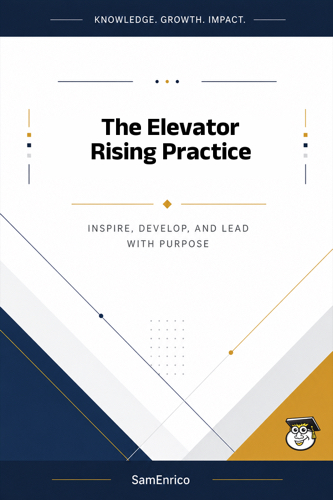
Non-FictionSelf-HelpClaustrophobia
The Elevator Rising Practice eBook
Teaches in-elevator grounding for claustrophobic a
Teaches in-elevator grounding for claustrophobic anxiety.
Formats
Free sample
Chapter 1: The 10-Second Window--–- The doors close. Your heart, which was pounding in the lobby, now does something strange. It doesn't just race. It stops. For one full second, there is silence inside your chest.
Then it explodes. The number above the door says "7." You are going up. The walls feel closer than they were a moment ago. The air feels thinner. Someone coughs behind you and you flinch.
The elevator jerks, and your stomach drops as if the floor has opened beneath you. You grab the handrail. Your palm is wet. The numbers change: 8, 9. Fourteen seconds have passed.
It feels like fourteen years. Then the doors open. You stumble out. Your legs are jelly. You tell yourself: Never again.This is the 10-Second Window.
And this chapter is going to show you why those first ten seconds after the doors close are the difference between a lifetime of stairs and a life of freedom.The Anatomy of a Hijack Let us begin with a simple truth that will sound, at first, like a lie: You are not afraid of elevators.You are afraid of what happens inside your body during the first ten seconds of an elevator ride. The elevator itself is a steel box with buttons and a light. It has no intention toward you. It cannot hurt you. But your amygdala—two almond-shaped clusters of neurons deep inside your brain—does not know this.
And it does not care.The amygdala is your body's smoke alarm. It was designed four hundred million years ago, long before elevators existed, to detect threats like saber-toothed tigers and rival tribes. Its job is simple: react first, ask questions later. When the amygdala detects a potential threat, it initiates something called the amygdala hijack. Within milliseconds, it signals your hypothalamus, which activates your sympathetic nervous system.
Your adrenal glands dump epinephrine (adrenaline) into your bloodstream. Your heart rate doubles. Your breathing becomes shallow and rapid. Blood rushes away from your digestive system and toward your large muscles, preparing you to fight or flee. Your pupils dilate.
Your hearing sharpens. Your non-essential systems—including your prefrontal cortex, the part of your brain responsible for rational thought—are temporarily shut down.This is an elegant, lifesaving response when you are facing a tiger. It is a catastrophe when you are facing a door that will open in fifteen seconds.Here is what makes elevators unique, and why your amygdala treats them like dens of predators. An elevator hijack is not triggered by a single stimulus but by a convergence of three distinct threat signals. The first is claustrophobic: the enclosure.
The walls are close. The ceiling is low. There is no window. Your brain, reading these signals, says: Trap. The second is agoraphobic: the loss of control.
You cannot open the door. You cannot stop the machine. You cannot leave until it decides to stop. Your brain says: No escape. The third is acrophobic: the sensation of falling or rising.
Your inner ear (vestibular system) detects acceleration, but your eyes see a static box. The mismatch creates a sensation of falling or floating. Your brain says: Instability.Three threat signals. One hijack. And it all happens in the first ten seconds.Why Ten Seconds?Here is the most important data point in this entire book.
The average elevator ride in a commercial building lasts between fifteen and thirty seconds. A ride from the lobby to the third floor takes approximately twelve seconds. A ride to the tenth floor takes about twenty-five seconds. Even in a skyscraper, a non-express elevator rarely exceeds forty-five seconds of continuous movement.Your panic response, by contrast, follows a predictable curve. At second zero (doors close), your heart rate begins to climb.
By second three, it typically peaks. By second seven, cortisol and adrenaline levels are at their maximum. By second ten, if no further threat is detected, the parasympathetic nervous system—your body's brake pedal—begins to engage. Heart rate starts to fall. Breathing begins to slow.
The hijack is ending.This means that the first ten seconds are everything. If you can survive those ten seconds without escalating your panic—without fighting the elevator, without catastrophizing, without hyperventilating—your body will naturally begin to calm itself. You do not need to make yourself calm. You only need to stop making yourself panicked. The ten-second window is the bridge between the hijack and the recovery.
Most people, without knowing it, spend those ten seconds digging themselves deeper into the hole. They hold their breath. They tense every muscle. They stare at the door and will it to open. They imagine the worst.
All of these responses tell the amygdala: Yes, the threat is real. Keep firing.This chapter will teach you to do the opposite. But first, we have to correct the single most damaging misunderstanding about elevator phobia.The Illusion of the Coffin Let me ask you a question. When you imagine the worst elevator ride of your life, what do you picture? Most people describe something like this: The doors close.
The walls feel like they're moving inward. The air gets thick. I can't breathe. I'm going to suffocate. I'm going to die in here.This is the coffin illusion.
And it is completely, provably, statistically false.Here are the facts. Elevators are not sealed chambers. Every commercial elevator in the developed world is required by building code to have ventilation. The International Building Code (IBC) Section 3008 requires that elevator cars have at least two permanent openings for air circulation, or a mechanical ventilation system capable of exchanging the car's air volume every ten minutes. In practice, most elevators have far more ventilation than this minimum.
The gaps between the car and the shaft, the vents near the ceiling, and the natural convection of the shaft itself mean that the air in an elevator is completely replaced every two to four minutes.Even if the elevator stalled completely, with all ventilation blocked, the volume of air inside a standard elevator car (approximately 50 cubic feet per person at capacity) would support a single person for over twelve hours. Twelve hours. That is not a coffin. That is a very small studio apartment with poor views.The suffocation sensation you feel is real, but its cause is not lack of oxygen. Its cause is hyperventilation.
When you panic, you breathe too quickly. Rapid breathing flushes carbon dioxide out of your blood. Carbon dioxide is not just a waste product; it regulates your blood's p H and signals your brain to breathe. When CO2 drops too low, your blood becomes too alkaline. This triggers a cascade of symptoms: dizziness, tingling in your fingers and lips, dry mouth, chest tightness, and a sensation of not being able to get enough air.
Every single one of these symptoms is caused by your breathing, not by the elevator. The elevator is innocent. Your brain is misreading the data.The coffin illusion is a perceptual error, not a physical reality. And perceptual errors can be corrected.The Three-Factor Model of Elevator Panic To correct the error, we have to understand it. Elevator panic is not one thing.
It is a convergence of three distinct fear factors, each of which can be addressed separately. I call this the…
This is the end of the free sample. Get the eBook to keep going. Buy now
About this book
Details
- Author
- Triplett Hermelinda
- Publisher
- SamEnrico
- Language
- English
- Genre
- Non-Fiction, Self-Help, Claustrophobia
- Released
- 2026-06-10
- Pages (approx.)
- 128
- Available as
- eBook, Audiobook

Read better in the ZLOADR app
Your eBooks on your phone or tablet. Sign in with your SamEnrico account and start reading.
More by Triplett Hermelinda
 Tool Stack for MeasurementTriplett Hermelinda$11.99
 Conversation Starters for Doctors VisitsTriplett Hermelinda$11.99
 Napping for Creativity BoostTriplett Hermelinda$11.99
 Loving Kindness PainTriplett Hermelinda$11.99
 Bipolar Sleep Hygiene PlanTriplett Hermelinda$11.99
 Crisis Legacy BuildingTriplett Hermelinda$11.99
 Amazon Subscription Box ModelTriplett Hermelinda$11.99
 Financial Boundary GuideTriplett Hermelinda$11.99
 The Great Pacific Garbage Patch: A Plastic OdysseyTriplett Hermelinda$11.99
 Masters of the Marble: Florence's Renaissance RevivalTriplett Hermelinda$11.99
 Harald Hardrada's Last Stand: The Blood Eagle of Stamford BridgeTriplett Hermelinda$11.99
 The Mineral Guide to HessoniteTriplett Hermelinda$11.99
You may also like
 Hong Kong Handover 1997Dunn Johnnie$11.99
 Zumba For Postnatal Recovery CourseNeal Christian$11.99
 Zumba for BeginnersLadner Nikia$11.99
 YouTube Comment Mining GuideHumes Pandora$12.99
 Worry Box MeditationCarlin Rudy$11.99
 Workplace Stress MeditationNguyen Lynn$11.99
 Workplace Stress and Sleep RepairHawley Ivory$11.99
 Workplace Perfectionism CureDelaney Jeffry$11.99
 Workplace Injustice Anger GuideWallen Isabelle$11.99
 Work Addiction and Burnout LinkGreenwood Ester$11.99
 Women in Yoga and WellnessBeattie Galina$11.99
 Women in Stand Up ComedyChun Evangeline$11.99