
Non-FictionHealth & WellnessElectrical
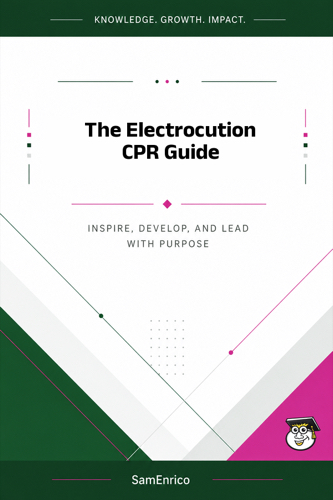
The Electrocution CPR Guide eBook
Ensure scene safety before beginning CPR for elect
Ensure scene safety before beginning CPR for electrical injury victims.
Formats
Free sample
Chapter 1: The Second Victim...--–- The call came in at 11:47 on a Tuesday night. A man had collapsed in his backyard after a power line snapped during a thunderstorm. His wife, seeing him fall, ran outside without thinking. She touched his shoulder to turn him over. The line was still live.
The current passed through his body into hers. By the time firefighters arrived nine minutes later, both were dead. The paramedic who told me this story years later said the same thing every rescuer eventually learns: "She didn't die because of the storm. She died because no one told her to wait."This book exists to make sure you are never that wife. Never that neighbor.
Never that well-meaning stranger who rushes in and never walks out.Electricity is the invisible threat that hides in plain sight. Unlike fire, which announces itself with heat and smoke, or a car wreck, which announces itself with screeching metal and breaking glass, electricity gives almost no warning before it kills. A downed wire lies quietly on wet pavement, silent and dark, looking like nothing more than a fallen rope. A lightning strike is over in a microsecond, leaving behind a body that appears safe but a location that remains deadly. A household appliance shorting out in a bathroom makes no sound until you step into the puddle.This chapter establishes the foundational truth that every other chapter in this book builds upon: you cannot save anyone if you become a victim yourself.
The physics of electricity, the psychology of rescue, and the hard statistics of double-fatality incidents all point to the same conclusion. The first and most important step in any electrical emergency is not CPR. It is not the AED. It is not even calling 911. The first step is ensuring that you, the rescuer, survive the first ten seconds of the scene.Let me be brutally clear about what we are facing.
According to data from the Centers for Disease Control and Prevention, approximately 400 people die from electrical injuries in the United States each year. That number is small compared to heart disease or car accidents, but the multiplier effect is what matters. For every person who dies from direct electrocution, another person—often a rescuer—is seriously injured or killed trying to help. The Occupational Safety and Health Administration tracks these "secondary fatality" events. In a five-year review of electrical incidents, OSHA found that nearly fifteen percent of all electrocution deaths involved a rescuer who touched a victim still connected to a live source.
Fifteen percent. Almost one in seven. These are not strangers taking unreasonable risks. These are parents, spouses, coworkers, and good Samaritans who acted on instinct instead of information.The instinct to help is noble. It is also, in electrical emergencies, potentially fatal.
Your brain is wired to respond to a fallen person with immediate approach. That wiring evolved in an environment where the only dangers were visible predators and falling rocks. Electricity does not trigger the same threat-detection circuits. You cannot see it, smell it, taste it, or hear it until it is already passing through your chest. This chapter rewires that instinct.
By the time you finish reading, your response to an electrical injury will not be "run toward." It will be "stop, scan, isolate, then act."Understanding why requires understanding what electricity actually is and how it behaves when it leaves its intended path. This is not abstract physics. This is the difference between walking away from a rescue scene and being carried away from it.The Physics of Death: Voltage, Amperage, and Path Electricity is the flow of electrons through a conductor. In your home, that conductor is copper wire inside plastic insulation. In your body, that conductor is water, salt, and blood—all excellent at moving electrons from one point to another.
When a human body becomes part of an electrical circuit, the results depend on three factors: voltage, amperage, and path.Voltage is electrical pressure. Think of it as the force pushing electrons through a wire. High voltage does not necessarily kill you on its own, but it determines how far a current can jump through the air. This is called arc distance. A standard household outlet in the United States delivers 120 volts.
At that pressure, electricity cannot jump more than a fraction of an inch through dry air. You have to touch the source to be shocked. A downed power line carrying 14,000 volts, by contrast, can arc across fifteen feet or more. You do not need to touch the wire to be electrocuted. You only need to stand within the arc zone.
A lightning bolt carries up to 300 million volts. At that pressure, electricity can arc across miles of sky. There is no safe distance from a direct strike, though the risk of side flash—current jumping from the strike point to nearby objects—extends dozens of feet.Amperage is electrical flow. If voltage is the pressure pushing water through a hose, amperage is the volume of water moving. Amperage is what kills.
The human heart is exquisitely sensitive to electrical current. As little as 100 milliamps—one-tenth of one amp—flowing across the heart muscle for more than a few seconds will send it into ventricular fibrillation, a chaotic quivering that pumps no blood. One hundred milliamps is less current than a household light bulb. One amp, a thousand milliamps, will stop the heart entirely and cause massive internal burning along the current's path. The amperage delivered to a victim depends on voltage and resistance.
Dry skin has high resistance, around 100,000 ohms. Wet skin has low resistance, as little as 1,000 ohms. This is why bathroom and pool electrocutions are so common—wet skin allows far more current to flow with far less voltage.Path determines which organs the current passes through. A current that enters the left hand and exits the left foot will travel diagonally across the chest, passing directly through the heart. This is the most lethal path.
A current that enters the right hand and exits the right foot will also cross the chest, though at a different angle. A current that enters one hand and exits the other will pass through the chest horizontally, again hitting the heart. A current that enters a foot and exits the other foot will pass only through the legs, missing the heart entirely—painful and damaging to muscles, but far less likely to cause cardiac arrest. The same current that kills one person may only injure another, depending entirely on path.These three factors combine in ways that defy intuition. High voltage does not always mean high fatality.
A lightning strike delivers immense voltage but often travels around the outside of the body in a phenomenon called flashover, leaving superficial burns but sparing internal organs. A household shock at 120 volts can kill if the path crosses the heart and the skin is wet. There is no such thing as a "safe" electrical shock. There is only luck and circumstance.Low Voltage Versus High Voltage: Two Different Kinds of Danger Most people assume that household electricity is relatively safe because they have been shocked by it before without serious injury.…
This is the end of the free sample. Get the eBook to keep going. Buy now
About this book
Details
- Author
- Fenton Nenita
- Publisher
- SamEnrico
- Language
- English
- Genre
- Non-Fiction, Health & Wellness, Electrical
- Released
- 2026-06-11
- Pages (approx.)
- 125
- Available as
- eBook, Audiobook

Read better in the ZLOADR app
Your eBooks on your phone or tablet. Sign in with your SamEnrico account and start reading.
More by Fenton Nenita
 The Energy Micronutrient GuideFenton Nenita$11.99
 Future of Emotional IntelligenceFenton Nenita$11.99
 Chemical Pregnancy Support GuideFenton Nenita$11.99
 Microscope Trace Evidence LabFenton Nenita$11.99
 Digital Legacy MindfulnessFenton Nenita$11.99
 Holidays After Child LossFenton Nenita$11.99
 Ease Factor AdjustmentFenton Nenita$11.99
 The Sun King's Shadow: Louis XIV and the Birth of Modern DiplomacyFenton Nenita$11.99
 The Last Stand of the 47 Ronin: A Forgotten BetrayalFenton Nenita$11.99
 How to Start a Protective Clothing for Industrial Use Business (Beginners Guide)Fenton Nenita$11.99
 A Collector's Handbook to the Austin A90 Atlantic SaloonFenton Nenita$11.99
 Amazon A Plus Content GuideFenton Nenita$12.99
You may also like
 Hong Kong Handover 1997Dunn Johnnie$11.99
 Zumba For Postnatal Recovery CourseNeal Christian$11.99
 Zumba for BeginnersLadner Nikia$11.99
 YouTube Comment Mining GuideHumes Pandora$12.99
 Worry Box MeditationCarlin Rudy$11.99
 Workplace Stress MeditationNguyen Lynn$11.99
 Workplace Stress and Sleep RepairHawley Ivory$11.99
 Workplace Perfectionism CureDelaney Jeffry$11.99
 Workplace Injustice Anger GuideWallen Isabelle$11.99
 Work Addiction and Burnout LinkGreenwood Ester$11.99
 Women in Yoga and WellnessBeattie Galina$11.99
 Women in Stand Up ComedyChun Evangeline$11.99